
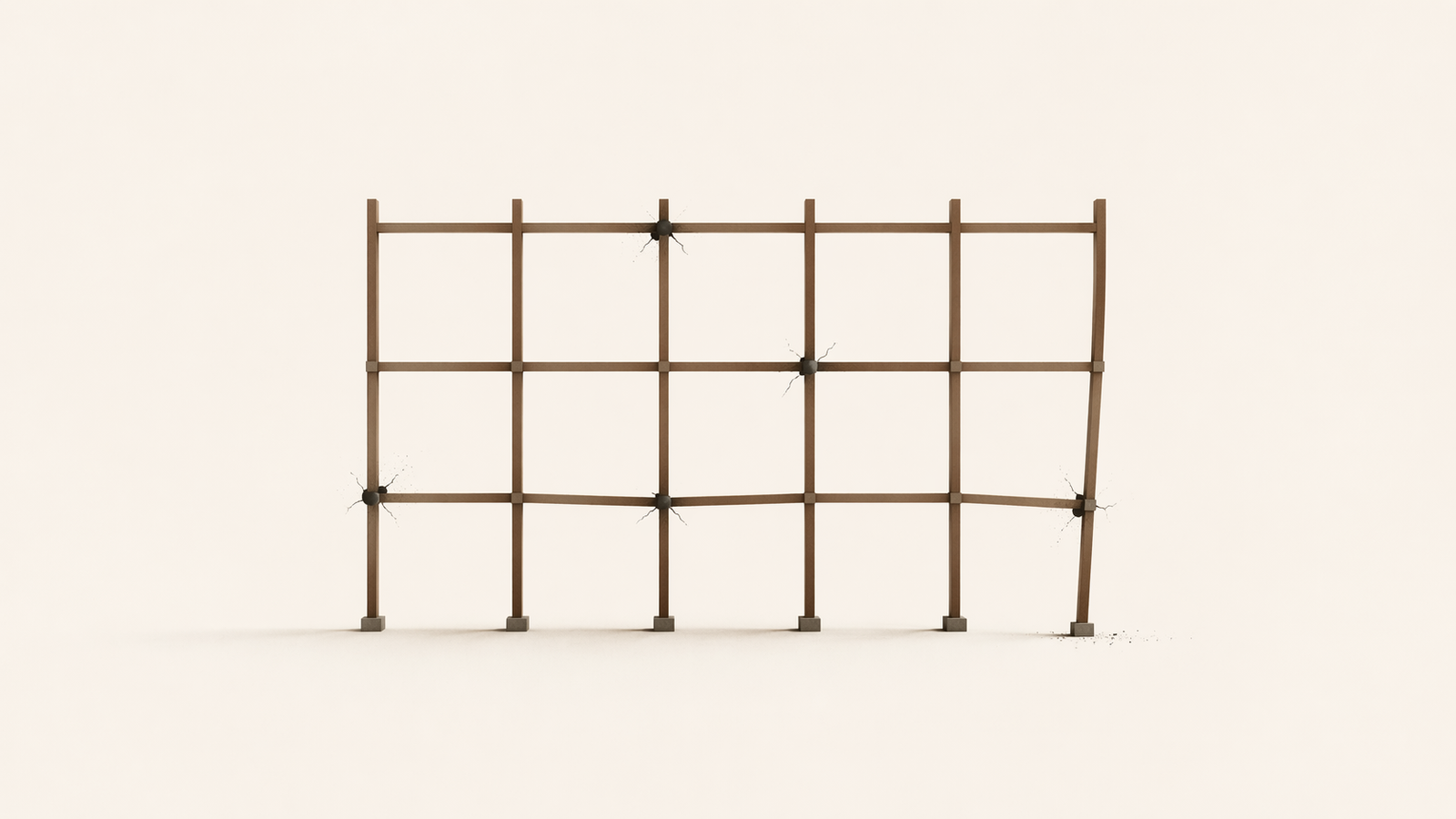
System failure signs rarely appear as dramatic events. More often, they show up quietly, through patterns people dismiss too early.
A delayed response appears harmless. A missed handoff feels explainable. A repeated conversation seems like normal friction. A deadline that needs another reminder may not feel urgent at first. However, when these signals repeat, they point to something deeper than inconvenience.
What looks like small friction is often the beginning of structural misalignment.
Over time, that misalignment compounds. Instead of correcting the issue, people adjust around it. As a result, work slows, clarity weakens, and trust begins to erode without anyone naming the problem directly.
This is how systems fail. Not always through one obvious collapse, but through repeated signals that no one treats seriously enough.
This checklist helps identify the warning signs before breakdown becomes collapse.
How to Identify System Failure Signs Early
Quick Self-Check
If you recognize 2 or more of these signs, your system is already under strain.
If you recognize 3 or more, breakdown is not coming. It has started.
Table of Contents
→ System Failure Signs Checklist
→ Common System Failure Signs Most People Ignore
→ FAQ
System Failure Signs Checklist
5 Signs Your System Is Failing
1. Deadlines Require Reminders
If progress depends on follow-ups instead of ownership, accountability is already weakening.
2. Conversations Repeat Without Resolution
When the same issue keeps coming up, the system is not correcting itself.
3. Responsibility Shifts Under Pressure
If ownership changes depending on difficulty, the structure is unstable.
4. Small Problems Take Too Much Energy
Simple issues should not require heavy coordination. If they do, friction is rising.
5. Trust Feels Uncertain
When people start second-guessing whether things will get done, the system has already been compromised.
Reality Check
Most people do not notice system failure signs because they normalize them.
However, if you recognize these patterns in your work, your habits, or your relationships, the system is already telling you the truth.
Common System Failure Signs Most People Ignore
Many system failure signs look harmless in isolation. However, when they repeat, they reveal structural weakness.
For example, a delayed response may not feel urgent. However, repeated delays indicate unclear ownership. Similarly, a missed handoff may seem like a simple mistake. In reality, it often signals a breakdown in responsibility.
These system failure signs are easy to dismiss because they appear small. Nevertheless, they compound quickly. Over time, they create friction, reduce clarity, and weaken trust across the system.
The dangerous part is normalization. Once people accept the friction as “just how things work,” the system stops improving. Instead, everyone learns to compensate for a structure that should have been corrected.
Why System Failure Signs Matter
Each signal points to a break in alignment.
Deadlines without ownership create drift. Repeated conversations create distortion. Rising friction creates waste. Unclear responsibility creates instability. Loss of trust creates collapse.
These are not isolated problems. Instead, they connect in ways that compound over time.
If one sign keeps showing up, then others are probably nearby. If three signs are present, the system is not merely strained. It is already failing.
This matters because systems rarely fail in silence. They usually warn you first. The warning may be small, but it is still useful. A reminder is not just a reminder. A repeated conversation is not just a communication issue. A small problem that takes too much energy is not small anymore.
In practical terms, system failure signs reveal where responsibility is no longer clear enough to hold under pressure. The issue may look personal on the surface, but the deeper problem is usually structural.
For example, a missed deadline may not mean someone is careless. It may mean the owner was never clear. Likewise, a repeated conflict may not mean people are difficult. It may mean the standard was never defined. In the same way, a trust problem may not begin with betrayal. It may begin with too many small moments where follow-through became uncertain.
Once those patterns become normal, the system starts teaching people to compensate instead of correct. That is when failure becomes expensive.
What Most People Get Wrong
Most people respond to system failure signs emotionally instead of structurally.
They push harder. More reminders get sent. Another meeting gets scheduled. Then motivation becomes the attempted fix.
That is weak repair.
The issue is not effort. The issue is design.
Until expectations are clear, ownership is visible, and follow-through is reinforced, the same breakdown will keep returning. More effort inside a weak system usually creates more frustration. It does not create stability.
This is where bad leadership often hides. It calls confusion a communication problem. It calls unclear ownership a people problem. It calls repeated breakdown a lack of commitment. However, the system is usually telling the truth. If the same problem keeps returning, the structure is not strong enough.
Accountability matters because it connects expectation to ownership before failure spreads. It is not just about admitting fault after something breaks. Rather, it is the operating structure that keeps responsibility visible while the system is still functioning.
For the deeper structural frame, read Accountability: A Structural Guide.
How to Use This Checklist
Do not treat this checklist as theory.
Use it to audit real systems:
- Work routines
- Team handoffs
- Personal habits
- Family expectations
- Leadership structures
Ask one direct question:
Where are these system failure signs already showing up?
If the answer is obvious, do not wait for collapse. Start with clarity. Name the standard. Assign ownership. Then reinforce follow-through.
You can also score the system simply:
- 1 sign: early drift
- 2 signs: active friction
- 3 signs: structural weakness
- 4 or more signs: breakdown is already underway
The point is not to panic. Instead, the point is to stop pretending. Once the pattern is visible, repair becomes possible.
However, visibility is not enough. A system does not improve because someone notices the problem. It improves when the warning sign gets connected to a specific correction.
If deadlines require reminders, clarify ownership. If conversations repeat, define the decision that has not been made. If responsibility shifts under pressure, name the accountable owner before the next pressure point arrives. If small problems take too much energy, simplify the process. If trust feels uncertain, rebuild predictability through visible follow-through.
How to Start Repair
Repair starts with removing ambiguity.
First, define the expectation clearly. Do not rely on assumed understanding. Say what must happen, when it must happen, and what finished means.
Next, name the owner. Shared responsibility sounds mature, but it often becomes shared avoidance when ownership is unclear.
After that, create a follow-through rhythm. A system cannot rely on memory alone. It needs review points, correction points, and a clear way to notice drift before it becomes damage.
None of this has to be dramatic. In fact, repair usually works better when it is calm and consistent.
The goal is not control. The goal is clarity.
Strong repair also requires a better question. Do not ask only, “Who failed?” Ask, “What made failure easier than follow-through?” That question moves the conversation out of blame and into structure.
When the answer is clear, the repair becomes practical. You can shorten the handoff. You can define the decision point. You can set a review rhythm. You can remove extra steps. You can make responsibility visible before pressure arrives.
That is how systems recover without theatrics.
For a deeper breakdown of what happens when the structure fails, read What Happens When Accountability Breaks Down.
The Groundwork
Systems do not fail because people do not care.
They fail because accountability was never made clear enough to hold under pressure.
When the signals appear early, the structure can still be repaired. However, when the signals are ignored, the system eventually forces correction through failure.
The work is not complicated. It is disciplined. Notice the signs. Name the gap. Clarify the owner. Reinforce the follow-through.
That is how systems recover.
If the same problems keep returning, the system is not being corrected. It is being tolerated.
Continue Building
This piece is part of a larger framework. Move from warning signs to structural repair using the links below.
→ Framework: Accountability: A Structural Guide
→ Breakdown: What Happens When Accountability Breaks Down
→ Comparison: Examples of Accountability vs Lack of Accountability
Receipts
→ Harvard Business Review: The Right Way to Hold People Accountable
Frequently Asked Questions
What are system failure signs?
System failure signs are repeated signals that expectations, ownership, communication, or follow-through are no longer holding clearly.
What is the first sign a system is failing?
The first sign is usually drift. Deadlines slip, handoffs blur, and small issues start requiring extra reminders.
Why do systems fail gradually?
Systems fail gradually because small problems often look manageable until they become repeated patterns.
How can system failure be corrected?
System failure can be corrected by clarifying expectations, assigning ownership, and reinforcing follow-through consistently.
Why does trust decline when a system fails?
Trust declines because people can no longer predict whether commitments, standards, or corrections will hold.
By The Groundwork Perspective | Pillars
