
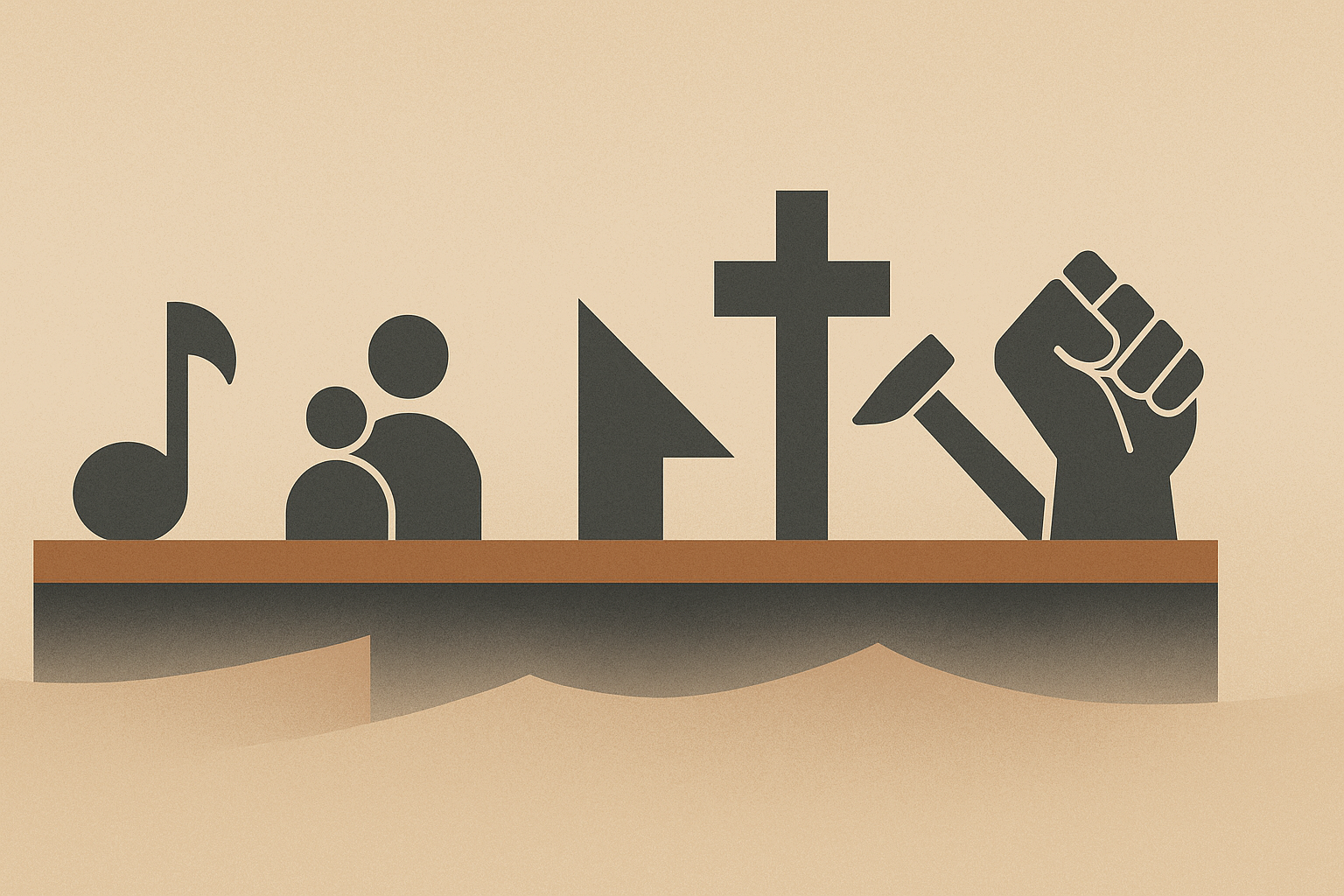
A Black American cultural framework cannot be reduced to entertainment, aesthetics, or a list of famous contributions. Culture becomes durable because people carry memory, relationships, practices, institutions, skills, and strategies across generations.
Culture Needs More Than Expression to Hold
Music matters. Family matters. Faith matters. Migration, work, economic behavior, institutional life, and political struggle matter too.
Still, none of those things should be treated as the single explanation for Black American culture.
They are better understood as overlapping systems through which cultural continuity has repeatedly been carried.
That distinction is important.
The seven pillars in this framework are not a claim that Black American culture contains only seven components. Nor are they a standardized academic taxonomy.
Rather, they are a Groundwork analytical model for examining recurring structures that helped Black Americans preserve meaning, organize life, respond to constraint, build institutions, and transmit culture across generations.
The framework becomes most useful when the pillars are examined together.
A Working Framework
Seven Pillars That Help Carry Black American Cultural Continuity
The framework identifies seven recurring structures: music, family and kinship, migration, faith and spiritual life, craftsmanship and practical skill, economic adaptation, and political struggle.
Each performs a different function. More importantly, the pillars interact.
Migration changes family networks. Faith produces institutions. Music carries memory. Skilled work supports households and communities. Economic adaptation responds to changing opportunity. Political struggle changes the formal environment in which all of those systems operate.
So the value of the framework is not the number seven.
The value is seeing how multiple forms of cultural infrastructure can reinforce one another.
Groundwork Cultural Continuity Model
Pillar: Music
Music Carries Memory Farther Than Geography
Black American music is one of the clearest examples of cultural transmission.
Spirituals, gospel, blues, jazz, rhythm and blues, rock and roll, soul, funk, house, techno, and hip-hop emerged from different periods, places, technologies, and communities. They should not be flattened into one simple lineage.
Even so, taken together they demonstrate how musical practices can carry historical memory, emotional experience, religious meaning, regional identity, experimentation, language, and social commentary.
Music Also Became a Distribution System
Once recordings, radio, touring, film, television, and later digital platforms expanded the audience, Black American musical forms traveled far beyond the communities where they developed.
That reach helped make music one of the most visible parts of Black American cultural influence.
Yet visibility is not the entire function.
Music also carries culture between generations.
Pillar: Family and Kinship
Family and Kinship Carry Responsibility and Memory
Family is one of the primary places where culture becomes ordinary.
Children encounter expectations, language, stories, food, discipline, humor, care, conflict, celebration, grief, and responsibility long before those things are described to them as culture.
Black American family life has also frequently included relationships beyond a narrow nuclear-household definition.
Extended relatives, fictive kin, neighbors, church members, godparents, elders, and other community relationships can become part of networks of care and obligation.
Informal Networks Can Carry Formal Weight
Those networks should not be romanticized as substitutes for functioning institutions or sufficient public support.
However, they help explain how responsibility can be distributed when households face disruption, economic pressure, migration, caregiving needs, or institutional gaps.
Family, then, is not merely a private arrangement.
It is also a major site of cultural transmission.
Pillar: Migration
Migration Changes Geography Without Necessarily Erasing Culture
The Great Migration transformed Black American life by moving millions of Black people from the South to cities and regions across the United States during the twentieth century.
That movement changed employment, politics, neighborhoods, family networks, artistic production, institutions, and regional identities.
It also demonstrates an important cultural principle.
Culture can move without remaining identical.
Southern traditions entered Chicago, Detroit, New York, Philadelphia, Los Angeles, and other cities. Once there, people adapted to different economies, neighborhoods, technologies, institutions, and populations.
Movement Produces Regional Variation
As communities changed, distinct regional expressions developed.
That does not mean the older cultural relationships disappeared.
Instead, migration produced another layer of Black American cultural development.
Pillar: Faith and Spiritual Life
Faith Carried Meaning and Built Institutions
Faith has played a major role in Black American history, but its importance cannot be reduced to private belief.
Black religious institutions have often functioned as places of worship, education, organizing, mutual aid, leadership development, music, community gathering, and political activity.
That institutional role matters.
Religious life can carry ritual and moral language, while churches and other faith institutions can create physical and organizational spaces where people repeatedly gather.
Meaning Can Be Infrastructure
Communities do not live through material systems alone.
People also need ways to interpret suffering, hope, obligation, death, justice, family, responsibility, and the future.
Faith traditions have been one of the places where those questions were organized and transmitted.
Pillar: Craft and Practical Skill
Craftsmanship Carries Knowledge Through Practice
Not all cultural knowledge lives in books, speeches, or institutions.
Some knowledge lives in hands.
Building, repairing, cooking, sewing, styling, farming, barbering, making music, working trades, producing art, and solving practical problems all transmit forms of knowledge.
These skills can create economic value. They can also carry aesthetics, standards, techniques, habits, and relationships between generations.
Function Can Become Cultural Memory
A skill repeated across families or communities can become more than a way to complete a task.
It can become part of how people understand competence, self-reliance, beauty, service, work, and responsibility.
Craftsmanship belongs in the framework because culture is also transmitted by doing.
Pillar: Economic Adaptation
Economic Adaptation Responds to the Opportunity That Actually Exists
Black Americans have repeatedly had to build economic strategies inside markets that did not offer equal access to property, credit, employment, education, capital, or commercial opportunity.
Those conditions produced many responses.
People pooled resources, worked multiple jobs, opened businesses, created professional networks, joined mutual-aid organizations, entered trades, migrated for employment, and developed informal economic arrangements.
Those strategies differed by period and place.
Adaptation Should Not Be Confused With Equal Access
The ability to adapt does not prove that the underlying economic system was fair.
In fact, some adaptive strategies existed precisely because formal access was restricted.
That distinction is central to Discipline Before Dollars: disciplined behavior matters, but personal discipline cannot erase the structure of the environment in which economic decisions are made.
Pillar: Political Struggle
Political Struggle Changes the Environment Around Culture
Political struggle is different from music, family, faith, or craftsmanship.
It should not be treated as though all seven pillars perform the same cultural function.
Its role in this framework is environmental.
Organized political action can change laws, public access, institutional rules, voting rights, educational opportunity, employment protections, and the boundaries of citizenship.
Those changes affect the conditions in which communities live and build.
Civil Rights Changed More Than One Community
Reconstruction, the long struggle against segregation, the modern Civil Rights Movement, voting-rights campaigns, labor organizing, legal advocacy, and other political efforts all belong to a much larger history of Black civic struggle.
That history deserves precision rather than mythology.
Civil Rights. Who Fought for Them and Who Benefited examines one part of that question by separating who carried particular costs from the broader groups that later benefited from structural changes.
What Connects the Pillars
The Framework Matters Because the Pillars Reinforce One Another
No single pillar explains Black American cultural continuity.
Music can carry memory, but families teach people how to interpret memory. Migration moves communities, while faith institutions and social networks help rebuild continuity in new places.
Practical skills create economic pathways. Economic conditions shape where families can live. Political struggle alters some of the rules governing those opportunities.
Then culture moves through the entire structure.
The Framework Is Dynamic, Not Fixed
Different periods place different weight on different pillars.
Technology changes how music travels. Migration patterns change. Family structures evolve. Religious participation changes. New professions emerge. Economic barriers shift, and political conflicts move into new terrain.
For that reason, continuity should not be confused with sameness.
The framework holds when its functions remain legible even as their forms change.
Culture Beneath the Pillars
This framework identifies recurring structures through which cultural continuity can move. For the broader definition of culture beneath those structures, see The Architecture of Black American Culture .
Cultural strength does not come from one tradition doing all the work. It comes from multiple systems carrying memory, meaning, responsibility, skill, and adaptation at the same time.
The Groundwork
Cultural Continuity Is Built Across Systems
The Black American cultural framework is larger than aesthetics.
Its visible expressions matter, but those expressions sit inside relationships, movements, institutions, skills, beliefs, economic strategies, and political histories.
That is why no single artifact can prove the whole culture.
A song cannot explain a family network. A church cannot explain a migration. A business cannot explain a voting-rights campaign. A political victory cannot explain a food tradition.
Yet each can reveal one part of the structure through which Black American life developed and reproduced itself.
Inheritance Still Requires Stewardship
The framework remains useful only if it can be examined honestly.
Not everything inherited deserves preservation. Some institutions weaken. Some norms become harmful. Certain strategies that were adaptive under one set of conditions may become less useful under another.
Therefore, respecting cultural inheritance does not mean freezing it.
It means understanding what function a structure performed, whether that function still matters, and what should carry it now.
That is the difference between nostalgia and stewardship.
What previous generations built deserves more than admiration. It deserves enough clarity to know what should be preserved, strengthened, repaired, or rebuilt.
Groundwork Architecture
The Principle and Condition Beneath This Work
This framework is governed by one principle and one structural condition from the Groundwork Daily architecture.
Core Principle
Build What Holds
Cultural continuity depends on structures capable of carrying memory, skill, relationships, knowledge, and meaning beyond a single moment or generation.
Primary Condition
Continuity
Continuity asks whether essential functions remain connected across migration, institutional change, adaptation, generational disagreement, and changing conditions.
See the full Core Principles and Conditions architecture .
Receipts
The Evidence Beneath the Framework
National Museum of African American History and Culture: Cultural Expressions
NMAAHC documents African American culture across music, movement, language, style, foodways, craftsmanship, and other forms of cultural expression. The resource supports the article’s distinction between visible expression and the broader histories and systems that give expression meaning.
Smithsonian Institution: African American Music
Smithsonian collections document the historical breadth of African American musical traditions and their central place in American cultural development.
Library of Congress: Civil Rights History Project
The Civil Rights History Project preserves oral histories and first-person accounts related to the struggle for civil rights, documenting the roles of individuals, communities, organizations, institutions, and political action.
National Museum of African American History and Culture: Black Foodways and Cuisine
NMAAHC documents Black foodways through history, migration, agricultural knowledge, adaptation, family memory, and community practice, supporting the framework’s treatment of practical knowledge as a carrier of culture.
The seven-pillar model is a Groundwork Daily analytical framework rather than a standardized academic taxonomy. External sources support the historical and cultural functions discussed within the framework, not the claim that Black American culture has exactly seven pillars. External links were live and accessible when this article was published or last substantively updated.