
System Updates
Langston Reed examines the systems beneath familiar outcomes: the institutions, incentives, public money, rules, and information structures that determine what people ultimately experience.
Paid patriotism in sports became a national controversy when Americans learned that some military tributes at professional sporting events were not simply voluntary gestures by teams. Instead, some were included in government marketing agreements financed with taxpayer money.
That discovery did not make every flag ceremony, military salute, anthem, or recognition of service members artificial. Nor did it mean that professional sports teams lacked genuine relationships with the military. However, it exposed a boundary problem: audiences were not always given enough information to distinguish a team-funded tribute from an activity connected to a government advertising or recruitment contract.
As a result, the controversy reaches beyond football or even sports. It raises a larger civic question about how public institutions use emotionally powerful environments to communicate with citizens. When government money, private entertainment, recruitment objectives, and national symbolism occupy the same moment, transparency becomes part of the message itself.
Short Answer
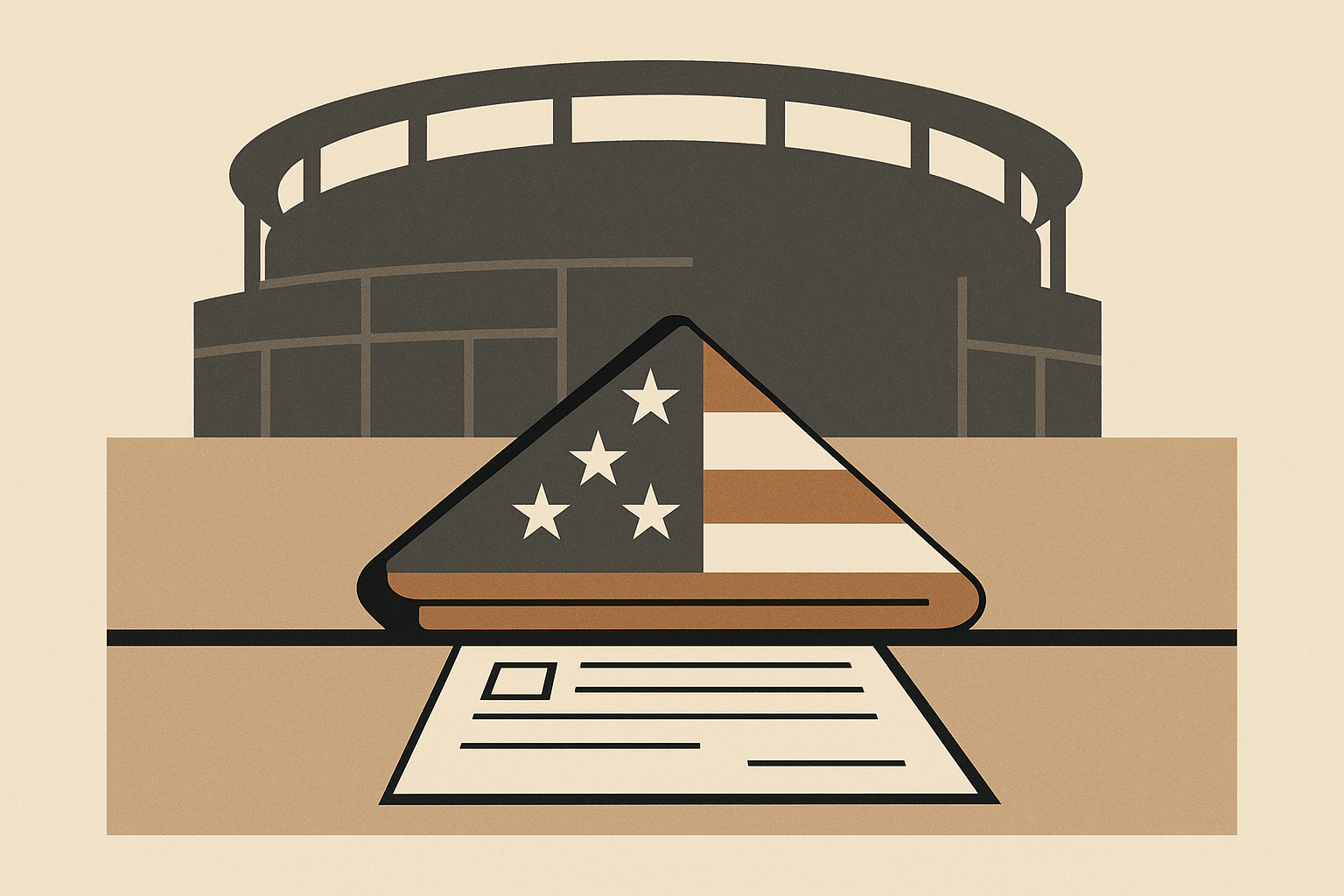
Paid patriotism in sports refers to military marketing contracts that included taxpayer-funded patriotic or military-appreciation activities at sporting events. A 2015 Senate investigation found millions of dollars in sports marketing contracts containing such activities. The controversy centered on taxpayer accountability and the blurred boundary between recruitment marketing, voluntary tribute, and sponsored patriotic ceremony.
What Paid Patriotism in Sports Actually Was
The phrase entered wider public discussion through congressional scrutiny of Department of Defense marketing agreements with professional sports organizations. Senators John McCain and Jeff Flake examined contracts involving military branches, the National Guard, teams, and sports organizations and published the joint oversight report Tackling Paid Patriotism in 2015.
According to the investigation, some contracts included activities such as color guards, military recognitions, enlistment or reenlistment ceremonies, ceremonial first pitches, full-field flag displays, and other forms of military visibility. The report identified at least $6.8 million in taxpayer-funded contracts that contained activities investigators classified as paid patriotism.
Importantly, the government objective was not mysterious. Military organizations advertise, recruit, and conduct public outreach. Sports offered access to large audiences and highly visible public settings. Therefore, the real question was not whether the military could market itself, but whether some contract deliverables crossed into civic tribute without making the sponsorship clear.
Paid Patriotism Was Not the Same as Ordinary Advertising
A recruiting booth, stadium advertisement, branded display, or clearly sponsored activation is recognizable as marketing. By contrast, an on-field recognition of a returning service member carries the appearance of civic gratitude first.
That difference changes the audience’s position. If the government paid for the ceremony through a marketing agreement, spectators were seeing both a tribute and a contractual deliverable. Yet without disclosure, they could reasonably understand the moment as something the team chose to provide independently.
Why Sports Became Valuable Civic Space
Professional sports are commercial entertainment, but they also function as shared civic spaces. Stadiums gather thousands of people around common symbols, rituals, music, uniforms, local identity, and collective emotion. Television then extends those rituals to millions more.
Because attention is already concentrated, sports are unusually valuable to institutions trying to reach the public. The audience is assembled before the institutional message arrives. In addition, emotional participation is high, so a message delivered inside the event can land differently from the same message delivered through a conventional advertisement.
Patriotic Rituals Predated Paid Patriotism in Sports
American sporting events had incorporated national symbols and military participation long before the contracts examined by the Senate. Anthems, flags, flyovers, color guards, ceremonial appearances, moments of remembrance, and recognition of service members were not invented by military marketing agreements.
That history made the sponsorship issue more complicated. A paid ceremony could fit seamlessly beside genuine traditions because both used the same symbolic language. Consequently, the difference between a voluntary tribute and a contractual marketing deliverable might be impossible to see from the stands.
Shared Civic Symbol
↓
Sports Environment
↓
Collective Attention
↓
Institutional Message
↓
Audience Interpretation
How Paid Patriotism in Sports Contracts Worked
The contracts were broader than payments for patriotic ceremonies. Military marketing arrangements could include conventional advertising, recruiting access, tickets, hospitality, signage, promotional appearances, digital exposure, and other benefits intended to increase military visibility or reach potential recruits.
For that reason, it would be inaccurate to characterize every dollar in a sports marketing agreement as payment for patriotism. The Senate investigation instead examined which contracts contained particular activities that crossed from recognizable advertising into military appreciation or patriotic presentation.
The NFL Became the Most Visible Example
Professional football received much of the public attention because of the NFL’s enormous audience and the visibility of military ceremonies at games. Still, the issue extended beyond football. The Senate investigation identified relevant arrangements across several professional sports and sporting environments.
Reducing the story to “the Pentagon paid the NFL to be patriotic” therefore produces a cleaner headline but a weaker understanding. The actual system involved public marketing budgets, military recruitment objectives, private sports organizations, contract deliverables, ceremonial activity, and inconsistent boundaries between them.
A Separate NFL Chronology Matters
Groundwork Daily examines the football-specific history more closely in Why the Pentagon Paid for NFL Patriotism—and Why It Stopped . This article takes the wider systems view instead: how sponsorship changes civic meaning when the transaction is difficult for audiences to see.
Paid Patriotism in Sports Blurred Tribute and Marketing
A military tribute and a military advertisement can support some of the same institutional goals without being the same thing. One recognizes service, while the other intentionally promotes an organization, opportunity, or message. Problems emerge when the audience cannot tell which function is operating.
Consider the difference between a recruiting advertisement on a stadium screen and an on-field recognition of service members. The first clearly signals persuasion. The second primarily signals gratitude. If both are contractual marketing deliverables, persuasion has moved into a form that audiences may interpret through a different emotional frame.
Disclosure Restores Context
Disclosure does not automatically make a sponsored ceremony good or bad. Instead, it restores information. Once viewers know that a presentation is sponsored, they can interpret the event with an understanding of both its symbolic meaning and its institutional purpose.
Without that context, the sponsor knows something important that the audience does not. This information gap is the larger governance problem. Public institutions should be especially careful when taxpayer-funded persuasion is embedded inside civic rituals whose authority comes partly from appearing noncommercial.
Why Paid Patriotism in Sports Could Be Persuasive
The value of sports marketing comes partly from context. Fans are not sitting in a stadium primarily to evaluate government communication. They are there to watch a game, participate in a community, spend time with family or friends, and experience competition.
Meanwhile, patriotic ceremonies draw on symbols with meaning that predates any marketing contract. The flag, military uniform, anthem, veteran, returning service member, and public oath already carry cultural associations. A sponsor therefore does not have to manufacture that emotional meaning from scratch.
The Environment Changes How a Message Is Read
A recruiting commercial announces itself as persuasion. A recruiting presence attached to a military appreciation ceremony can be experienced first as recognition and only second, if at all, as institutional outreach. This does not mean the audience is being controlled. Rather, it means context influences how a message is understood.
More broadly, institutions communicate through more than speeches, press releases, and advertisements. They also communicate by choosing environments, symbols, partnerships, messengers, and rituals that shape how information will be received.
Paid Patriotism Was Also a Taxpayer Accountability Question
Focusing only on hidden sponsorship misses another part of the controversy. The money came from public military budgets. Therefore, the contracts raised a basic procurement question: what exactly was the government purchasing, and did those expenditures serve a legitimate recruitment or advertising purpose?
Governments routinely spend money communicating with the public. Military recruiting requires outreach, and large sporting events can provide access to potential recruits. Even so, public spending needs defensible objectives, measurable value, and boundaries clear enough for oversight.
Honoring Service Is Different From Buying Recognition
The Senate investigation challenged the idea that taxpayers should finance ceremonies that appeared to be voluntary tributes by wealthy sports organizations. If a team wants to honor military service, it can choose to do so using its own resources. If a military branch is buying recruitment exposure, that transaction can be identified as marketing.
Separating those functions protects both. Genuine tributes do not have to carry suspicion about hidden payment. At the same time, legitimate recruiting campaigns can be evaluated as advertising instead of being confused with independent civic recognition.
What Paid Patriotism in Sports Reveals About Civic Trust
Civic trust depends partly on whether institutions accurately describe what they are doing. People do not need every public message to be neutral. Governments advocate policies, agencies promote programs, militaries recruit, corporations advertise, and nonprofits campaign for causes. Persuasion is part of public life.
Trust becomes harder to sustain, however, when persuasion borrows the appearance of an independent gesture without making the institutional relationship visible. The problem is not that audiences encounter a point of view. The problem is that they may not know they are encountering a paid message at all.
Transparency Protects the Ritual Too
Clear sponsorship protects more than the audience. If voluntary military tributes and paid marketing activations become indistinguishable, later disclosure can cast suspicion over ceremonies that were never purchased in the first place.
Hidden sponsorship therefore creates a paradox. Concealment may make a message feel more authentic in the short term, yet discovery can reduce confidence in the broader category of activity. Transparency can preserve meaning rather than weaken it.
What the Paid Patriotism Controversy Did Not Prove
The scandal should not be stretched beyond what the evidence supports. It did not establish that every patriotic display at an American sporting event was purchased by the government. Many teams and organizations have voluntarily honored military personnel, veterans, first responders, and national events without being paid to do so.
Nor did the investigation establish that patriotism itself was manufactured by sports leagues or the Pentagon. National symbols had deep cultural meaning long before the contracts under investigation existed. Government sponsorship could use that meaning, but it did not create it.
Marketing Is Not Automatically Manipulation
Military organizations have legitimate reasons to communicate with potential recruits, and professional sports have legitimate reasons to sell sponsorship and advertising inventory. Consequently, the existence of a transaction is not by itself evidence of wrongdoing.
The stronger criticism concerns boundaries. Recruitment advertising should be recognizable as recruitment advertising. Public expenditures should have defensible objectives. Military-appreciation ceremonies should not quietly become marketing deliverables while audiences are left to assume the team is providing the tribute independently.
What Better Governance of Paid Patriotism Would Require
The strongest response is not to remove patriotism from sports or prevent public agencies from advertising. Instead, better governance creates clearer boundaries between tribute, sponsorship, recruitment, and taxpayer-funded promotion. Those categories can coexist without being deliberately blurred.
Make Sponsorship Visible
When a public agency pays for a presentation, the audience should have a practical way to know that sponsorship exists. Disclosure does not need to overwhelm the ceremony. However, it should be clear enough that the institutional relationship is not concealed.
Separate Appreciation From Recruitment Deliverables
Contracts should distinguish ordinary advertising and recruitment services from ceremonies whose primary function is honoring service members. As a result, procurement becomes easier to audit, and the public can more readily understand what taxpayer money purchased.
Measure the Public Objective
If recruitment is the justification for an expenditure, agencies should be able to explain what the spending is intended to accomplish and how performance is evaluated. Visibility alone is not the same as effectiveness.
Make Contract Terms Reviewable
Public money should leave a public trail. Procurement records, contract deliverables, spending categories, and oversight mechanisms allow journalists, lawmakers, watchdogs, and citizens to distinguish a legitimate communications program from a poorly governed expenditure.
Recognition Skill: How to Read Paid Patriotism in Sports
The durable skill from this case is not learning to distrust every patriotic ceremony. That would simply replace one weak assumption with another. Instead, learn to distinguish the visible event from the institutional arrangement underneath it.
When a public symbol appears inside a commercial environment, ask who organized the moment, who paid for it, what objective the sponsor was pursuing, whether the sponsorship was disclosed, and whether public money was involved. Those questions do not tell you what to believe. They give you enough context to decide for yourself.
Five questions to carry forward
- Who paid for the moment?
- What did the contract or partnership purchase?
- What objective did the sponsor hope to achieve?
- Could the audience reasonably recognize the sponsorship?
- If public money was involved, where is the accountability trail?
Receipts
These sources document the military sports contracts, congressional investigation, and subsequent NFL review discussed in this analysis.
Primary Investigation
- U.S. Senate — Tackling Paid Patriotism: A Joint Oversight Report — the McCain-Flake investigation documenting Defense Department sports marketing contracts containing military-appreciation and patriotic activities.
Subsequent NFL Review
- ESPN — NFL Returning $723,000 for Sponsored Military Tributes — reports the NFL’s external audit and decision to return $723,734 associated with sponsored military-appreciation activities.
Groundwork Daily Expansion
- Why the Pentagon Paid for NFL Patriotism—and Why It Stopped — the deeper Groundwork Daily examination of the Pentagon-NFL relationship, the funding mechanism, and how the practice changed.
The Groundwork
Paid patriotism in sports matters because it exposed a boundary that is easy to miss. A symbol can be sincere and strategically useful at the same time. Likewise, a ceremony can honor a service member while also increasing an institution’s visibility.
The better civic habit is therefore not automatic belief or automatic suspicion. It is informed interpretation. Citizens should be able to see both the symbol and the structure behind it: who funded the presentation, why the relationship existed, what public money purchased, and whether the institutional purpose was made clear.
Ultimately, transparency does not strip meaning from a civic ritual. It gives the public enough information to decide what that ritual means without having the financial architecture hidden from view.
The System: Updated.
What looked like the problem: The Pentagon paid sports teams to perform patriotism.
What the system reveals: Military agencies purchased sports marketing and recruitment access, but some contracts also crossed into patriotic and military-appreciation activities whose sponsorship was not obvious to audiences. The updated model is public money → marketing contract → civic ritual → audience interpretation → oversight and trust.
Put the Principle to Work
Accountability Is a Form of Strength
When public money and emotional messaging occupy the same space, do not stop at the visible presentation. Follow the contract. Identify the payer, the deliverable, the institutional objective, and the accountability mechanism. Demanding that structure is not cynicism; it is how public trust becomes verifiable rather than assumed.
Join the Groundwork List
Get systems analysis, institutional literacy, and practical frameworks built to remain useful after the headline moves on.
Continue Building
Continue through the public-perception and institutional-literacy cluster based on the mechanism you want to understand next.
Go Deeper —
Why the Pentagon Paid for NFL Patriotism—and Why It Stopped
Follow the Pentagon-NFL relationship more closely, including the contracts,
investigation, and eventual policy response.
Public Perception —
Narrative Engineering and the Architecture of Public Perception
Examine how institutions shape interpretation through repetition, framing,
sequencing, and message architecture.
Attention —
The Attention Economy Has No Boundaries, So You Must Build Them
Understand why control over attention changes the power of messages before their
claims are ever evaluated.
Institutional Literacy —
Building Institutional Literacy
Build the broader skill of reading institutions through authority, incentives,
resources, rules, and observable outcomes.

Meet the Builder

Langston Reed
Builder, Civic Power & Policy
Langston Reed helps readers understand how institutions, governance, public policy, incentives, and infrastructure shape everyday life. His work develops institutional literacy by translating complex systems into practical frameworks that remain useful after the immediate news cycle has moved on.
Continue through System Updates, Building Institutional Literacy, or The Sovereign Ledger.