
Community begins where accountability lives.
The Framework
Local voting power shapes daily life more than most national races ever will. Headlines may chase presidents and governors, but local elections decide who manages schools, courts, public safety, housing, roads, transit, and neighborhood investment. In other words, local voting power determines how public systems function where people actually live.
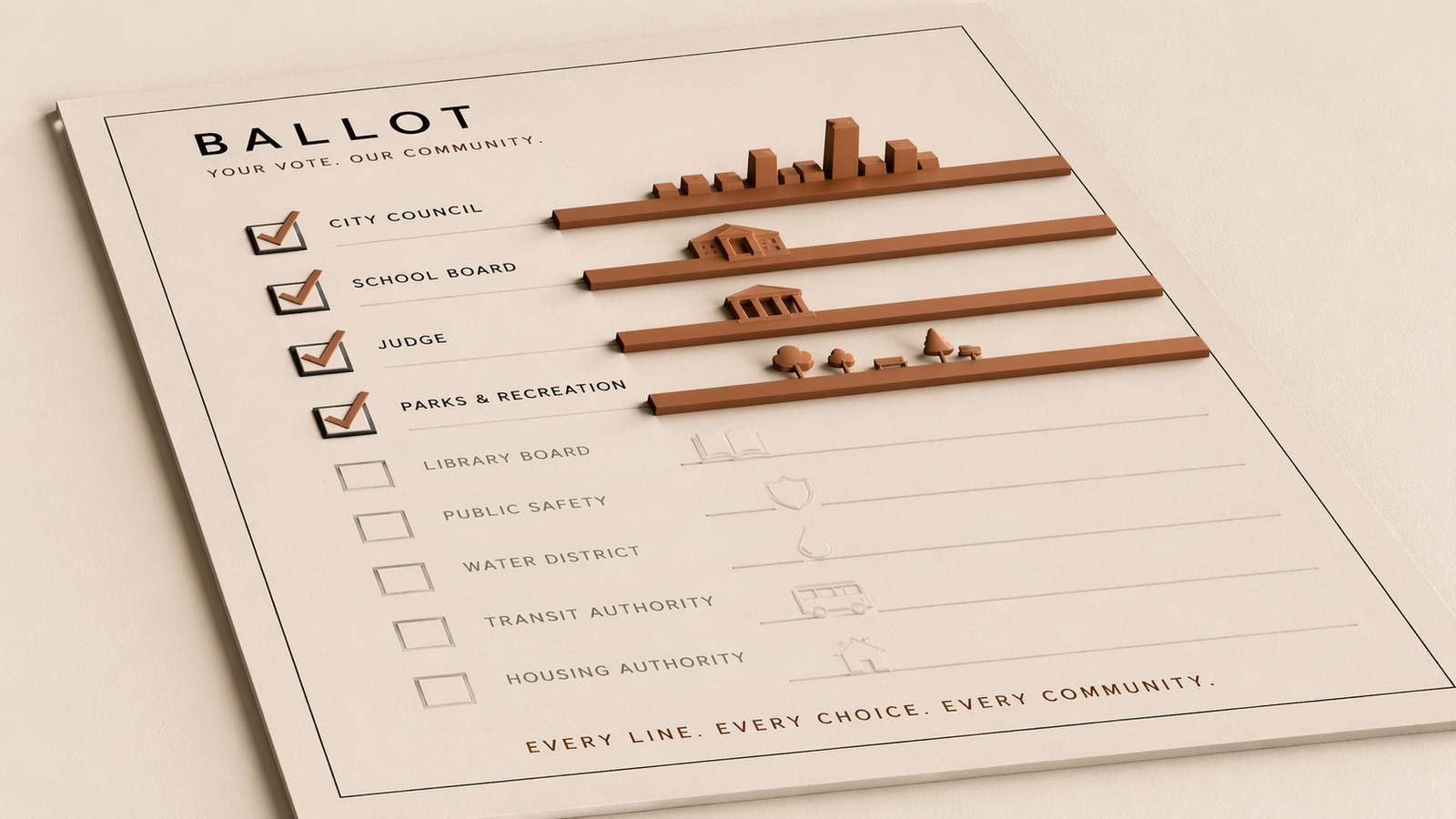
That is why the lower half of the ballot carries more weight than many voters realize. Council members, judges, school board officials, and district-level leaders do not simply hold titles. They control decisions that shape the quality, pace, and fairness of everyday life. When voters ignore those lines, they do not step outside power. They surrender it to whoever stays engaged.
Too many people treat local elections like background noise. They focus on the loudest race, make one emotional choice, and then rush through the rest. That habit weakens accountability. It also gives organized interests more room to dominate smaller contests with less resistance.
Real civic discipline starts closer to home. It starts with understanding that every local office controls a piece of the structure around you. If you want stronger schools, cleaner streets, safer public spaces, fairer courts, or better service delivery, you cannot treat local elections like an afterthought.
Why Local Voting Power Matters
Local voting power matters because local government is operational, not symbolic. Federal elections shape broad direction. However, local elections shape daily conditions. They influence whether trash gets collected on time, whether streets stay repaired, whether school priorities stay aligned, and whether public money strengthens the neighborhood or bypasses it.
That distinction matters. National politics often controls attention. Local politics controls maintenance, access, enforcement, and allocation. One shapes narrative. The other shapes environment.
As a result, people often overestimate the value of distant influence and underestimate the value of nearby control. That is backward thinking. If a voter cares about how a community functions, then local voting power deserves disciplined attention.
What Local Offices Actually Control
Every local office carries a specific set of responsibilities. Those responsibilities may look small on paper. In practice, they build the structure people move through every day.
City councils help decide how tax dollars get spent. They influence sanitation, parks, capital repairs, community services, and development priorities. School boards shape curriculum direction, district priorities, spending decisions, and leadership accountability. Judges influence how law is interpreted in daily life. District attorneys influence charging priorities and enforcement culture. County and municipal officials shape housing, transit, health services, and local infrastructure.
None of that is abstract.
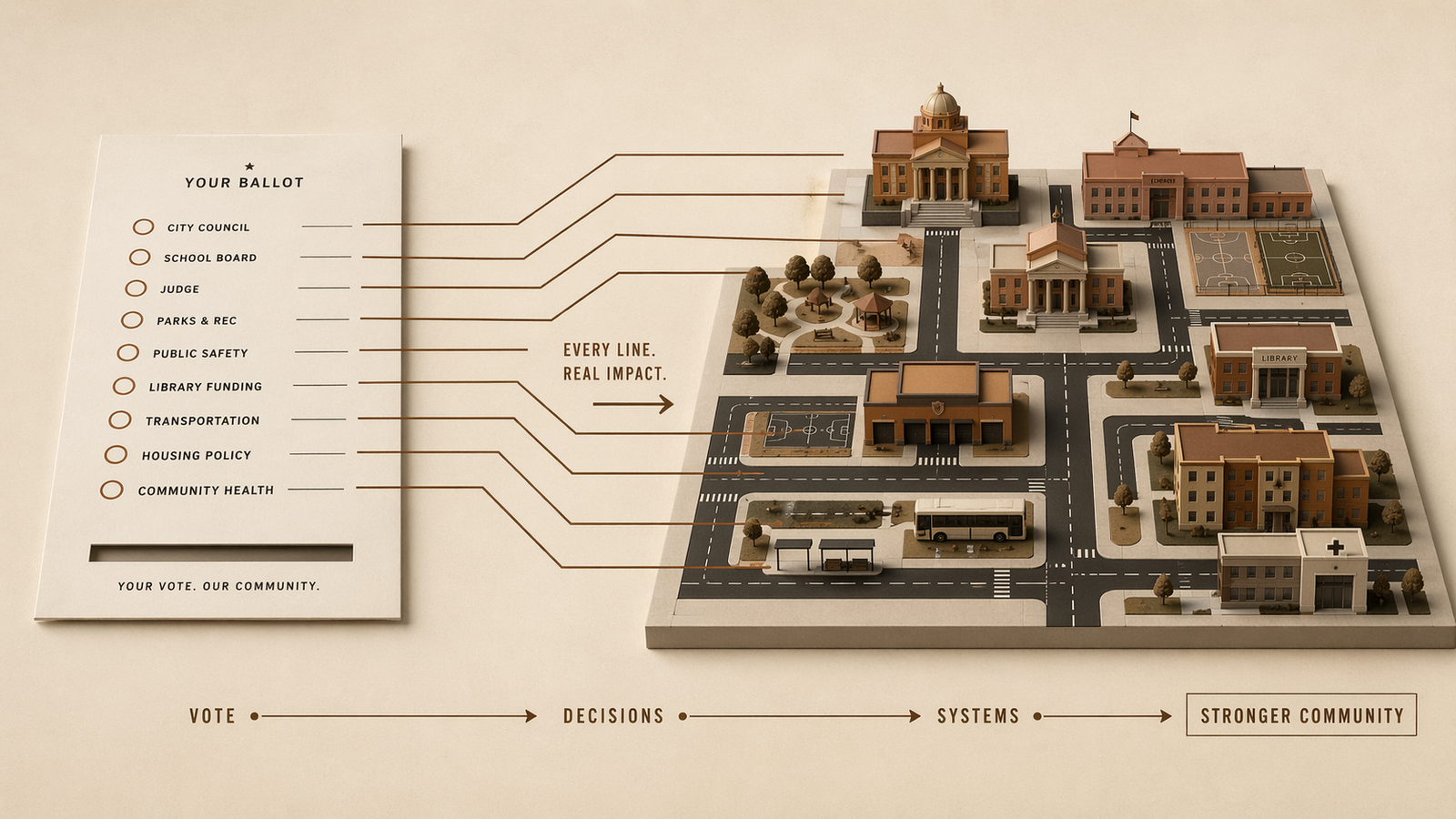
Those offices influence whether a library stays open, whether an intersection gets repaired, whether a park receives funding, whether a school gets support, and whether a neighborhood gets overlooked. Therefore, every line on the ballot represents a transfer of authority.
That is the point too many voters miss. A ballot is not just a list of names. It is a map of control.
What Happens When Turnout Drops
When turnout drops, power does not disappear. It concentrates.
A low-turnout election does not become neutral. Instead, it becomes easier for smaller, more organized groups to dominate the outcome. That means public priorities start reflecting the discipline of a narrow group rather than the needs of the broader community.
Moreover, low turnout rewards consistency from people who know exactly what they want. Developers, advocacy groups, unions, local blocs, and motivated voting networks do not need a majority of all residents. They only need more discipline than the people who stay home.
That is how communities lose influence quietly. Not through dramatic theft. Through repeated absence.
Meanwhile, many residents complain about conditions after the fact. They ask why the school changed, why the budget shifted, why the court feels disconnected, or why neighborhood priorities never seem to match neighborhood needs. Often the answer is simple. Too few people showed up when authority was being assigned.
How Votes Turn Into Daily Conditions
A vote is not the end of civic action. It is the beginning of a chain.
First, voters assign authority. Then officeholders make decisions. Next, those decisions become policy choices, budget allocations, staffing priorities, and enforcement patterns. Finally, those choices become lived experience.
Vote → officeholder → decision → policy → daily condition
That chain explains why local voting power matters so much. It also explains why civic neglect creates visible consequences. People often see the final condition but ignore the earlier stages that produced it.
For example, if a community wants safer parks, stronger schools, better transit, or more responsive local government, it must care about who controls those systems before the decline becomes obvious. Otherwise, voters react late to problems that were built slowly.
Discipline means acting upstream. It means understanding that public conditions do not appear by accident. People create them through repeated choices, repeated tradeoffs, and repeated patterns of participation or neglect.
How to Read the Ballot With Discipline
Most people need a framework, not more noise.
Instead of scanning the ballot for familiar names, read each office through four questions:
- What does this office control?
- How close is that control to daily life?
- Who benefits when this office is ignored?
- How can this officeholder be held accountable later?
That approach slows the process down in the right way. It replaces guesswork with structure. It also forces a voter to treat the ballot like a system instead of a ritual.
Furthermore, disciplined voting means researching beyond campaign slogans. A polished mailer is not proof of competence. A familiar name is not proof of alignment. A loud personality is not proof of useful leadership.
Look for patterns. Look for funding priorities. Look for decision history. Look for what the candidate has defended, ignored, or enabled. Then judge accordingly.
How to Protect Local Voting Power
Protecting local voting power starts with refusing casual disengagement. It means showing up for the small races with the same seriousness people bring to the marquee names.
It also means following the work after Election Day. Voting without follow-up creates weak accountability. Strong communities do more than cast ballots. They watch budgets, read agendas, notice patterns, and respond when public authority drifts away from public interest.
In that sense, voting is not just participation. It is maintenance.
Communities stay stronger when residents understand where authority sits and how it moves. They stay weaker when people confuse outrage with involvement. Anger may express frustration. However, only disciplined participation builds leverage.
If local voting power is ignored, communities absorb the cost later. If local voting power is protected, communities gain a better chance to shape what gets funded, corrected, defended, and sustained.
Takeaway: Local voting power is not minor power. It is neighborhood-level leverage. Use it with discipline, or someone else will use it for you.
