Article Map
China Plus One Supply Chain: The Signal
The China Plus One supply chain is not primarily a story about China.
It is a story about resilience.
For more than twenty years, companies optimized global supply chains around efficiency. Production concentrated where labor was affordable, infrastructure was mature, and manufacturing could scale quickly.
That model created extraordinary growth.
It also created extraordinary dependence.
When pandemics disrupted ports, trade disputes reshaped tariffs, and geopolitical tensions restricted key technologies, executives learned a hard lesson.
The system had become too efficient to remain resilient.
The response now has a name: China Plus One supply chain.
This strategy is not about abandoning China. That storyline is lazy.
It is about making sure no single country becomes a single point of failure.
Critical Note
This article is educational. It is not investment advice.
Supply chains, foreign direct investment, country risk, and manufacturing strategy change over time. Individual companies, countries, and sectors face different risks. Readers should use this as a structural framework, not as a financial recommendation.
The Old Globalization Model Rewarded Concentration
For decades, globalization rewarded concentration.
Production clustered where costs were lowest.
Supplier networks deepened.
Ports expanded.
Industrial ecosystems reinforced themselves.
China became the world’s manufacturing center because it offered a rare combination of scale, infrastructure, labor, logistics, supplier depth, and policy coordination.
Those advantages produced enormous efficiency.
However, efficiency introduced concentration risk.
One disruption could affect thousands of firms at the same time.
The pandemic exposed that weakness. Trade disputes reinforced it. Semiconductor shortages made it impossible to ignore.
As a result, executives began asking a different question.
Not, “Where is manufacturing cheapest?”
Instead: “Where can manufacturing continue if something fails?”
That question changed the operating logic of globalization.
Why the China Plus One Supply Chain Exists
The phrase China Plus One supply chain often creates confusion.
It does not mean companies are leaving China.
Many continue to operate there. Some continue to invest there. China remains too large, too capable, and too embedded in global production to dismiss.
The shift is about dependency.
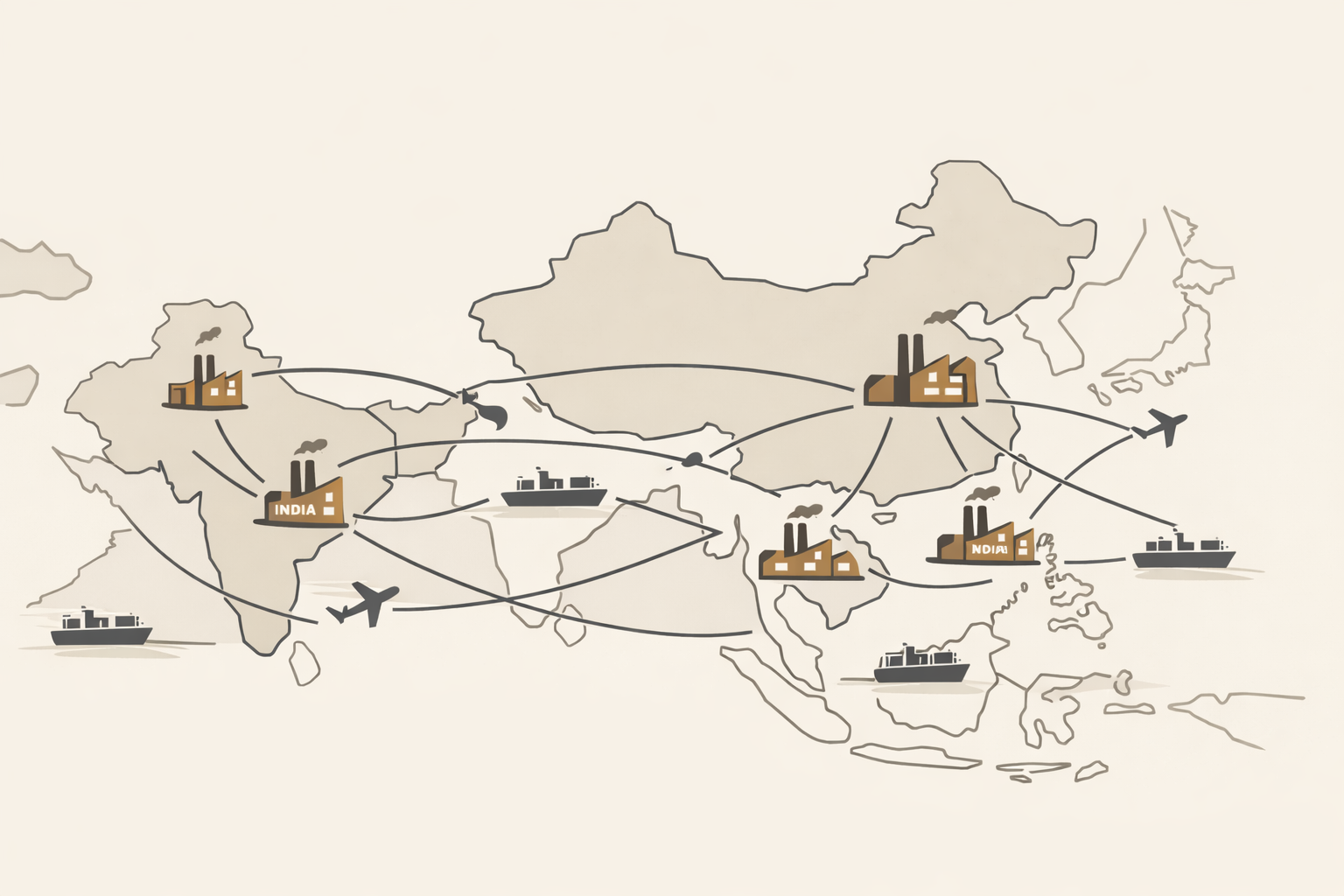
Companies are adding additional manufacturing centers outside China so production can continue during disruption.
That means duplicate suppliers.
Multiple factories.
Regional diversification.
Alternative logistics.
These choices may increase cost. Yet they also reduce vulnerability.
That tradeoff reflects a structural shift in executive thinking.
Concentration Risk
↓
Supply Disruption
↓
Executive Reassessment
↓
Redundant Production
↓
China Plus One Supply Chain
Institutional Capacity Creates Economic Power
Factories rarely move because of speeches.
They move because systems work.
Institutional capacity includes more than tax incentives. It includes reliable electricity, modern ports, efficient customs, predictable courts, skilled labor, stable regulations, technical education, transportation infrastructure, and supplier ecosystems.
Each layer reduces uncertainty.
Reducing uncertainty attracts capital.
Capital builds factories.
Factories attract suppliers.
Suppliers create industrial ecosystems.
Industrial ecosystems create national leverage.
This is why institutional literacy matters.
Countries compete through systems long before they compete through slogans.
Reliable Institutions
↓
Lower Uncertainty
↓
Foreign Direct Investment
↓
Factories
↓
Supplier Ecosystems
↓
National Economic Power
The Three Winners: India, Vietnam, and Indonesia
The new supply chain map does not reward every country equally.
Capital follows capacity, not sentiment.
India, Vietnam, and Indonesia show three different ways nations can become useful inside the China Plus One supply chain.
India: Scale
India offers industrial scale.
Its population, domestic market, workforce depth, and manufacturing incentives position it as a second production pillar for global firms.
The advantage is not simply low labor cost.
The advantage is long-term capacity.
Capacity attracts suppliers. Suppliers attract logistics. Logistics attract more investment.
Industrial ecosystems grow one layer at a time.
Vietnam: Execution
Vietnam plays a different role.
It has become a disciplined manufacturing partner for companies seeking speed, export reliability, and operational precision.
Rather than replacing China, Vietnam often complements it.
That matters because global firms do not only need size. They need dependable execution.
Every new supplier reinforces the next.
Over time, reliability becomes a national asset.
Indonesia: Resources
Indonesia occupies another layer of the supply chain.
Its leverage comes from critical materials, especially nickel.
Electric vehicle batteries, energy storage, and industrial electrification depend on reliable access to key minerals.
That gives Indonesia influence even when it is not the final assembly location.
Raw materials are becoming geopolitical infrastructure.
Manufacturing Has Become National Security
Manufacturing once belonged mostly to economic policy.
Now it belongs to national security strategy.
Semiconductors, rare earth minerals, medical equipment, battery production, artificial intelligence hardware, and defense components are no longer ordinary industrial categories.
They are strategic systems.
Governments now understand that supply chains can shape alliances, sanctions, trade pressure, and military readiness.
Factories influence diplomacy.
Critical minerals influence bargaining power.
Industrial ecosystems influence security.
The economic map and the geopolitical map now overlap.
The New Definition of Emerging Markets
For decades, emerging markets were evaluated through growth.
Population.
Urbanization.
Consumption.
Cheap labor.
Those factors still matter.
However, they are no longer enough.
The new question is different.
Can this country absorb production?
Can its institutions remain predictable?
Can its logistics operate under stress?
Can suppliers scale without breaking?
Can manufacturing continue during geopolitical disruption?
Growth remains valuable. Reliability has become indispensable.
That is the new definition of an emerging market.
The System: Updated
The China Plus One supply chain is not primarily about China.
It is about risk.
Globalization is entering a second generation.
The first generation optimized efficiency.
The second generation optimizes continuity.
Countries that build dependable institutions attract production.
Production attracts suppliers.
Suppliers attract investment.
Investment strengthens national influence.
Economic power begins with institutional capacity.
Everything else compounds from there.
Recognition Skill
After reading this System Update, you should now be able to recognize that modern manufacturing follows institutional reliability, not labor costs alone.
When you see news about new factories, trade agreements, foreign direct investment, or supply chain shifts, ask the sharper question: which institutions made that investment possible?
Further Groundwork
Receipts
UNCTAD: Global investment trends and foreign direct investment patterns.
World Investment Report 2024
OECD: Global value chains, production networks, and trade structures.
OECD: Global Value Chains and Trade
World Bank: Global economic conditions and emerging market outlooks.
World Bank: Global Economic Prospects
IMF: Macroeconomic outlooks, trade pressure, and global growth patterns.
IMF: World Economic Outlook
McKinsey Global Institute: Research on supply chain risk, resilience, and rebalancing.
Risk, Resilience, and Rebalancing in Global Value Chains
Stay Grounded
Build institutional literacy. Get weekly systems analysis across economics, governance, technology, and civic life.
Meet the Builder

Langston Reed
Builder, Civic Power & Policy
Langston Reed helps readers understand how institutions, governance, and public policy shape everyday life. His work develops institutional literacy by translating complex civic systems into practical frameworks that remain useful long after the news cycle has moved on.
“Institutions reveal themselves not through what they promise, but through the incentives they create and the outcomes they consistently produce.”
Continue Learning
System Updates is Groundwork Daily’s civic analysis series led by Langston Reed. It studies how policies, institutions, markets, infrastructure, and public rules shape everyday life.