
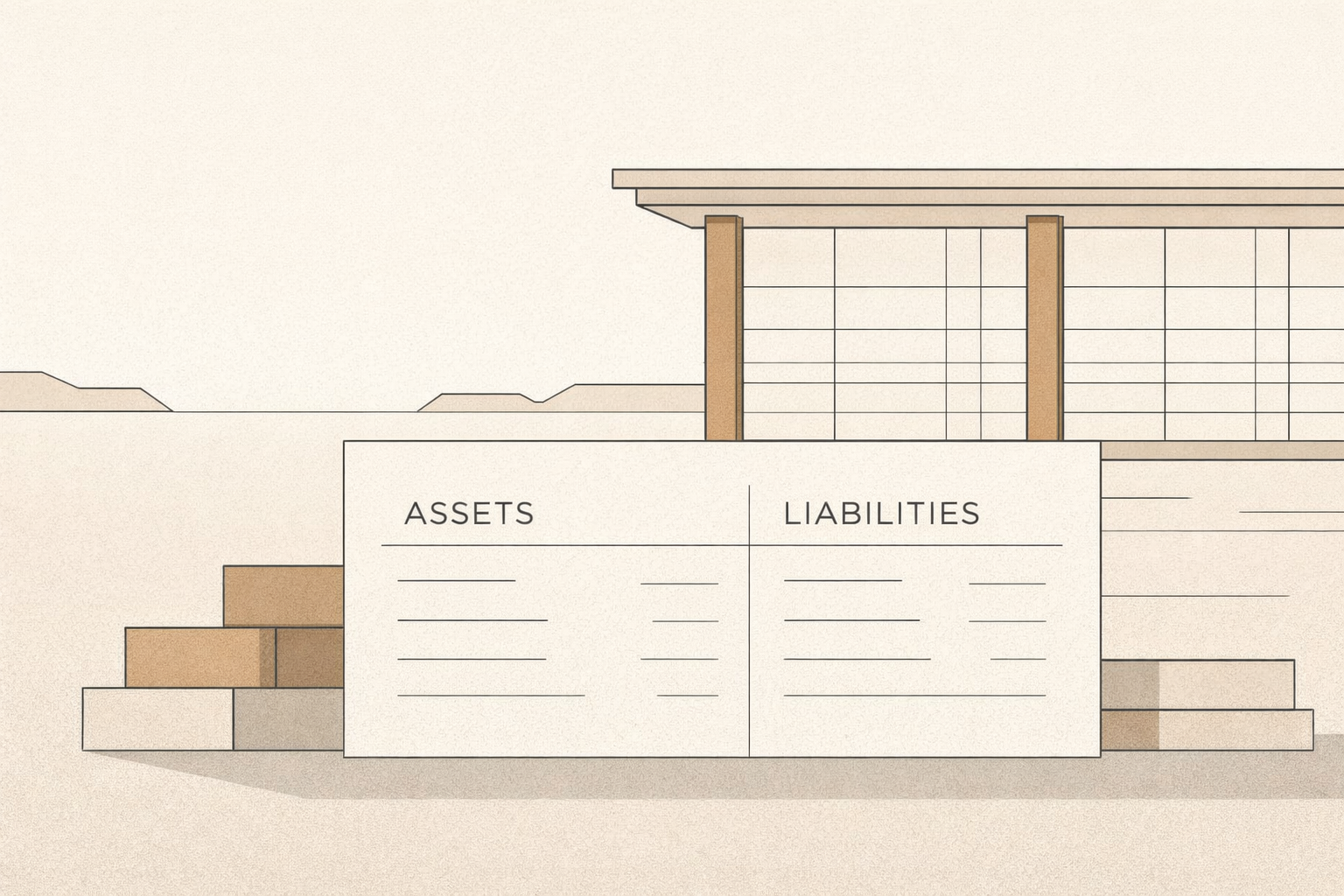
Self-sufficiency is a balance sheet, not a belief. Independence does not exist because it is declared. It exists when income, assets, liabilities, and reserves align under pressure. If the numbers do not work, the story does not hold.
Motivation can start the work. However, math finishes it. That is why the most useful definition of self-sufficiency is measurable: can needs be met without external rescue when conditions get harder, not easier?
For the civic side of leverage, this companion piece adds context: What Actually Replaces Electoral Power When You Walk Away.
Self-sufficiency balance sheet: what the term actually means
Self-sufficiency means the ability to meet essential needs through systems you control, without relying on last-minute help. In practical terms, it is the difference between stability and exposure.
A self-sufficiency balance sheet is not only money in and money out. It is the full structure:
- Cash flow: predictable income and controlled expenses
- Assets: things that retain value and reduce future costs
- Liabilities: obligations that drain future capacity
- Reserves: cash and buffers that prevent collapse during disruption
When these components work together, independence becomes real. When they do not, independence becomes a mood.
Why the self-sufficiency balance sheet gets mistaken for mindset
Belief feels powerful because it is internal. It creates identity and momentum. Yet systems respond to leverage, not conviction. Markets respond to purchasing power. Landlords respond to payment. Governments respond to enforceable positioning.
As a result, communities can align in language and still remain fragile in practice. Alignment without capitalization does not scale. Discipline without reserves does not last.
How to measure a self-sufficiency balance sheet under pressure
If self-sufficiency is real, it survives bad weeks. It survives interruption. It survives surprise expenses. The test is not the best month. The test is the worst month.
Use these balance-sheet questions to ground the conversation:
- What funds this? Revenue, retained earnings, or donations?
- What sustains it? Contracts, memberships, or one-time energy?
- What protects it? Cash reserves, insurance, redundancy, or hope?
- What happens during disruption? Layoffs, inflation, illness, legal issues?
If the answers stay vague, the structure remains incomplete.
Self-sufficiency balance sheet reality: reserves matter more than revenue
Revenue matters, but revenue alone does not create safety. A system can earn and still stay fragile. Reserves change the outcome. Reserves turn disruption into inconvenience instead of catastrophe.
In other words, reserves buy time. Time buys options. Options create freedom.
Why community economics fails without governance
Many cooperative projects collapse for predictable reasons. People underestimate costs. They overestimate participation. They ignore maintenance. Then enthusiasm covers the gap until it cannot.
Over time, unpaid labor burns out. Donations slow. Equipment breaks. The belief remains, but the system weakens.
Governance draws the line between a cooperative and a group chat. Self-sufficiency needs rules, accountability, and processes that hold even when the mood changes.
Self-sufficiency balance sheet vs self-reliance
Self-reliance is personal competence. Self-sufficiency is institutional durability. Competence helps individuals survive. Durability helps communities compound.
Both matter. However, a community cannot mindset its way past rent, utilities, compliance, payroll, and repairs.
Self-sufficiency balance sheet math: independence is cumulative
Real independence builds slowly. It compounds through ownership, retained earnings, and institutional memory.
- Cash flow stabilizes operations
- Operations fund reserves
- Reserves protect continuity
- Continuity builds credibility
Credibility attracts better terms, stronger partnerships, and long-term durability. That is how self-sufficiency becomes an asset, not a slogan.
The Bottom Line
Self-sufficiency is not proven by intention. It is proven by survival under pressure. When the balance sheet holds through disruption, independence exists. When it fails without rescue, belief becomes a substitute for capacity.
