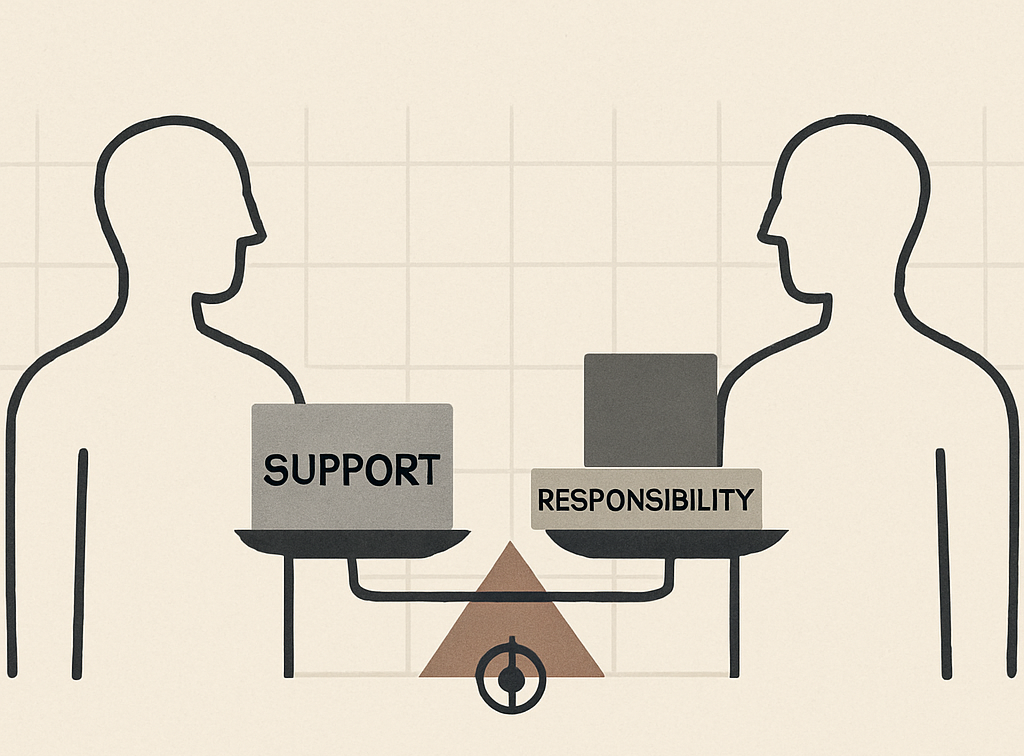
Accountability in custody is not punishment. It is the structure that keeps families stable when emotions run high. In disputes, accountability is often the only thing that protects clarity and prevents conflict from becoming chaos.
Accountability in Custody Is Protection, Not Attack
Courts are often painted as adversaries in custody matters. The deeper problem is the quiet belief that accountability is an attack. The moment a parent is asked to document schedules, share responsibilities, or maintain predictable routines, someone cries harm. Yet accountability in custody is the only thing standing between a child and chaos.
Strong households are not built on affection alone. They are built on agreements. A bedtime is an agreement. A school morning routine is an agreement. A financial contribution is an agreement. The parent who honors these agreements creates stability. The parent who refuses them creates instability. The court often does nothing more than formalize the difference.
Many custody battles are not about the child. They are about escaping accountability. One parent wants the benefits of being seen as involved without the discomfort of being measured. The other parent ends up carrying the weight. Weight carried alone becomes resentment. Resentment becomes distance. Distance becomes crisis. The slope is predictable.
What Accountability Reveals
Accountability protects both parents. It protects the parent who consistently shows up by creating documentation, patterns, and predictability. It protects the parent who struggles by offering structure, reminders, and boundaries that they may not build on their own. Most importantly, it protects the child by limiting how much adults can improvise with their life.
Accountability also reveals motive. When a parent resists structure, avoids documentation, or refuses shared responsibility, the issue is not love. The issue is control. Control wants freedom without obligation. Accountability demands obligation before freedom. These two ideas do not sit together calmly. This is why custody cases become volatile. They are rarely about parenting skills alone. They are about power.
There is also an internal layer. Accountability is not just external rules and court papers. It is the standard a parent sets for themselves. A parent must hold themselves accountable for the habits they model, the tone they set, the stability they create, and the honesty they practice. Children learn responsibility from what their parents consistently do, not from the speeches they give when everyone is upset.
Blueprints, Not Just Orders
A custody agreement is not a burden. It is a blueprint for stability. It is a set of commitments calibrated for the long term. When both parents accept accountability, the home becomes predictable, calm, and safe. When one parent refuses it, the home fractures. Fractured homes produce fractured outcomes.
Strength is quiet in this space. Strength is the parent who documents, shows up, follows through, and builds routines even when it is inconvenient. Strength is choosing the child over ego. Strength is accepting that accountability is not an accusation. It is an act of care that limits harm.
Accountability sharpens people. It exposes excuses. It confronts avoidance. It makes visible what was once hidden. When adults stand in that visibility without flinching, children learn a lesson that outlives any court order. Responsibility is not optional. It is part of becoming someone who can be trusted.
The outcome is simple. Families that embrace accountability grow stronger. Families that resist it grow unstable. The court cannot fix what adults refuse to face. Accountability is a form of strength. In custody matters, it is the difference between chaos and clarity, between conflict and cooperation, between reacting emotionally and building a home with intention.
The Groundwork
Accountability in custody is not about winning or losing. It is about alignment. When agreements, routines, and responsibilities are clear, emotion stops driving the entire story. The child receives a steady frame instead of a shifting battlefield. That frame is the work of adults who are willing to be measured.
Receipts