The Current Landscape: China’s “Scale and Speed” Advantage
China’s technological acceleration now defines the global race in robotics, electric vehicles, and AI education. This shift marks a new phase in industrial policy where China’s technological acceleration combines automation scale, domestic supply chains, and national education reform to outpace Western innovation.
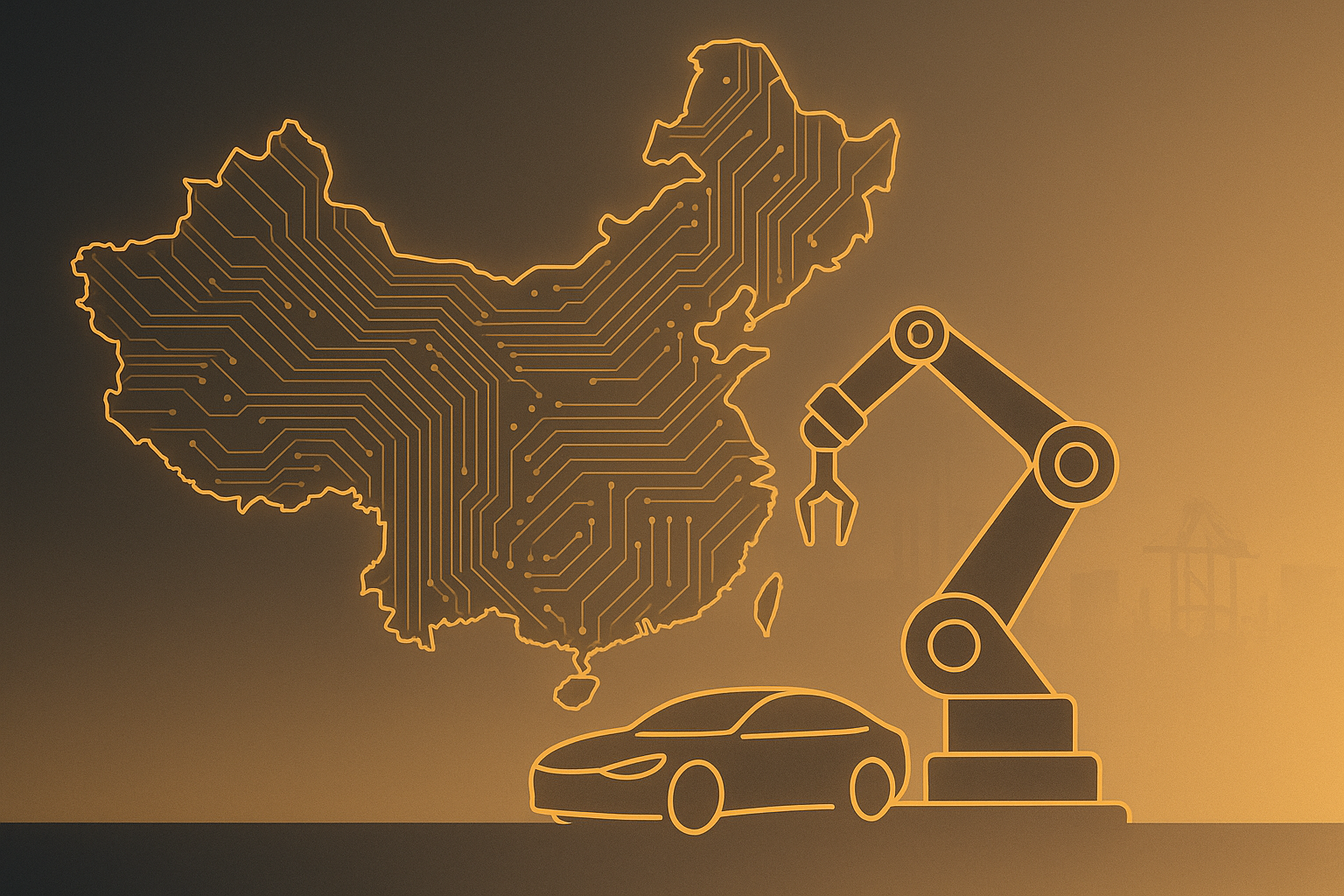
1. Automation Dominance
China installs over half of the world’s industrial robots each year. Its robot density—robots per 10,000 workers—has quadrupled in six years, surpassing the United States. Domestic production makes Chinese robots roughly one-third cheaper than European or Japanese models, sustaining a cost advantage that accelerates automation.
2. The EV and Battery Moat
China controls between 70% and 90% of the lithium-ion battery value chain, supported by over $230 billion in state funding since 2009. While U.S. manufacturers focused on premium EVs, China emphasized smaller, affordable models, expanding its market share and scaling production faster than any competitor.
3. The Talent Pipeline
China’s Ministry of Education has mandated AI literacy from primary school onward. This structured, nationwide approach to AI education builds a generation fluent in coding and robotics, in sharp contrast to the U.S., where AI training remains decentralized and uneven.
The Trajectory: Converging Advantages and Strategic Competition
Global competition has shifted from developing algorithms to mastering Embodied AI—systems that physically interact with the world. This evolution ties robotics, mobility, and AI together into a single industrial frontier.
- Mass Production of Humanoids: Chinese companies plan to manufacture over 10,000 humanoid robots annually by 2025—over half of projected global output—reducing costs and speeding integration into logistics and manufacturing.
- Supply Chain Lock-In: Control of rare earths, batteries, and motors keeps other nations dependent on Chinese components for affordable robotics and EV production.
Two Emerging Global Models
- China’s Digital Authoritarian Model: Centralized coordination, rapid rollout, and extensive data collection to maximize state oversight.
- The U.S. Innovation Model: Decentralized research, privacy protections, and higher precision manufacturing at smaller scale.
The danger lies in scale economics: low-cost Chinese technology could become the global standard, exporting governance norms that emphasize control over individual data rights.
The U.S. Role and Individual Action
National Strategy Levers
- Leapfrog in Energy: Invest in next-generation solid-state batteries and new chemistries where China holds no monopoly.
- De-Risk Supply Chains: Diversify access to semiconductors, sensors, and rare earth materials through allied production networks.
- National AI and Robotics Strategy: Create unified standards for AI education, workforce training, and safe deployment frameworks.
Individual Agency
- Demand AI Literacy: Encourage local schools to add practical AI and ethics instruction.
- Support Allied Innovation: Prioritize domestic or allied-nation technology purchases to reduce reliance on Chinese supply chains.
- Engage Ethically: Join discussions on AI regulation, privacy, and rights. Civic literacy is now national security.
Note: For verified reporting, see Wall Street Journal’s coverage on AI in Chinese classrooms and Brookings analysis of China’s industrial policy.
See Discipline Before Dollars for how structure underpins national strength and civic discipline.