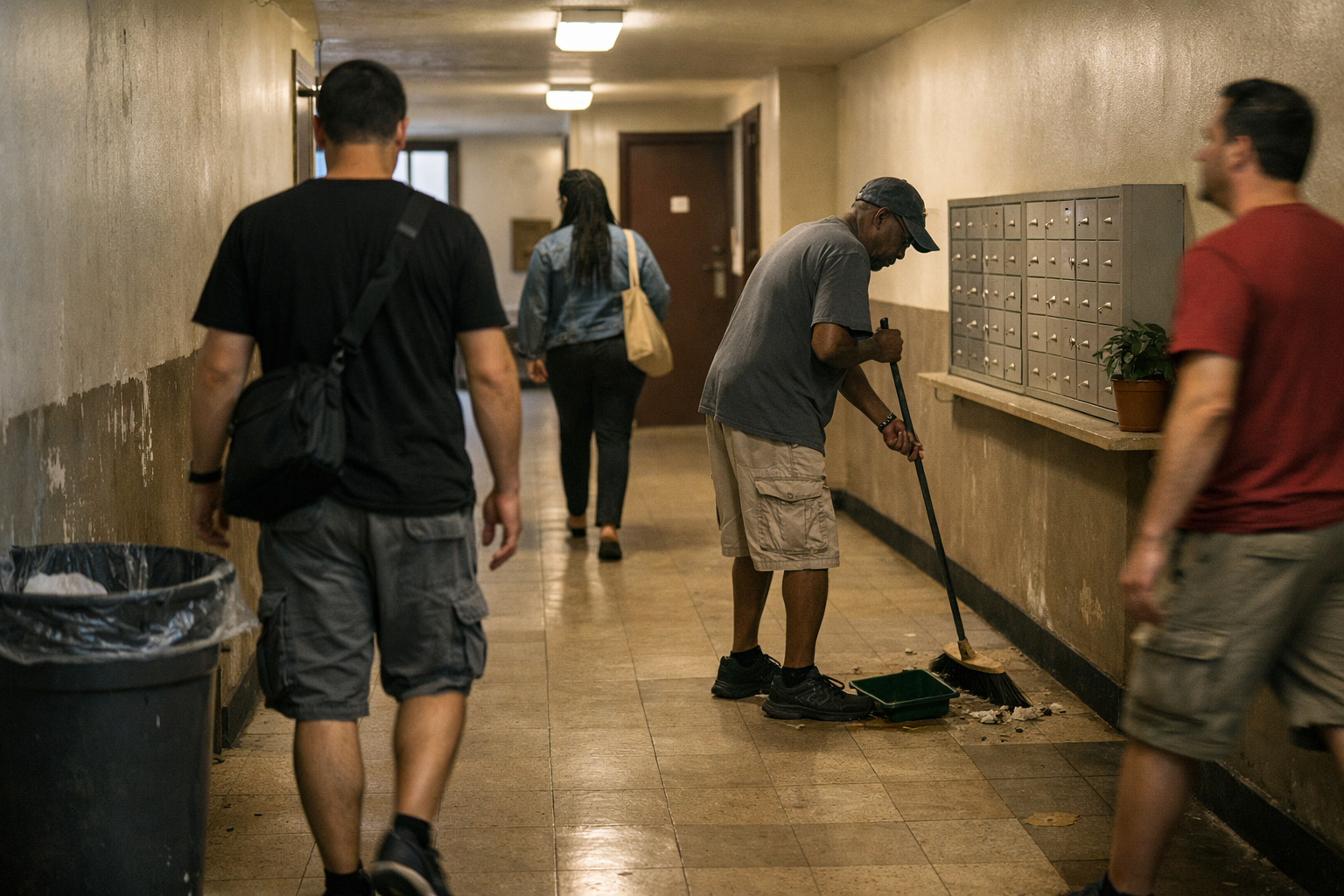
Community participation failure rarely announces itself. It begins the moment responsibility becomes optional and contribution starts falling on the same few people every time.
You can see it in a hallway, a building lobby, a shared courtyard, or a block where one person keeps sweeping while everybody else keeps walking. The surface issue looks small. A little clutter. A little neglect. A little unevenness. But that is not the real story.
The real story is structural.
A shared system is being used by many people while being carried by very few. That arrangement can survive briefly. It cannot survive indefinitely.
The Problem
Most people misunderstand how breakdown starts. They look for one dramatic event. One act of vandalism. One major conflict. One obvious moment when everything goes wrong.
That is weak analysis.
In real environments, decline is usually quieter than that. Community participation failure starts when people learn that the space will still function even if they do nothing. Once that lesson settles in, non-participation becomes rational.
Not noble. Not admirable. Rational.
If someone else is already taking out the trash, reporting the leak, moving the package, sweeping the floor, or correcting the disorder, then the cost of opting out looks low. That is how the pattern begins.
What’s Actually Happening
This is not a story about cleanliness. It is a story about incentives.
The system is teaching residents that use and responsibility are no longer connected. People still receive the benefit of an orderly environment, but they are not required to help sustain it. Once that gap opens, consumption stays high while contribution drops.
And when contribution becomes uneven, the burden does not disappear. It concentrates.
One person becomes the unofficial maintainer. Another becomes the person who always reports issues. Another becomes the one who still cares what the space looks like. Everyone else adapts to the convenience.
That is not community. That is load transfer.
Why It Keeps Happening
It keeps happening because shared systems collapse fastest where ownership is socially vague.
When nobody is clearly accountable, people default to three assumptions:
- someone else will handle it
- their individual effort will not matter much
- they can keep benefiting without participating
Those assumptions create a stable pattern of withdrawal.
And once withdrawal becomes normal, visible contribution starts to feel abnormal. The person doing the work begins to look exceptional instead of standard. That is a dangerous shift because it changes maintenance from a baseline expectation into a personal trait.
At that point, the system is already drifting.
The Cost
The first cost is physical decline. Shared areas stop being maintained to the same standard. Disorder lingers longer. Small issues sit until they become larger ones.
The deeper cost is social.
People who keep carrying the system start noticing that they are carrying it alone. Over time, that produces resentment. Resentment produces withdrawal. Withdrawal produces lower standards. Lower standards produce faster decay.
That is how the environment changes without anyone officially deciding to let it go.
The block does not fail all at once. It fails one repeated exemption at a time.
The Groundwork
The structural lesson is simple: what is shared without expectation will be used without responsibility.
If participation matters, it cannot remain invisible, informal, and optional forever. Shared environments stay stable when contribution is attached to clear norms, visible ownership, and repeated standards.
Goodwill helps, but goodwill is not enough. Systems that rely on goodwill alone eventually get consumed by the people least willing to contribute to them.
That is why this is not a motivational issue. It is a design issue.
If a building, block, or shared environment wants order, then responsibility has to be made legible. Someone has to know what is expected. Someone has to know what neglect costs. Someone has to know that participation is part of belonging, not an extra favor performed by the unusually disciplined.
Community participation failure is not about bad intentions. It is what happens when a shared system allows people to separate benefit from responsibility for too long.
Why Neighborhood Order Beats Big Promises
A published Block Logic companion on how neighborhood stability depends on repeated local structure.
Next in cluster: Maintenance Without Ownership
The point where shared upkeep becomes unpaid labor carried by the same few people.