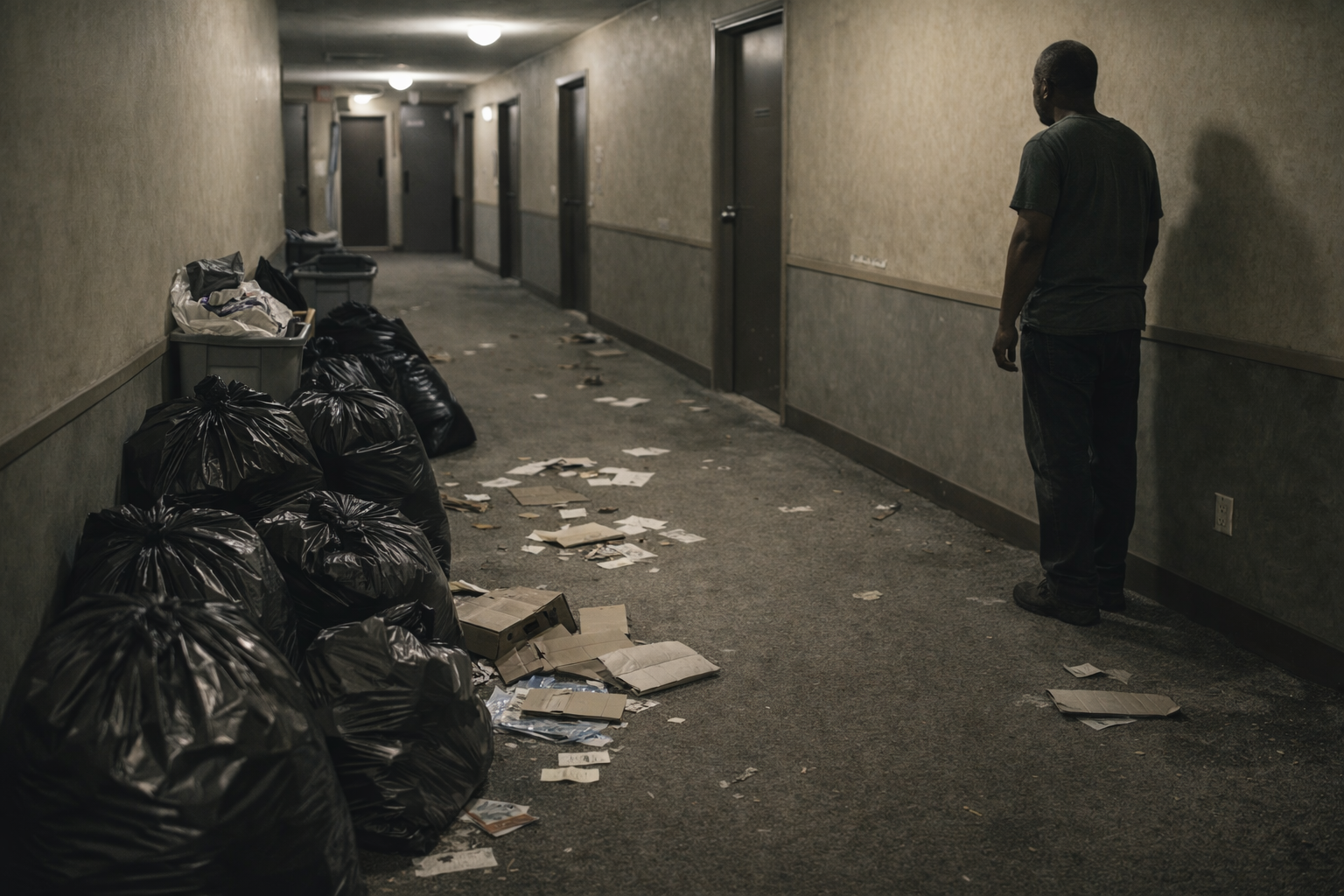
Community system collapse rarely begins with one dramatic event. It becomes visible when the people quietly carrying the burden stop showing up and the shared environment reveals how much invisible maintenance it was actually running on.
Most people miss that sequence. They think collapse starts when the hallway looks bad. It starts earlier than that.
A small group usually keeps absorbing the cost of everyone else’s disengagement. For a while, that effort hides the weakness. The floor still gets swept. The trash still moves. The shared space stays usable enough that others can treat stability like a permanent feature instead of a maintained condition.
Then the contributors stop showing up.
The Problem
Shared systems do not usually fail because nobody cared. They fail because too few people cared long enough to keep carrying what too many people treated as somebody else’s job.
That pattern matters because concentrated responsibility makes a system fragile. From the outside, it still looks functional. Underneath, the structure has already weakened.
Order often hides subsidy. A handful of reliable people keep compensating for everyone else, and their effort prevents visible decline.
How Community System Collapse Becomes Visible
Community system collapse becomes visible when maintenance disappears and no replacement behavior emerges.
The hallway tells the truth quickly. Trash accumulates. Mail gets scattered. Small disorder no longer gets corrected. The environment shifts from lightly strained to visibly neglected because no one remains to do the quiet work that used to hold the system together.
This is not random decay. It is exposed dependency.
The system was never as healthy as it looked. Contributors were propping it up, and their effort made dysfunction harder to see.
Why Community Collapse Keeps Happening
People keep making the same mistake. They see visible order and assume shared commitment produced it.
Usually, that assumption is wrong. In weak systems, contribution concentrates while benefit remains shared. That arrangement trains people to expect the work to get done even if they do nothing.
Once that expectation settles in, withdrawal gets easier. People adapt to the convenience of someone else’s discipline. The more dependable the contributors are, the less pressure everyone else feels to participate.
That is how disengagement becomes normal long before collapse becomes obvious.
The Cost
The first cost is environmental. Standards fall fast once upkeep stops. Neglect becomes visible because nobody intercepts it early.
The deeper cost is social. Trust erodes when people realize the system cannot hold without unpaid over-functioning from the same few individuals. Confidence drops. Expectations weaken. Participation becomes even less likely because visible disorder tells everyone the shared standard is already gone.
Recovery then gets harder. Cleaning a neglected environment is difficult. Rebuilding belief in shared responsibility is harder.
The Structural Rule
The structural lesson is simple: systems do not collapse when participation declines a little. They collapse when the people carrying the decline decide they are done absorbing it.
Strong communities do not wait for visible breakdown before they recognize imbalance. They distribute responsibility earlier. They make contribution legible. They reduce the gap between using a system and sustaining it.
Weak communities do the opposite. They lean harder on the same reliable people until those people disappear from the equation.
Then the neglect everyone ignored becomes impossible to miss.
Community system collapse becomes visible when the contributors holding everything together step back and the environment has to function without them. Weak systems do not fail suddenly. They fail when the subsidy ends.
Unequal Responsibility in Communities: The Cost of Carrying Everyone Else
How shared systems deplete the few people repeatedly forced to carry everyone else.
Free Rider Problem in Communities: Contribution Is the Price of Belonging
Why shared systems weaken when people benefit without helping sustain them.
Next in cluster: Standards Are What Prevent Collapse
What stable environments do before visible decline begins.