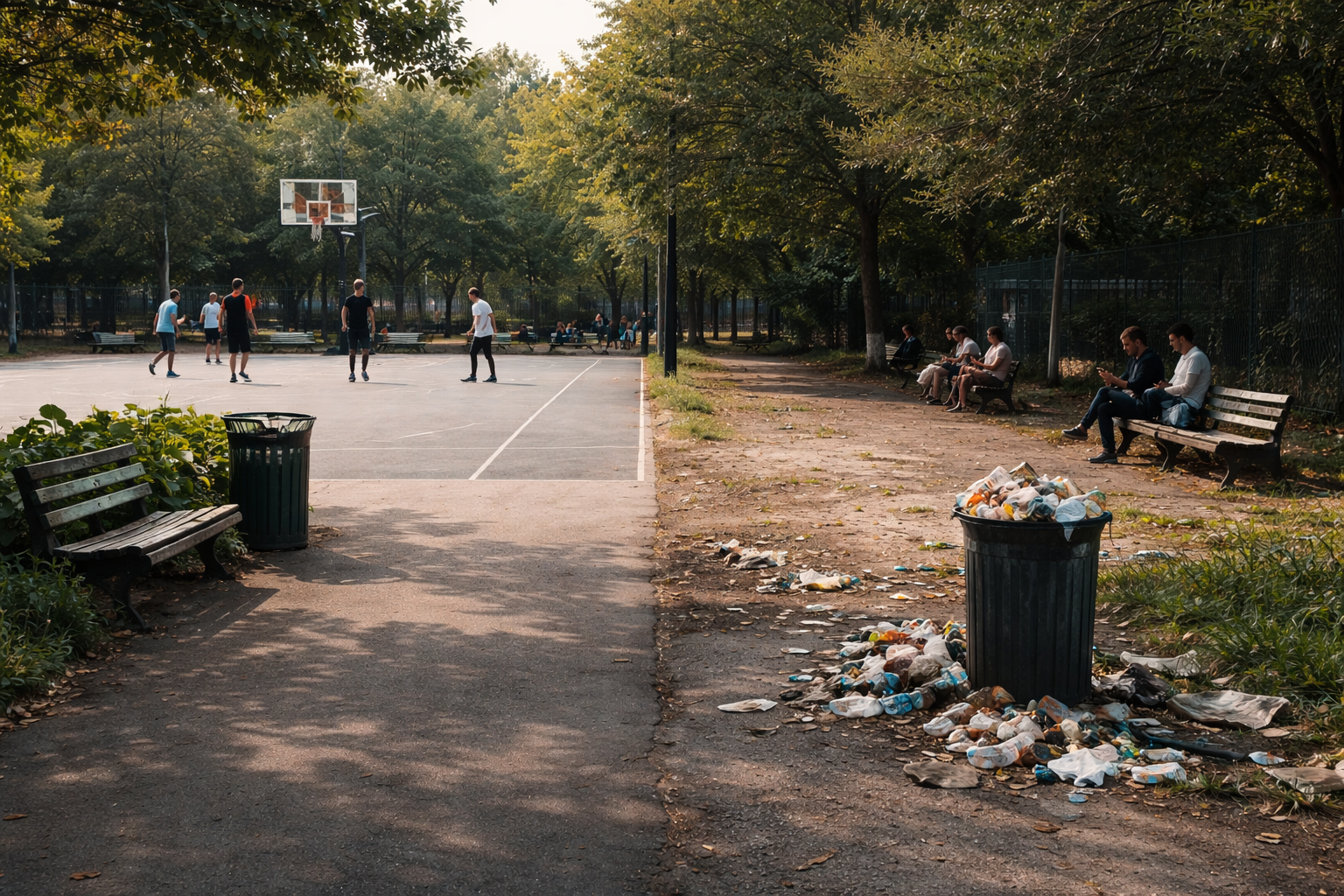
Community systems failure is not random. It is predictable, repeatable, and already happening in the spaces people move through every day.
It starts small. A trash can overflows and stays that way. A bench remains broken. A shared space gets used heavily but maintained lightly. Nothing collapses overnight. The shift is gradual, almost invisible, which is exactly why it spreads.
The Problem
The issue is not that people do not care. It is that the system no longer connects use with responsibility.
Walk through a neighborhood park late in the day. One side is active. People are playing, sitting, cleaning up after themselves. The space holds because someone is still contributing to it. A few steps away, the pattern changes. Trash collects near the benches. A bin is tipped over. The ground is worn but unattended. People pass through, but no one intervenes.
Same park. Same resources. Different outcomes.
What’s Actually Happening
This is how community systems failure unfolds. Contribution becomes uneven, and the system absorbs the imbalance.
The people maintaining the space continue for a while. The people extracting from it continue without interruption. Over time, the signal becomes clear: upkeep is optional, and someone else will handle it.
From there, behavior adjusts quickly to that signal.
Why It Keeps Happening
Shared responsibility weakens when it is not reinforced.
If contribution is invisible, it feels unnecessary. If neglect carries no consequence, it becomes normal. That combination creates a slow drift where fewer people carry more weight, until even they begin to step back.
Once that happens, decline accelerates.
The Cost
The visible damage is the least important part.
What actually erodes is trust. People stop expecting the space to hold. They stop correcting behavior. They stop investing effort. Eventually, disengagement becomes the most rational response.
A neglected environment does not just reflect disorder. It teaches it.
The Groundwork
Shared systems do not survive on intention. They survive on structure.
They require visible contribution, consistent participation, and a clear connection between use and responsibility. Without that, imbalance is not an exception. It is the default.
A system does not collapse when people stop caring. It collapses when people stop contributing.
Continue Building
The Free Rider Problem Is Not Theory. It Is Practice
Contribution Must Be Visible or It Disappears
Discipline Before Dollars
Structure Builds Freedom
The Stability Framework
Receipts