
How Crime Stories Become Ideological Content Machines Online
How crime stories become ideological content online is one of the clearest media shifts of the digital era.
Crime stories once followed a predictable path. A crime occurred. Police investigated. Journalists reported what happened. Courts handled the consequences.
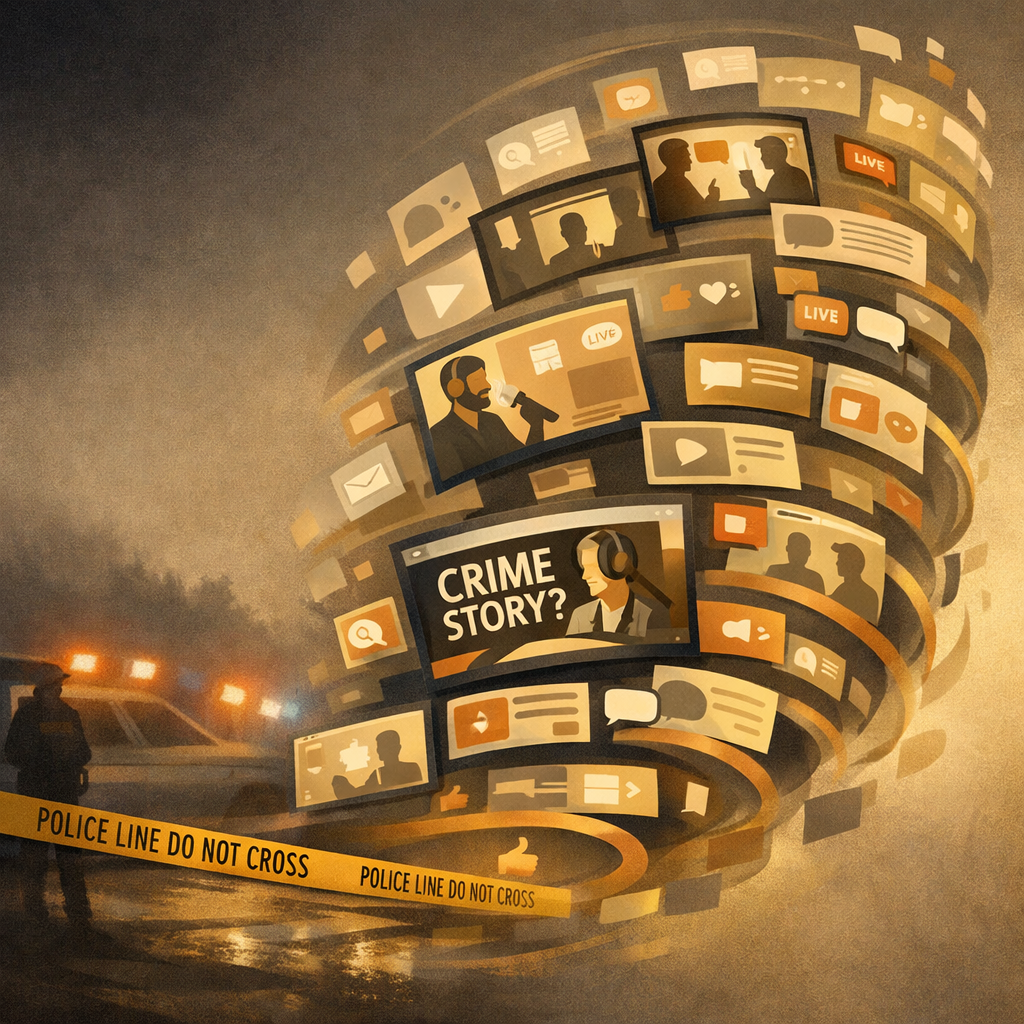
Today that linear process has been absorbed into something else entirely: a nonstop commentary ecosystem built to capture and monetize attention.
What once produced court records now produces reaction videos, livestreams, algorithmic debate, and ideological branding. The event still matters, but the commentary economy now plays a major role in determining how the public understands the event.
How Crime Stories Become Ideological Content Online
The moment a crime enters the public sphere, it becomes raw material for the internet’s commentary economy. Within hours, the event is dissected by reaction channels, podcasts, live streams, and social media threads. Each format rewards speed, emotional charge, and rapid interpretation over slow verification.
What used to be coverage has become narrative production.
Online commentary channels operate inside an incentive structure built around attention. Algorithms reward engagement, reaction, and moral intensity. Provocative content usually earns more reach than neutral information. Crime stories are uniquely suited to this environment because they contain conflict, moral tension, and human drama, all of which translate easily into clicks, comments, and debate.
When a story begins circulating online, it quickly becomes source material for dozens of creators who interpret the same event through different ideological frames. One commentator may frame the incident as evidence of systemic injustice. Another may treat it as proof of cultural decline. A third may focus on gender dynamics, family structure, or institutional failure.
Each interpretation competes for attention.
The Algorithmic Narrative Machine

Social platforms do not merely distribute information. They shape which narratives travel the furthest by deciding what appears in front of whom, and how often. Algorithms amplify content that triggers discussion, outrage, and disagreement. That structure encourages creators to emphasize interpretation and conflict rather than neutral reporting.
The process often begins with a simple event but quickly evolves into a feedback loop:
Crime story
Commentary reaction
Audience engagement
Algorithmic amplification
Further commentary
A short video of a street altercation, for example, can spawn dozens of reactions within hours. Political streamers, true crime podcasters, TikTok analysts, and anonymous accounts may all tell slightly different stories about the same thirty seconds of footage. With every cycle, the original incident becomes less central than the narratives surrounding it.
The audience is no longer watching a single story unfold. The audience is watching competing interpretations battle for dominance, each one calibrated to the tastes and emotional expectations of a particular niche.
The Battle of Narratives

As commentary multiplies, audiences encounter multiple versions of the same event. One narrative may highlight institutional bias. Another may frame the story as evidence of cultural decay. A third may emphasize personal responsibility or individual pathology.
Each narrative selects certain facts, emphasizes particular themes, and downplays competing explanations. This is not always coordinated manipulation. More often, it is the natural result of a decentralized commentary ecosystem where creators interpret events through the lens of their audience, their own worldview, and the metrics that determine whether their work will be seen.
In an environment where reach depends on engagement, the most emotionally charged and morally confident interpretations tend to win. That is one reason how crime stories become ideological content online matters far beyond media criticism. It changes how the public assigns blame, sympathy, urgency, and meaning.
The Economics of Attention
The transformation of crime stories into ideological debates is driven by the economics of attention. Platforms are optimized to maximize time on site, not public understanding. Their business models reward anything that keeps people scrolling, reacting, and sharing.
Creators compete for visibility inside that system, learning over time which tones, angles, and narratives the algorithm appears to favor. Audiences then gravitate toward interpretations that confirm existing beliefs or satisfy emotional expectations, reinforcing the cycle.
The outcome is a media environment where a single event can generate dozens of competing explanations within hours, each framed as the real story behind what happened.
Understanding the System
Recognizing this system changes how commentary should be consumed. Instead of asking which commentator is correct in some absolute sense, it becomes more useful to ask a different question:
What incentives are shaping the narrative I am seeing?
Crime stories may begin with a real-world event, but the online ecosystem quickly turns those events into narrative engines that feed on attention, outrage, and identification. Understanding the incentives behind that process allows audiences to step back from the noise, see the machinery operating beneath the debate, and recognize that the central conflict is no longer only about what happened.
It is also about which version of what happened people are being trained to believe, and why.
Further Groundwork
The Attention Economy Is Not Free: How Platforms Turn Human Focus Into Market Power
Global Economic Trends 2026: The 60-Day Shift Reshaping Energy, AI, and Trade
Receipts
Georgetown Law | The Attention Economy
Overview of the attention economy and how platforms structure visibility and engagement.
Center for Humane Technology | The Attention Economy
Explanation of how digital platforms compete for human attention and shape user behavior.
CalMatters | Social Media Algorithm Commentary
Commentary on how social algorithms intensify outrage and polarizing content.
CrimeReads | Feeding the Media Monster
Discussion of how crime and true crime narratives are reshaped for mass media consumption.
Boston University | Why We’re Fascinated by True Crime
Analysis of audience fascination with crime stories and the emotional appeal of true crime media.
Flat Hat Magazine | The Ethics of True Crime in an Age of Social Media
Reflection on narrative framing, ethics, and the social consequences of crime storytelling online.

Explore more analysis in the Culture, Media & Leadership archive.