
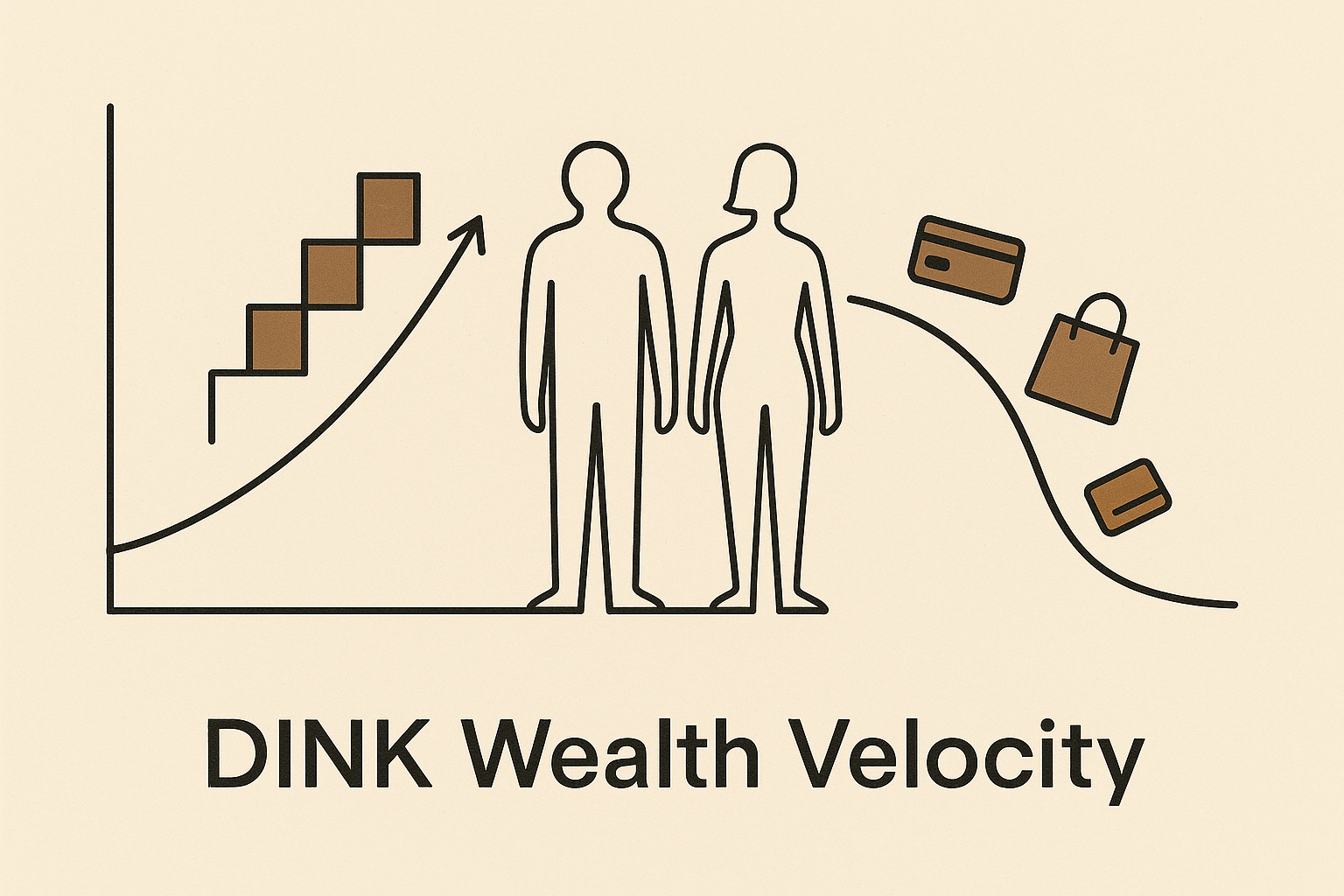
DINK wealth inequality begins long before midlife. DINK households move through their early earning years with a level of efficiency most families cannot match. Their cost structures are lighter, their margins are wider, and their discretionary income behaves more like investable fuel than survival money.
DINK Wealth Inequality and the Compounding Gap
Still, efficiency cuts both ways. When two adults compound together, they accelerate whatever system they have built. Discipline compounds. Avoidance compounds. Debt compounds. Even lifestyle creep compounds at speed. Because of this, the early financial comfort that defines many DINK years can quietly shift into long-term vulnerability if there is no shared financial architecture.
This is why the compounding gap becomes obvious in the late thirties and early forties. Some DINK households convert the extra income into ownership—equity positions, cash reserves, appreciating assets, and structured long-term protection. Others convert it into upgraded apartments, expanded travel cycles, subscription creep, and monthly payments disguised as lifestyle freedom. The divergence appears slow, but it accelerates with time.
DINK wealth inequality widens because the system compounds whatever is fed into it. By midlife, the spread is no longer about income. Instead, it reflects accumulated posture. One household has ballast; the other has brand. One has structure; the other has stories. The math is quiet but ruthless: compounding does not reward intention. It rewards discipline, design, and consistency over time.
Therefore, DINK inequality is not a cultural debate—it is arithmetic. Two incomes without a unified plan create momentum but not direction. However, two incomes tied to disciplined rules create acceleration that lasts. DINK households with structure age into stability. DINK households without it age into volatility.
For a deeper look at how discipline shapes financial outcomes, review Brookings’ analysis of economic divergence: Brookings – The Geography of Economic Inequality in the United States .
The Groundwork
DINK households have velocity, but velocity without structure becomes drift. The compounding gap is not a mystery; it is the predictable outcome of systems left to run without rules. A household becomes what it repeats, and compounding simply tells the truth louder over time.