How wars affect local economies is rarely obvious at first. Modern supply chains connect distant conflicts to everyday costs like fuel, food, shipping, and electricity. The pressure usually moves through infrastructure before it reaches households.
That is the part many people miss.
Most modern conflicts do not affect neighborhoods through direct contact. They affect them through systems. The world now runs on tightly connected networks of oil, shipping, logistics, electricity, and food distribution. When one part of that system takes a hit, the effect travels.
How Wars Affect Local Economies Through Global Supply Chains
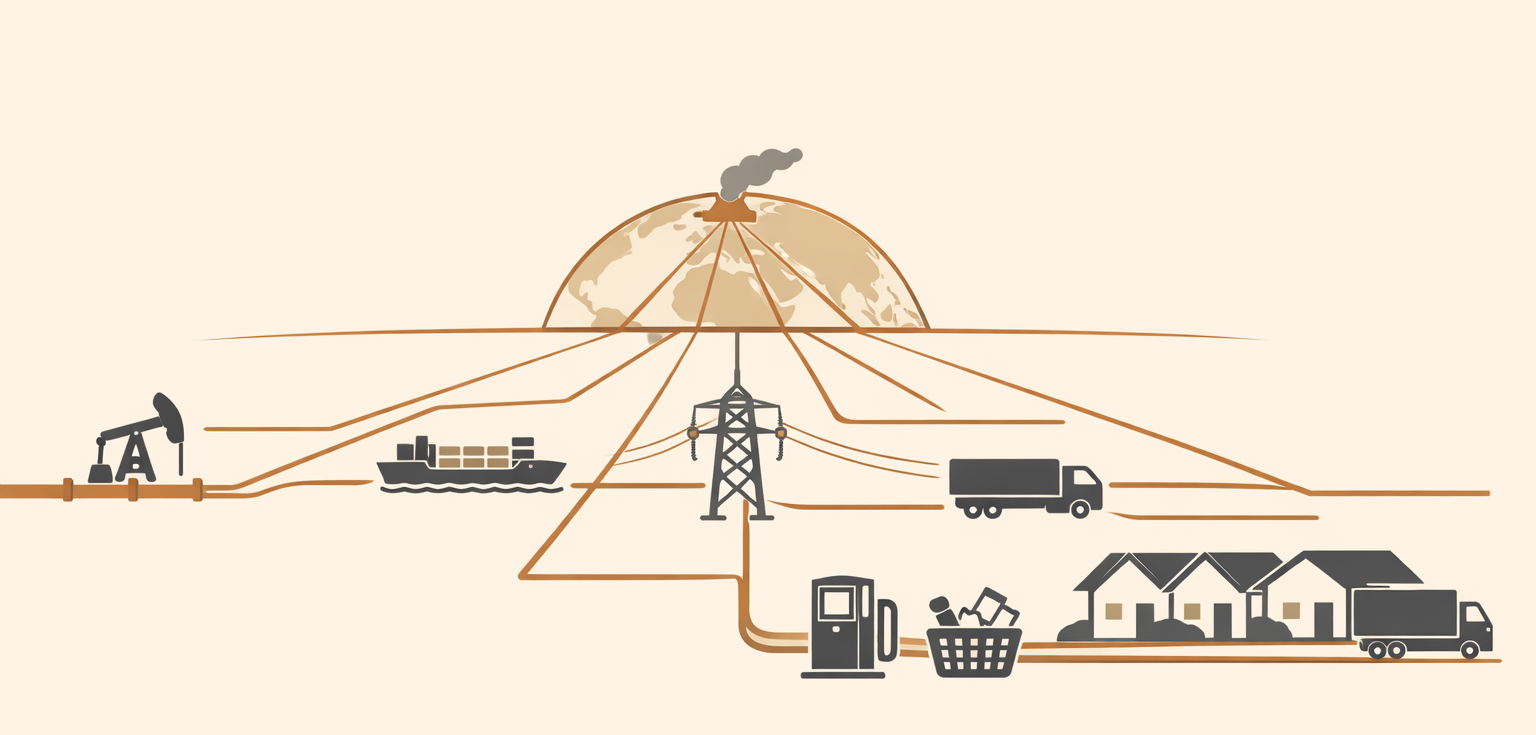
Global commerce depends on infrastructure that most people never see. Oil moves through chokepoints and shipping corridors. Goods move in containers across oceans, through ports, onto trucks, and into warehouses. Food systems depend on fuel, fertilizer, refrigeration, and transportation all working together.
These systems look stable because they are usually invisible. However, invisible does not mean simple.
Each layer depends on the others. Energy powers transportation. Transportation moves goods. Digital systems coordinate timing, inventory, and routing. When stress hits one layer, the rest of the system absorbs the shock.
Distant Conflict Becomes Local Cost
A disruption near a major energy corridor can affect fuel markets far beyond the region where the conflict begins. Meanwhile, a delay in maritime traffic can increase shipping insurance, freight costs, and delivery times. A squeeze on energy can also raise the cost of fertilizer, manufacturing, and basic distribution.
Those costs do not stay inside global markets.
They eventually move into ordinary places. The gas station. The grocery store. The monthly utility bill. The operating budget of a small business trying to hold its prices steady.
This is how distant instability becomes local pressure. Understanding how wars affect local economies helps explain why events thousands of miles away can raise fuel costs, food prices, and shipping expenses at home.
Why Infrastructure Matters More Than Headlines
Headlines usually focus on leaders, military events, and political statements. Those details matter, but they are not the whole story.
The deeper question is structural. Which systems are exposed. Which routes carry the risk. Which industries depend on those routes. Which households are most vulnerable when those costs move downstream.
That is where the real consequence lives.
War does not need to reach a neighborhood physically to affect it economically. It only needs to touch the systems that keep daily life moving. As a result, local communities often feel the effects of global instability long before they fully understand the cause.
Reading the System Clearly
Understanding global supply chains makes the world easier to read. Events stop looking random. Patterns become visible. A conflict in one region can influence shipping in another. Shipping can influence inventory. Inventory can influence price. Price can influence household stability.
This is why infrastructure matters so much.
Strong systems absorb pressure better. Fragile systems pass the cost downstream faster. Communities with little margin feel the effect first because they already live close to the edge of disruption.
The lesson is not panic. The lesson is clarity.
In a connected economy, how wars affect local economies depends heavily on systems far beyond local control. Because of that, preparation and structural resilience matter more than ever for local communities and households.