
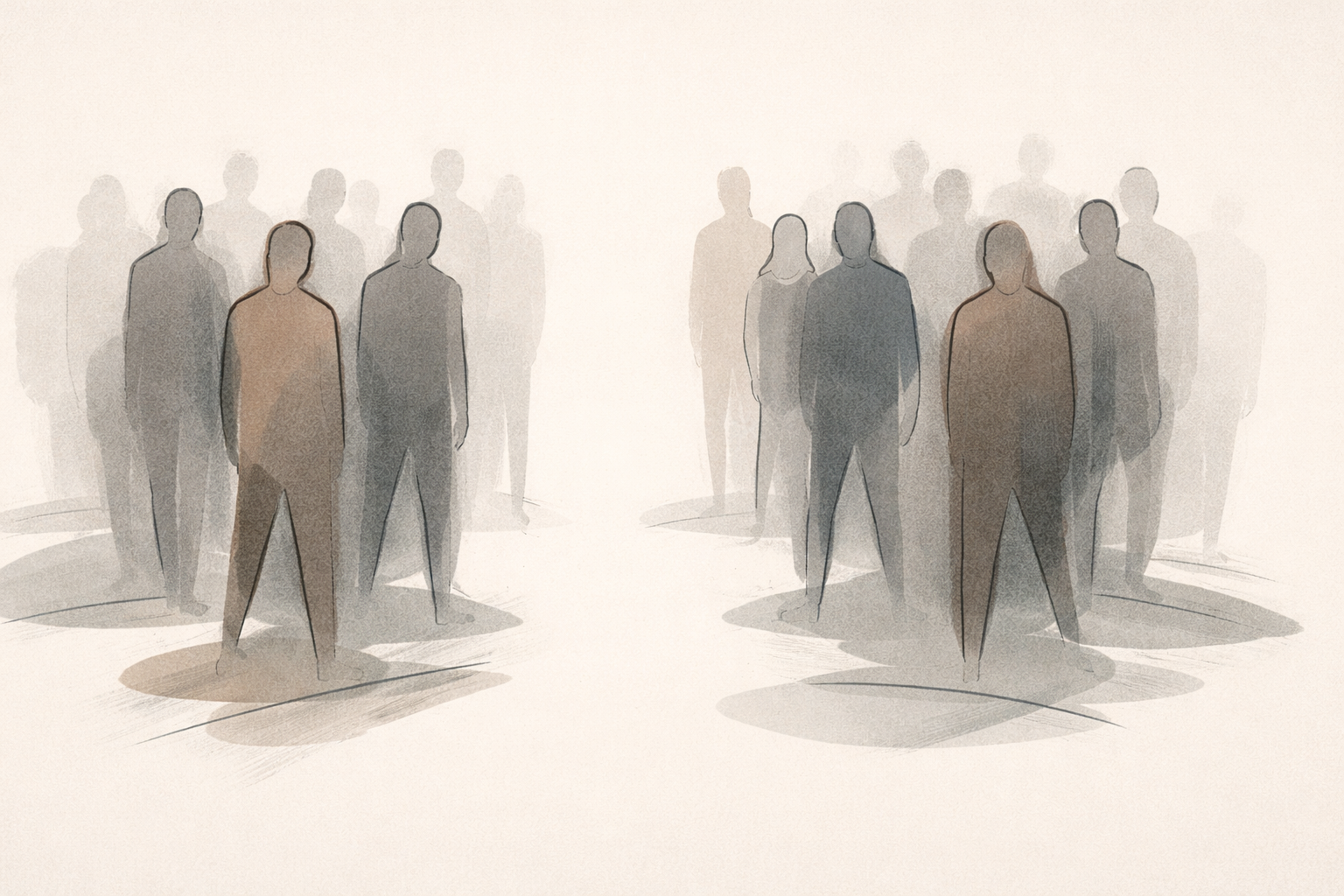
Responsibility diffusion explains why crowds escalate faster than individuals. When accountability spreads across many people, no one feels responsible for stopping momentum. As a result, silence fills the gap where intervention should have occurred. The moment keeps moving, and what felt wrong at first begins to feel normal simply because it continues.
Instead of showing up as one loud decision, this pattern arrives through small hesitations. Someone waits. Another person mirrors the waiting. Meanwhile, the crowd rearranges itself around the assumption that somebody else is in charge. Eventually, the absence of a signal becomes the signal.
Public life is full of places where this happens: sidewalks, trains, school hallways, parties, stadiums, workplaces, and online spaces that behave like crowds even when nobody is standing shoulder to shoulder. In practice, the crowd does not need to be angry for escalation to happen. Curiosity is enough. Amusement is enough. Boredom can be enough.
Why responsibility diffusion escalates crowds
In a group, the social air changes. People begin to outsource responsibility to a ghost.
One person assumes an authority figure will handle it. Another person assumes the loudest person will handle it. Someone else assumes there must be a reason nothing has stopped yet. Over time, these assumptions stack, and hesitation becomes a shared posture.
Several quiet scripts run at once:
- Someone else will speak up.
- Someone else knows what is happening.
- Someone else is in charge.
- Someone else will take the risk.
Although the scripts sound harmless, they work like fuel. The longer a situation continues, the more it becomes a performance. Then the crowd starts protecting the performance instead of protecting the people inside the moment.
How shared responsibility disappears in crowds
Responsibility disappears fastest when no one wants to be the first mover. The first mover is visible. The first mover risks embarrassment. The first mover might be misunderstood. Consequently, many people choose the safer role: observer.
Observation looks neutral, but it is rarely neutral in a crowd. A silent crowd communicates approval or at least tolerance. That is why escalation can feel sudden. The crowd did not suddenly change its mind. The crowd simply continued long enough for the line to blur.
The most dangerous absence is not police
The most dangerous absence in these moments is not police. It is peers.
Stable environments have something subtle and powerful: ordinary intervention. A look that communicates disapproval. A short phrase that names the line. A step forward that interrupts the rhythm. Importantly, this kind of intervention is rarely dramatic. It is early. It is small. It works precisely because it happens before the moment becomes a clip.
When peers do not intervene, the crowd learns quickly. There is no cost here. Not now. Not visibly. The lesson lands. Next time, escalation starts sooner, because the group has rehearsed the absence of consequence.
“Where there is no guidance, a people falls.”
Proverbs 11:14
Silence trains behavior faster than rules
Silence does not feel like a decision, but in crowds it behaves like one. Silence communicates that the boundary is unclear. Silence communicates that the boundary does not exist. Worse, silence communicates that anyone who speaks will become the problem for interrupting the mood.
Because of that, the first seconds matter. If the first seconds contain a clear boundary, most people adjust. If the first seconds contain only recording and laughter, the environment shifts toward whatever is most entertaining, provocative, or rewarding.
Modern attention systems accelerate this drift. Phones do not invent the behavior, but they amplify the incentive. Once recording becomes the default response, the crowd starts acting like an audience. Then the audience turns the moment into a stage. A stage demands escalation.
None of this requires ideology. It does not require a plan. It only requires a gap where guidance should be. Once that gap becomes familiar, it becomes culture.
How to interrupt escalation without becoming the story
Wisdom matters here. Safety matters. Not every moment is yours to manage, and not every environment is safe to confront. Still, understanding the mechanics of responsibility diffusion helps you decide what to do sooner and with more clarity.
When intervention is possible, early interruption is usually safer than late interruption. After a moment becomes a performance, the crowd often defends the performance rather than listen to reason. In contrast, early interruption introduces a pause before the crowd locks in.
Early interruption can look like this:
- Clarity: name the boundary in plain language.
- Calm: keep your tone level so emotion does not become fuel.
- Position: step into the gap, not into a fight.
- Exit: do not stay long enough to become a character in the moment.
The goal is not control. The goal is to reintroduce a pause. Crowds need pauses to stabilize. Without pauses, momentum becomes instruction.
For a formal explanation of the concept often associated with responsibility diffusion, see Britannica’s overview of the bystander effect.
Shared space depends on shared restraint
Crowd escalation is not only a social issue. It is an infrastructure issue. Shared spaces function when people protect them without being forced. When that protection disappears, every public system becomes easier to disrupt. Service becomes less reliable. Costs rise through repairs and delays. Trust erodes. Families retreat into private space because public space feels unpredictable.
This is why the principle matters: shared restraint is the invisible beam holding public life together. The Journal can observe the pattern, but the doctrine sits upstream. Read Shared Space Requires Shared Restraint for the governing principle beneath this reflection.
Nova’s Note
A crowd is not only many people. It is many small hesitations stacked together. When no one signals “enough,” the environment teaches the wrong lesson and teaches it efficiently.
Responsibility diffusion does not always look like chaos. Sometimes it looks like a quiet crowd watching a small wrong thing happen. The danger is the same. When the first line is not held, the second line becomes harder to hold. Eventually, the third line disappears without anyone remembering when it moved.
Not through ideology. Through silence.
Further Groundwork
