
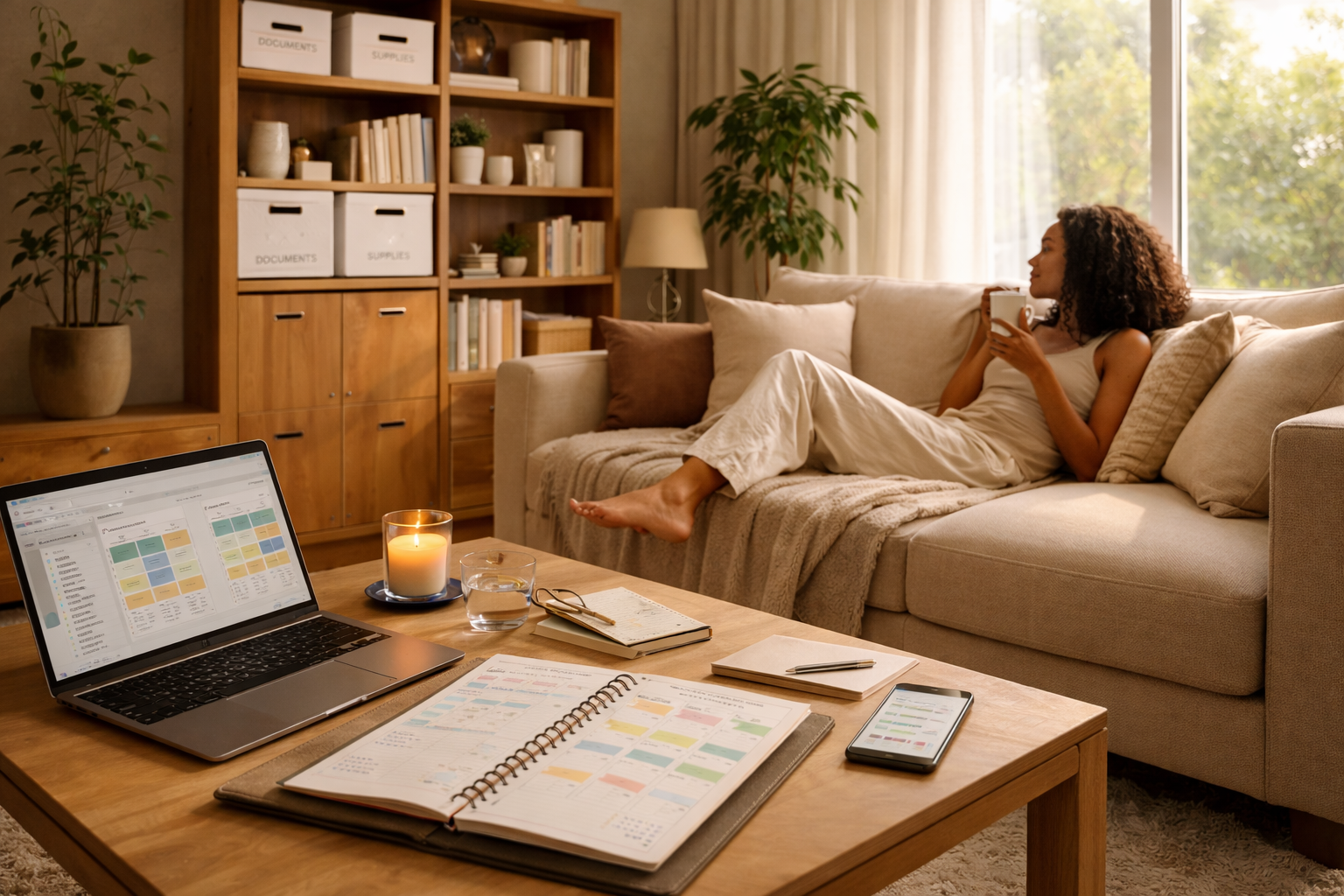
Soft life systems are what people ignore when they talk about ease.
Right now, everybody is chasing the soft life. Clean counters. White sheets. Oat milk. Candles. Calm.
However, what you are looking at is not ease. It is infrastructure.
Still, people keep trying to copy the look without building the foundation. They want the outcome, but almost nobody wants the maintenance plan.
The Aesthetic vs. The System
Softness photographs well because structure does not.
On the surface, you see serenity. In reality, you do not see the shared calendar eliminating chaos.
Likewise, you see silence. What remains hidden are the boundaries protecting it.
And yes, you see empty space. What you miss are the decisions that cleared it.
As a result, most people chase the look of peace instead of the architecture behind it.
Who Actually Affords Ease
Ease is not a mood. Instead, it is logistics.
People who sustain comfort are not guessing their way through the day. Instead, they control their time, reduce decisions, and design routines that do not require recovery.
To be clear, this is not only about money. It is about control.
At the same time, financial instability makes softness harder to maintain. Pew Research shows that many adults still rely on financial support, which explains why the appearance of ease often outruns the systems behind it. Pew Research Center lifestyle data
Ultimately, ease costs systems, not slogans.
Discipline Hiding Behind Soft Life Systems
Behind the aesthetic, the soft life depends on systems most people avoid:
- Budgets that remove financial noise
- Calendars that protect time and energy
- Boundaries that require enforcement
- Emotional regulation that filters outside chaos
Admittedly, none of this performs well online.
Even so, all of it is required.
Without systems, softness does not last.
The Cost of Performing Softness
Trying to look calm while living chaotic is expensive.
Over time, that pressure shows up as debt behind curated routines, burnout behind controlled aesthetics, and anxiety behind forced affirmations.
In other words, performing ease without structure becomes delayed pressure.
The Illusion Market
Platforms sell outcomes, not systems.
Because of that, you are shown results instead of requirements.
Consequently, people chase softness while still living in instability.
They want peace without planning.
They want comfort without control.
They want calm without structure.
However, it does not work that way.
If the system is not built, the lifestyle will not hold.
Real talk: Soft is not fragile. It is fortified.
If you are not building systems, you are not building ease.
You are borrowing it.
