
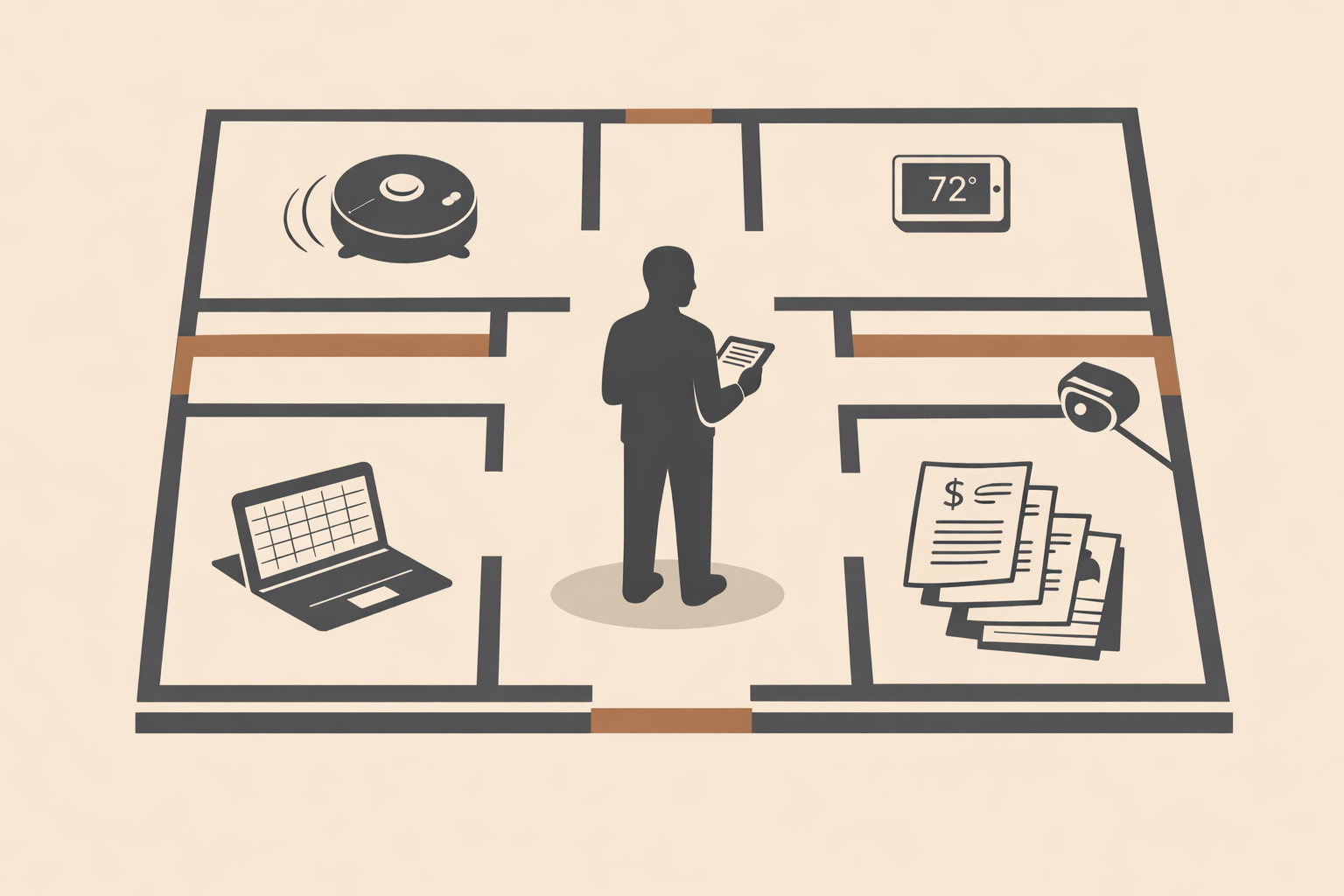
The stay at home parent systems manager is not a cultural myth. It is an economic reality shaped by home automation, subscription infrastructure, and disciplined household operations.
Many people argue whether stay-at-home parenting is easier today than it was decades ago. However, that comparison usually confuses physical strain with structural complexity.
Instead, approach this as an operations problem: how has household infrastructure changed the economics of domestic labor, and what happens to the time automation gives back?
Stay at Home Parent Systems Manager: The Structural Shift
Decades ago, domestic work carried heavy friction. Laundry required more manual handling. Many homes washed dishes by hand. Meal preparation consumed more hours. Paying bills required physical presence. Temperature control remained manual. Information moved slowly. Child supervision required proximity.
Then appliances compressed physical labor. Washing machines, dishwashers, microwaves, and central heating reduced effort. As a result, families reclaimed energy and hours.
Now digital automation compresses friction again.
- Robot vacuums reduce cleaning cycles.
- Smart thermostats optimize heating and cooling.
- Auto bill pay removes administrative delays.
- Grocery delivery reduces logistical overhead.
- Shared digital calendars align schedules.
- Home cameras support remote oversight.
- AI planning tools assist organization.
Domestic labor did not disappear. It evolved. The modern stay at home parent systems manager now oversees systems rather than repeating manual routines.
Stay at Home Parent Systems Manager Skills: Configuration Over Repetition
Home automation does not eliminate responsibility. It changes the discipline required to manage responsibility.
In practice, the work shifts toward configuration: subscription management, security controls, scheduling architecture, device permissions, and information filtering. Meanwhile, the home increasingly resembles a small operations center.
Stay at Home Parent Systems Manager Economics: Capital Allocation
Every automation decision carries cost. Devices require upfront capital. Subscriptions add recurring expense. Delivery services increase monthly burn. Setup and maintenance consume time.
Therefore, evaluate automation using arithmetic:
Upfront Cost + Recurring Subscription + Maintenance
versus
Hours Reclaimed × Economic Value Per Hour
If reclaimed time is not assigned to measurable outcomes, the system becomes convenience rather than infrastructure.
Efficiency remains neutral. Allocation determines outcome.
Stay at Home Parent Systems Manager Time Strategy
Time saved can compound. It can also dissolve.
For example, reclaimed hours can support:
- Income generation
- Skill acquisition
- Health investment
- Deeper child engagement
Conversely, those same hours can drift into passive consumption. That drift feels harmless yet erodes long-term stability.
Automation and Cognitive Load
The first compression wave reduced physical strain. The second wave reduces decision friction. However, more tools introduce more oversight requirements.
- More dashboards.
- More passwords.
- More updates.
- More notifications.
A stay at home parent systems manager must actively manage risk, subscriptions, and time allocation. Without measurement, the system controls the household rather than the household controlling the system.
Review domestic labor benchmarks using the Bureau of Labor Statistics Time Use Survey.
Audit subscriptions quarterly. Track reclaimed hours. Assign surplus time deliberately. Automation without allocation becomes lifestyle inflation.
The Bottom Line.
Home automation reduces friction. It does not reduce responsibility.
The stay at home parent systems manager now manages leverage instead of labor.
Families that apply arithmetic convert efficiency into stability. Families that chase comfort experience smoother days without structural progress.
