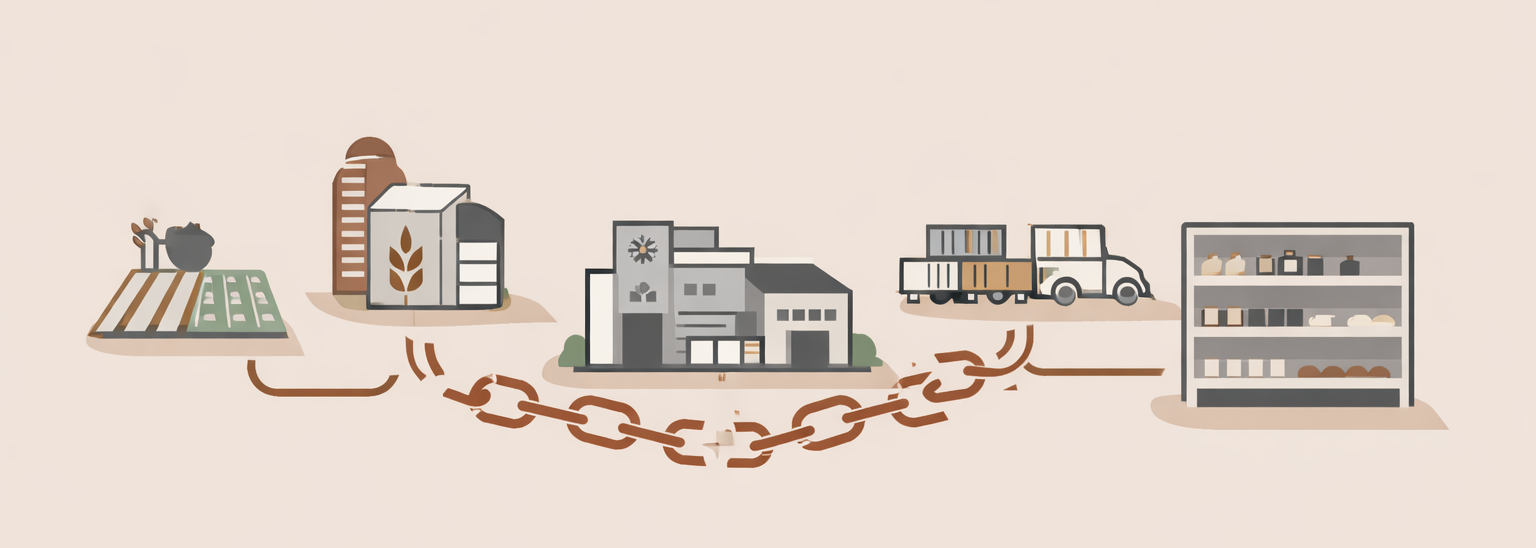
Why food shortages happen is easier to understand when the supply chain becomes visible. In many cases, farms produce enough food, but storage delays, transportation bottlenecks, labor shortages, and distribution failures prevent that food from reaching grocery shelves on time.
That is the part most people never see.
Food systems do not fail only at the point of production. They also fail in processing plants, trucking networks, warehouses, ports, and store delivery schedules. When those systems slow down, local shortages appear even while food remains available elsewhere in the network.
Why Food Shortages Happen Even When Farms Produce Enough
Production and distribution are not the same thing. Farms can produce large harvests, but people still experience shortages when the systems that move food break down. That is one of the clearest answers to why food shortages happen in modern economies.
Once food leaves the farm, it has to move through processors, cold storage sites, freight systems, and retail distribution channels. Each step depends on timing, energy, labor, and infrastructure. If one part stalls, the entire chain begins to tighten.
Distribution Failure Creates the Illusion of Scarcity
Food shortages often look like scarcity, but the deeper problem is access. A city can have empty shelves while warehouses elsewhere still hold supply. A region can produce enough crops while transport delays prevent delivery. In other words, abundance can still look like shortage when distribution fails.
This is why local shortages do not always mean the broader system ran out of food. They often mean the system could not move food where it needed to go fast enough.
Transportation and Storage Are Hidden Pressure Points
Truck capacity, fuel costs, refrigeration, rail movement, and warehouse timing all shape food availability. A delay in one part of the network can create pressure everywhere else. Perishable goods are especially vulnerable because they depend on precise scheduling and temperature control.
If trucks arrive late, shelves may not be restocked. If storage systems back up, products may spoil. If freight costs rise, smaller stores may struggle to replenish inventory quickly. These are logistics problems, but they become household problems very quickly.
Food Security Depends on Infrastructure
Food security is not only about farming. It is also about infrastructure. Strong logistics systems turn agricultural output into everyday access. Weak logistics systems turn routine disruptions into visible shortages.
That is why food security depends on more than fields and harvests. It depends on roads, fuel, labor, refrigeration, processing capacity, and distribution planning working together without major interruption.
The Grocery Shelf Reveals the System
By the time a shortage appears on a shelf, the problem usually started much earlier. The shelf is simply where the supply chain becomes visible to the public.
Understanding why food shortages happen helps make the economy easier to read. It also shows why stable infrastructure matters so much. When the system works, food moves quietly. When it strains, the shortage becomes public.
The shelf may look simple. The system behind it is not.