
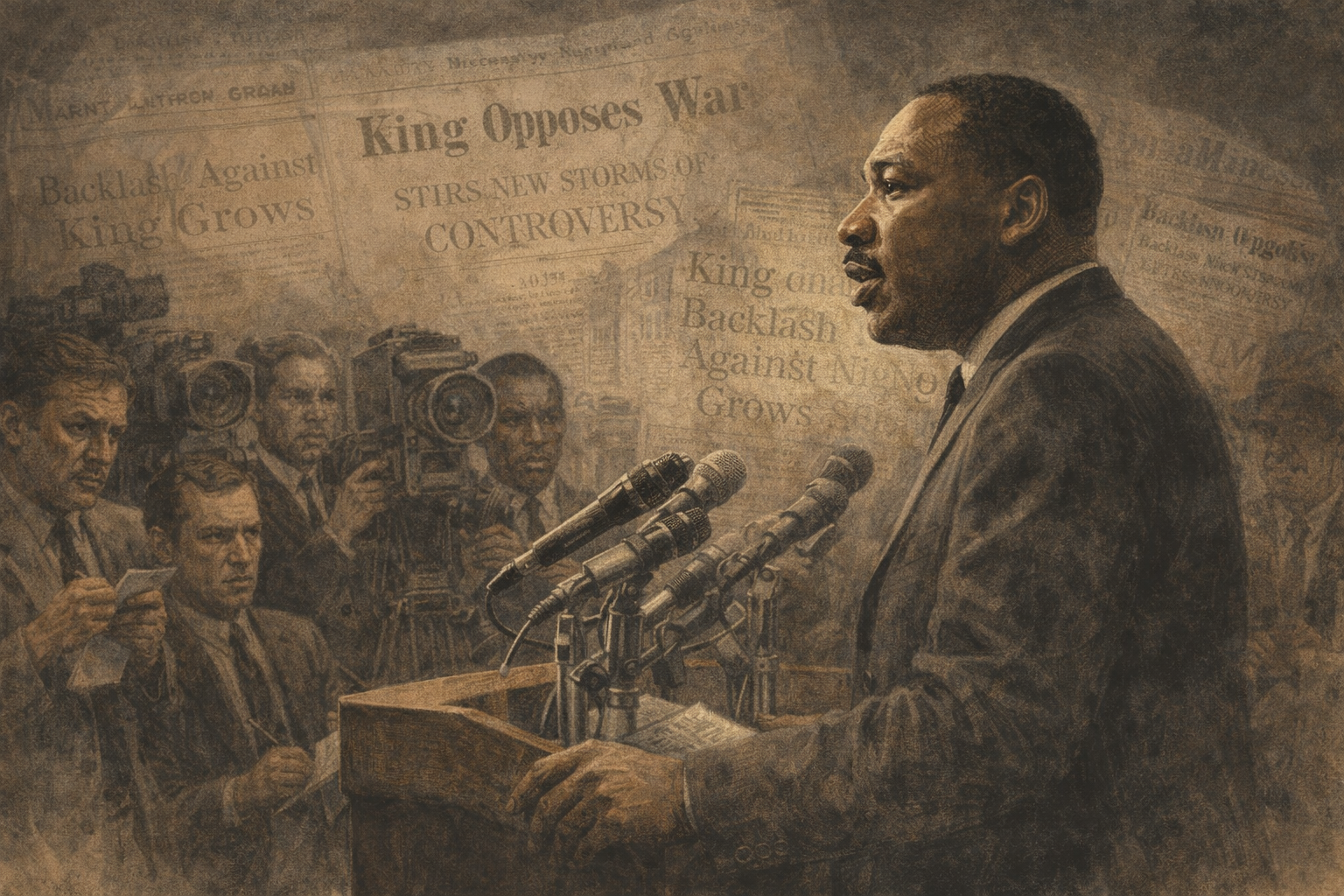
After the Civil Rights Act, Martin Luther King Jr. began confronting war, poverty, and economic inequality. The shift triggered intense media and political backlash.
The question of why MLK became controversial after 1965 is often missing from simplified versions of civil rights history.
By the mid-1960s, King had already helped win passage of the Civil Rights Act of 1964 and the Voting Rights Act of 1965. In popular memory, that is where the story often pauses. A moral leader confronts injustice, the nation listens, laws change.
History did not actually unfold that neatly.
After 1965, King expanded his criticism beyond legal segregation. He began speaking more directly about economic inequality, systemic poverty, and the Vietnam War. Those positions put him in conflict with powerful politicians, media institutions, and segments of the public that had previously tolerated his activism.
Understanding that shift requires looking at the economic arguments he began raising during this period, including the question of whether capital had to come before equality.
Why MLK Became Controversial After 1965
King did not stop after the major civil rights legislation passed. Instead, he expanded his critique. He began arguing that civil rights victories meant little if millions of Americans remained trapped in poverty.
He warned that legal equality without economic stability could leave people with rights on paper but few real opportunities in practice.
That argument pushed the movement into new territory, from civil rights reform into deeper questions about economic structure and national priorities.
The Turning Point After 1965
In 1967, King delivered one of the most controversial speeches of his life at Riverside Church in New York City. The speech, titled Beyond Vietnam: A Time to Break Silence, condemned the Vietnam War and criticized the United States for pouring money into war while neglecting social investment at home.
King argued that war abroad and poverty at home were connected.
He described what he called the “giant triplets”: racism, militarism, and economic exploitation.
This was not a modest expansion of the civil rights conversation. It challenged the political consensus of the time. Many supporters wanted the movement to stay focused on desegregation and voting rights. King was now criticizing foreign policy and calling for a broader restructuring of national priorities.
The backlash came quickly.
Media Backlash
Major newspapers that had previously praised King began openly criticizing him.
A 1967 editorial in The Washington Post described his antiwar speech as a serious mistake that could damage the civil rights movement. The New York Times also criticized his position, arguing that linking civil rights activism to opposition to the Vietnam War weakened his influence.
Television commentators and political figures echoed similar criticisms.
Instead of being framed primarily as a moral reformer, King increasingly appeared in headlines as a divisive public figure who had stepped outside what many elites considered acceptable.
The Poor People’s Campaign
King’s final major initiative intensified the backlash even further.
In 1968 he helped organize the Poor People’s Campaign, a national effort designed to demand economic rights for poor Americans of every race. The plan was to bring thousands of poor citizens to Washington, D.C., to demand jobs programs, fair wages, housing support, and structural economic reforms.
The movement represented a major shift. Earlier civil rights campaigns had targeted discriminatory laws. The Poor People’s Campaign targeted economic justice itself and how wealth, opportunity, and security were distributed in the United States.
You can explore the full history of that movement in The Poor People’s Campaign Explained.
Public Opinion Turned
By the late 1960s, King’s approval ratings had fallen sharply.
A 1966 Gallup poll found that nearly two-thirds of Americans viewed him unfavorably. Some opposition came from Americans who had always opposed civil rights activism. But criticism also came from moderates who believed King had moved too far into economic and foreign policy debates.
The version of King as a widely embraced national figure emerged largely after his assassination.
During his lifetime, his expanding agenda made him one of the most controversial public figures in the United States.
Why His Influence Grew Anyway
Despite the backlash, King’s later work reshaped the long-term conversation about civil rights.
By linking civil rights to economic justice and antiwar activism, he framed inequality as a structural problem rather than a purely legal one. That framework influenced later debates about poverty policy, labor rights, and access to opportunity.
Many scholars now view King’s final years as the period when his thinking became more systemic and more politically demanding.
The irony is clear. The same ideas that made him controversial in the late 1960s are part of what makes his legacy more powerful today.
King did not become controversial because his principles changed.
He became controversial because he applied those principles to larger systems of power.
