Communication in practice begins when words stop being the entire measure of communication. Tone, timing, silence, follow-through, repair, and repeated behavior all tell the other person whether clarity can be trusted.

Two people can talk every day and still build a relationship on assumptions.
Conversation is not the same as communication.
Communication becomes structural when what is said can be understood, questioned, corrected, remembered, and eventually reflected in behavior.
That distinction matters because relationships rarely struggle from a complete absence of words. More often, they struggle because the words and the operating reality stop matching.
One person thinks something was settled. The other thinks it was merely discussed. One thinks silence means space. The other experiences it as withdrawal. One believes an apology closed the issue. The other is waiting for the behavior to change.
So the governing question is larger than Are we talking? The better question is: Does the way we communicate help the relationship function?
Communication is not complete when something has been said. It is complete when enough clarity exists for both people to know what happens next.
Communication in Practice Is Not Just Talking
Many people speak often and still remain misunderstood.
Someone can explain a position clearly in their own mind and still leave the other person confused, guarded, or hurt.
Healthy communication therefore asks for more than expression. It asks for timing, tone, patience, humility, and accuracy.
The words matter, but they are not the whole message.
Behavior Communicates Too
Posture communicates. Silence communicates. Delay communicates. Repetition communicates. Avoidance communicates.
Follow-through may communicate more than all of them.
Two people can care deeply for each other and still miss each other if they never learn how to translate care into clarity.
Love does not remove the need for communication. It raises the standard for it.
Listening Beyond Language
I’ve learned that communication is less about speech and more about spirit. Sometimes tone says what words forget. A short answer can carry exhaustion. Silence is not always rejection. Sometimes it is someone trying not to say the wrong thing while still feeling everything.
I had to learn to slow down enough to hear what was meant, not just what was said. That takes grace. It also takes humility.
It is easy to hear a sentence and build a whole courtroom around it. It is harder to pause and ask, “Did you mean this?” before deciding what someone’s heart was doing.
Listening Creates Room for Truth
Good communication is a practice of awareness. It invites patience without demanding perfection.
It also asks both people to remember they are teammates, not opponents. That reminder matters most when emotions rise. A teammate does not collect evidence simply to win. A teammate listens for what needs repair.
People rarely remember every sentence. They remember whether they felt safe while hearing it. They remember whether their truth was received gently or turned against them later.
They also remember whether honesty made the relationship stronger or made them regret opening their mouth.
Listening tells another person that honesty has somewhere safe to land.
Clarity Is a Responsibility
Being calm does not automatically mean you are communicating well.
You can lower your voice, choose your words carefully, and still leave the other person carrying the entire burden of figuring out what you mean.
That is not clarity.
Clarity is a responsibility.
If you expect somebody to build a life with you, you cannot make that person live on inference. Needs have to be named. Expectations have to be discussed. Changes have to be explained instead of quietly introduced and left for the other person to discover.
Silence Needs a Purpose
Sometimes the responsible move is to speak.
At other times, the responsible move is to wait until you can speak without turning frustration into damage.
The distinction matters because silence can be self-command, but silence can also become avoidance.
A pause should have a purpose and a return.
The Conversation Has to Produce Something
Once both people understand that a problem exists, conversation cannot become a substitute for fixing it.
If the same issue keeps getting discussed but nothing changes afterward, the relationship is not communicating its way forward.
It is documenting a pattern.
That is where accountability enters the structure.
If I say I understand what hurt you, behavior should eventually provide evidence that I understood. If I ask you to trust me, consistency has to carry some of that weight. If we agree something needs to change, something has to change.
Words matter. Over time, behavior becomes the louder language.
A Household Cannot Run on Mind Reading
This becomes even more important when two people are trying to build something durable.
A household cannot run on mind reading. A partnership cannot run on unspoken expectations. A family cannot keep absorbing the cost of conversations that never become decisions.
The goal is not to win the argument.
The goal is to protect the structure.
The Four Layers of Communication in Practice
Without structure, disagreement becomes crowded.
People argue over the event, the meaning attached to it, the emotion it created, and what should happen next, all at the same time.
Separating those layers makes the conversation easier to examine.
Observation
What actually happened? Start with the plain record before adding motive, accusation, or fear. “You came home later than we discussed” creates more room for clarity than “You do not care about my time.”
Interpretation
What meaning did I attach to it? One person may interpret lateness as disrespect. The other may see exhaustion, traffic, or poor planning. Until meaning is named, people can argue about different problems.
Emotion
What did I actually feel? Hurt, fear, disappointment, embarrassment, or loneliness give the other person something clearer to understand than accusation or character judgment.
Request
What needs to happen going forward? A specific request turns emotion into direction. “Please text me if you are running late” gives the relationship something more useful to practice than “You need to do better.”
These layers do not make every conversation easy. They make the conversation more workable by separating what happened from what it meant, what it stirred up, and what needs to change.
Building a Communication Rhythm
Our perspectives meet on one point: communication needs a rhythm strong enough to survive ordinary life.
Some days one person leads and the other listens. Sometimes the conversation needs time before an answer is ready. At other moments, the issue needs to be named immediately because delay would only allow assumption to grow.
The work is learning the difference.
Rhythm Needs Guardrails
A healthy communication rhythm does not demand constant access or immediate resolution.
Instead, it gives both people enough structure to know that difficult conversations will not simply disappear.
Silence should not become punishment. Words should not become pressure. Distance should not become manipulation. Closeness should not become control.
When frustration comes, one reminder can change the direction of the room: we are on the same team.
That sentence does not solve the disagreement. It establishes the operating condition under which the disagreement should be solved.
Repair Matters More Than Perfect Communication
Every relationship will experience missed signals.
Someone will speak too quickly. Someone will withdraw. A sentence will land differently than intended. Old experience will occasionally enter a new conversation before either person notices.
The structural question is not whether those moments occur.
It is whether repair has somewhere to land.
Repair Changes What Happens Next
“Let me try that again.”
“I heard you, but I responded poorly.”
“I was defensive.”
“That came out harsher than I intended.”
“Can we slow this down?”
Those statements matter because they interrupt escalation.
Still, repair cannot end with language alone. An apology addresses the moment. Correction addresses the pattern.
Durable repair should leave some evidence in what happens next.
Grace and Accountability Need Each Other
Grace without accountability can become avoidance.
Accountability without grace can become judgment.
Healthy communication needs both.
Grace Protects Dignity
Grace says a person is larger than one mistake.
It leaves room for context, learning, correction, and growth.
But grace cannot require pretending the pattern does not exist.
Accountability Protects the Standard
Accountability says the mistake still matters.
It asks whether responsibility was accepted and whether behavior changed.
When one person falls short, the objective is not to permanently establish who was right.
The objective is to restore respect without hiding what needs correction.
Communication Is Household Infrastructure
Every durable system depends on information moving clearly.
Families are no exception.
A relationship has values, routines, expectations, responsibilities, decisions, schedules, money, commitments, and boundaries.
If those things are never named, the household runs on assumption.
Assumption may survive an easy season.
Pressure exposes it.
The Kitchen Table Is an Operating Space
Think about the ordinary table where schedules are compared, bills are discussed, plans change, family needs surface, and somebody finally mentions the thing that has been bothering them for three days.
That table is not merely furniture.
It is one of the places where family structure gets maintained.
Clear communication helps determine how decisions are made, how responsibilities move, how disappointment is processed, and how repair begins.
Communication builds more than romance. It builds household capacity.
What Healthy Communication Requires
Patience
Patience gives understanding time to form. It does not mean tolerating neglect. It means refusing to rush meaning before the truth has room to appear.
Emotional Accuracy
Anger may be covering fear. Distance may be covering embarrassment. Criticism may be covering disappointment or a need for reassurance.
When the wrong problem is named, the wrong problem gets solved.
Timing
Truth delivered at the wrong moment can still create unnecessary damage.
A serious conversation needs enough space for both people to be present.
Mutual Responsibility
One person cannot always initiate, translate, soften, organize, remember, and repair.
Shared communication means both people carry some responsibility for keeping information moving.
Follow-Through
Words lose weight when nothing changes after them.
Follow-through turns conversation into evidence.
The Weekly Communication Check-In
A relationship should not need a crisis before it receives focused attention.
A short weekly check-in creates a regular place for information to surface before small problems harden into stories.
- What felt good between us this week?
- Where did we miss each other?
- Is there anything we are avoiding?
- What do you need more of from me?
- What should we carry into next week?
This does not need to become a formal performance review.
Ten honest minutes at the kitchen table can be enough.
The value is repetition. When honesty has a regular place to go, every concern does not need to become an emergency before it receives attention.
Maintenance makes repair less dramatic because the system is inspected before something breaks.
Inspect the Communication System
Love is not sustained by perfect conversations.
It is sustained by a communication system that can survive imperfect ones.
That system needs room for truth, restraint, questions, correction, accountability, grace, and return.
More importantly, it needs evidence that important conversations affect what happens afterward.
Questions to Carry Forward
- Do I listen to understand, or mostly listen for the point I want to answer?
- What assumptions am I making that could be replaced by one direct question?
- Which conversation keeps returning because behavior never changed?
- Does silence in this relationship create useful space or unnecessary uncertainty?
- Is one person carrying most of the work of initiating and repairing communication?
- What is one communication practice we can put on the calendar before another problem forces the conversation?
Listen with care. Speak with structure. Repair with humility. Then let behavior prove that the conversation mattered.
For research and practical perspectives on communication, empathy, emotional regulation, social connection, and healthy relationships, explore the Greater Good Science Center at UC Berkeley .
Continue the Building the Foundation Series
Read the companion perspectives, continue to the series wrap, or explore the larger Legacy In Motion collection.
Explore communication, expectations, safety, responsibility, and trust from another side of the relationship.
Companion Perspective From a Man’s PerspectiveExamine self-command, provision, accountability, leadership, communication, and masculine responsibility in partnership.
Series Wrap The Foundation We Build TogetherBring structure, compatibility, power, space, interdependence, perspective, communication, and repair into one shared framework.
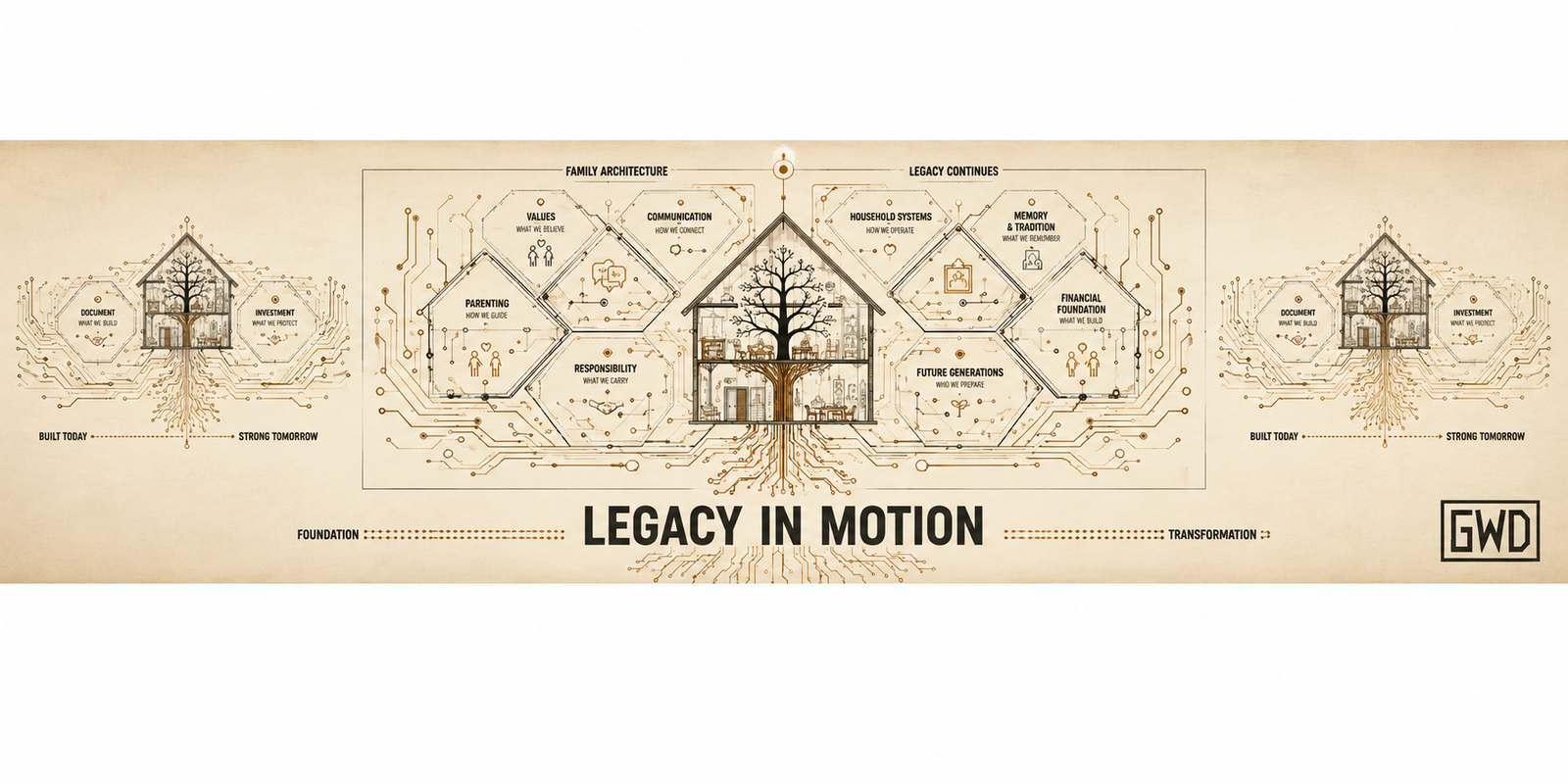
Series Hub Legacy In MotionExplore relationships, family structure, responsibility, communication, parenting, household systems, and generational continuity.
N. Grace James
Relationships, reflection, and lived perspective
N. Grace James contributes reflective perspective to Groundwork Daily’s work on relationships, communication, emotional maturity, and the lived experience of partnership.