Building healthy relationships takes more than love, chemistry, or good intentions. It requires structure strong enough to carry trust, responsibility, conflict, individuality, repair, and the ordinary pressure of a shared life.

This is where the blueprint comes back into view.
The series began with structure because a relationship cannot survive on feeling alone. It needs language, expectations, boundaries, rhythm, accountability, and a way to repair what pressure exposes.
From there, the work became more demanding.
Dating had to produce evidence. Compatibility had to be tested against real life. Power had to remain negotiable. Space had to create clarity instead of punishment. Interdependence had to increase shared capacity without erasing individuality.
Perspective then complicated the structure in a useful way.
Building healthy relationships means accepting that the same partnership can look different from opposite sides of the table. Communication therefore cannot simply mean speaking more. It has to become a system for keeping reality visible to both people.
The foundation is not one thing. It is the relationship between all the things that must keep working together.
Building Healthy Relationships Requires More Than One Strength
No single quality carries a relationship by itself.
Trust matters, but trust without communication can become assumption.
Love matters, but love without structure can become confusion.
Compatibility matters, but compatibility without repair can collapse under conflict.
The Parts Have to Reinforce Each Other
Independence matters, but independence without interdependence can leave two people living parallel lives.
Communication matters, but communication without accountability becomes conversation without correction.
Grace matters, but grace without boundaries can become permission for the same harm to repeat.
The foundation works because the parts reinforce one another.
Ten Layers for Building Healthy Relationships
Each entry addressed a different layer of the same relationship architecture.
Structure
Love Starts With Structure established the operating conditions: clarity, expectations, boundaries, cadence, and intention.
Evidence
Dating With Purpose, On Purpose asked what words, patterns, pressure, capacity, and time actually reveal.
Compatibility
What Makes Us Compatible moved beyond chemistry and asked whether two lives can actually fit.
Power
The Power Struggle examined influence, control, boundaries, decision-making, and repair.
Space
Knowing When Space Is Needed distinguished regulation from withdrawal and healthy space from punishment.
Interdependence
Appreciating Interdependence examined how support, responsibility, individuality, and shared capacity move through partnership.
Perspective
From a Woman’s Perspective explored how partnership, safety, expectations, communication, and responsibility can feel different depending on where someone stands inside the relationship.
Communication
Communication in Practice turned communication from an abstract virtue into a repeatable maintenance system.
Masculine Responsibility
From a Man’s Perspective examined self-command, provision, protection, leadership, accountability, and repair through a masculine lens.
Shared Foundation
This final entry brings those systems together and asks whether the whole structure can carry real life.
Building Healthy Relationships Means Building for Pressure
A relationship can look strong when both people are rested, money is stable, nobody is sick, the calendar is manageable, and the future feels predictable.
That is not the only test.
Structures reveal themselves under load.
Real Life Changes the Load
Work gets difficult. Parents age. Children need more. Money tightens. Bodies change. Grief arrives.
Somebody makes a mistake. Somebody loses patience. Plans stop matching reality.
At that point, the question becomes whether the relationship has enough structure to adapt without turning every disruption into collapse.
Durability is not avoiding pressure. It is knowing what the structure does when pressure arrives.
Building Healthy Relationships Requires Routine Maintenance
Most systems do not fail because nobody ever cared.
Instead, they often weaken because small problems stay unaddressed long enough to become normal.
Expectations stop being updated. Roles become outdated. Resentment becomes routine. Communication only happens after something goes wrong.
Maintenance interrupts that drift.
Build Checkpoints Before Crisis Creates Them
- What feels strong right now?
- What feels heavier than it did three months ago?
- Are our roles still fair for the life we have now?
- Is there a recurring conflict we keep ending without actually repairing?
- What are we assuming instead of discussing?
- What should we simplify before we ask either person to carry more?
Maintenance is not evidence that a relationship is weak. Rather, it is evidence that the relationship matters enough to inspect.
Healthy Relationships Need a Repair System
No relationship gets every conversation right.
People miss signals, speak too quickly, misunderstand, fail to follow through, and become defensive.
Therefore, the important question is what the system does with error.
Progress Requires Feedback
Does pride prevent correction? Does somebody have to pretend nothing happened?
Does the same failure keep returning because an apology ended the conversation before the pattern actually changed?
A healthy foundation does not eliminate mistakes. It makes mistakes easier to identify, discuss, repair, and learn from.
The goal is not to build a relationship that never needs repair. It is to build one that knows how to repair without losing itself.
The Building Healthy Relationships Foundation Test
The series ultimately comes down to whether the structure makes both people more capable of building a stable shared life.
-
Do we know what we are building?
Shared direction reduces confusion about what the relationship is expected to carry. -
Can both people remain visible inside the structure?
Partnership should create connection without erasing individuality. -
Can we disagree without making the relationship unsafe?
Conflict should not require humiliation, control, retaliation, or fear. -
Does responsibility move when capacity changes?
Strong systems adapt when life redistributes the load. -
Can we hear correction?
Feedback has to be possible if repair is going to become real. -
Do our words and systems match?
Love, trust, fairness, support, and responsibility should be visible in how daily life actually operates. -
Are we stronger because we built together?
The relationship should increase shared capacity without steadily reducing either person’s dignity, agency, or growth.
Building Healthy Relationships Happens on Ordinary Days
Most legacy is not created in dramatic moments.
It is created through repetition.
You see it in how people speak when tired, whether commitments are kept, and how money is discussed.
It also appears in who notices invisible work, whether correction is possible, and whether power remains negotiable.
Ordinary Behavior Becomes the Culture
A hard season may create teamwork or expose permanent imbalance.
A missed commitment may become a repair point or another layer of resentment.
Small decisions accumulate.
Eventually, what two people repeat becomes the relationship they live inside.
The Foundation Is the System You Keep Choosing
The foundation is not the photograph, the announcement, or the promise.
Instead, it is the structure beneath those things.
It is how two people speak when tired. It is whether promises become behavior. It is how responsibility moves when one person’s capacity changes.
It is whether disagreement remains safe and whether repair changes what comes next.
Most importantly, it is what happens when nobody is performing for an audience.
The foundation is the system two people keep choosing when nobody is watching.
Five Questions to Leave With
- What are we building beyond the feeling of being together?
- Which part of our structure is strongest right now?
- Which part needs maintenance before pressure exposes it?
- What are we willing to change instead of merely discuss?
- What will our ordinary habits teach the people who come after us about partnership?
Build Something That Can Carry More Than the Moment
Love can begin with attraction.
A life together requires more.
It requires structure strong enough to carry money, family, disagreement, responsibility, changing roles, outside pressure, individual growth, and the weight of time.
That is why this series was never only about relationships.
It is about what two people repeatedly build between them, what that structure teaches the household around them, and what eventually becomes durable enough to pass forward.
For research and practical perspectives on communication, empathy, emotional regulation, social connection, and healthy relationships, explore the Greater Good Science Center at UC Berkeley .
Building the Foundation
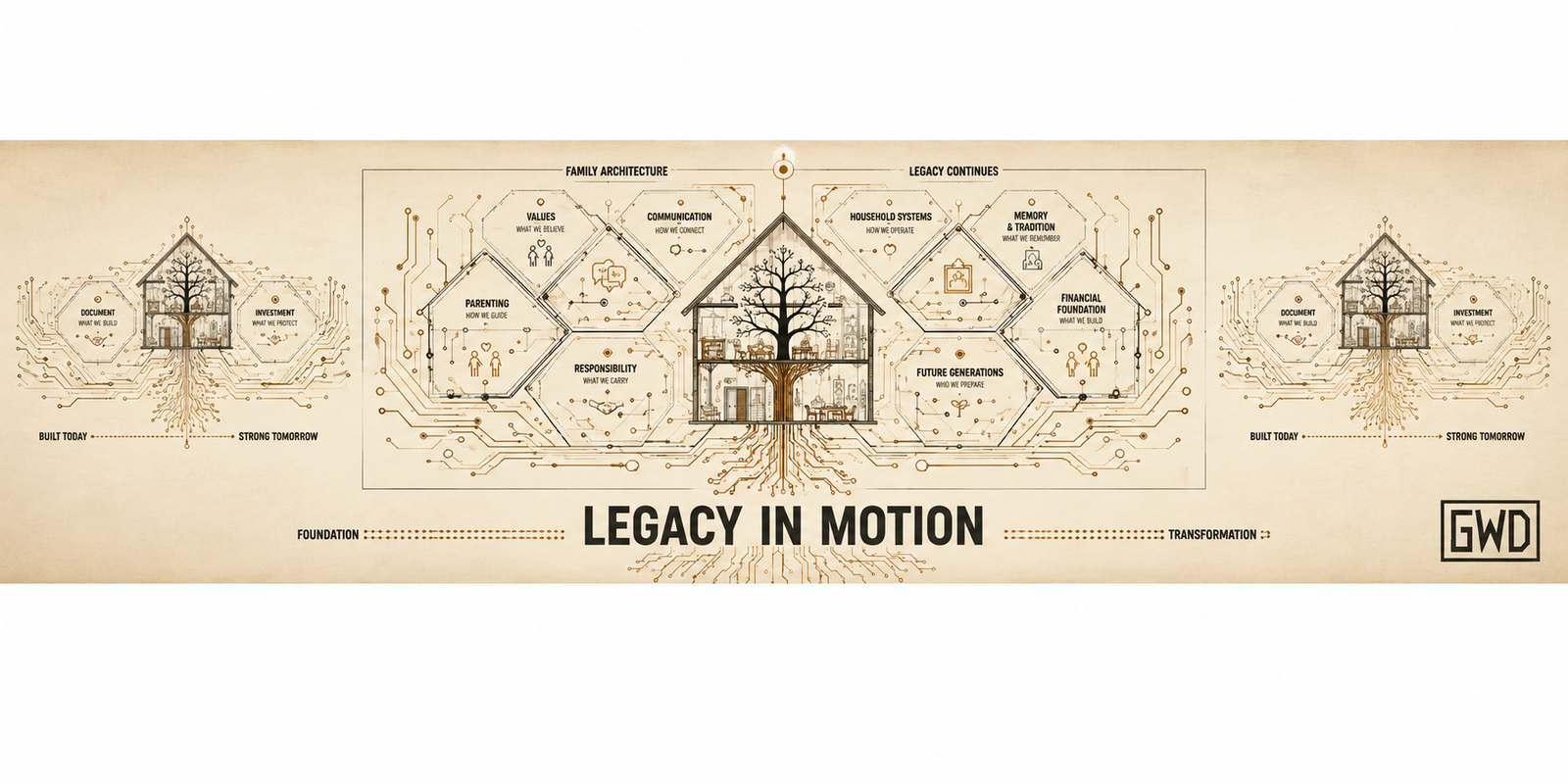
Return to any layer of the framework or continue into the larger Legacy In Motion collection.
Legacy In Motion
Building the Foundation is one layer of a larger body of work on relationships, household systems, responsibility, family structure, parenting, and generational continuity.
N. Grace James
Relationships, reflection, and lived perspective
N. Grace James contributes reflective perspective to Groundwork Daily’s work on relationships, communication, emotional maturity, and the lived experience of partnership.