You rarely lose an hour all at once. It usually leaves in fragments. A message gets checked before the work begins. A headline pulls you sideways. An unfinished thought asks to be solved immediately. Irritation from one conversation follows you into the next task. By the time you finally try to focus, your attention has already been divided among several things that never earned the right to be there.
That is the part most conversations about focus miss. They begin after the breach.
People talk about concentration as though the main challenge is holding attention once work begins. But attention has an earlier problem: deciding what is allowed to enter in the first place.
Every message, thought, emotion, request, memory, alert, and impulse can arrive. Arrival is unavoidable. Admission is not.
That distinction changes how mental discipline works. Instead of asking only, “How do I focus better?” a more useful question appears:
What keeps getting access to my attention without earning it?

Attention Usually Fails Before Discipline Does
People often interpret distraction as evidence that they lack discipline. That diagnosis is convenient because it puts the entire problem inside character. If you were stronger, more motivated, more serious, or more mature, perhaps you would simply concentrate.
But look at the system before judging the person.
The phone can interrupt at any moment. Email remains open. News is constantly refreshed. Multiple conversations are active. Work platforms generate alerts. Unfinished obligations remain mentally exposed. The mind is expected to move through all of this while preserving one clean line of thought.
Then, when the line breaks, the person blames concentration.
That is weak diagnosis.
A system with too many open entry points will spend increasing amounts of energy processing interruption. It has to notice the signal, determine whether it matters, decide whether to respond, suppress or redirect the impulse, and then reconstruct the task that existed before the interruption.
Sometimes the work itself is not what exhausts you. The repeated switching around the work does.
If every incoming signal is allowed to request an immediate decision, attention gets spent managing access before meaningful work even begins.
This is why discipline downstream can become expensive. The person keeps trying to force better output without changing the intake conditions that keep destabilizing the system.
The Attention Gate Has Three Separate Decisions
The gate metaphor becomes useful only if it explains something practical. Simply saying “protect your attention” is too vague. A functioning gate has to make distinctions.
The most important distinction is between arrival, admission, and authority.
A signal appears. You notice the message, thought, emotion, request, sound, alert, or concern.
You decide whether the signal deserves active attention now, later, or not at all.
You decide whether the admitted signal is allowed to change behavior, priority, or judgment.
These are not the same decision.
A message can arrive without being admitted. A feeling can be admitted without being given authority. A problem can deserve attention later without being permitted to reorganize the current hour.
That separation is mental governance.
Notice it.
Decide whether it enters.
Decide what power it gets.
Without those distinctions, everything collapses into one reaction. Something appears, therefore it must be processed. Something feels urgent, therefore it must be acted on. Something creates discomfort, therefore the current task must stop.
The gate disappears.
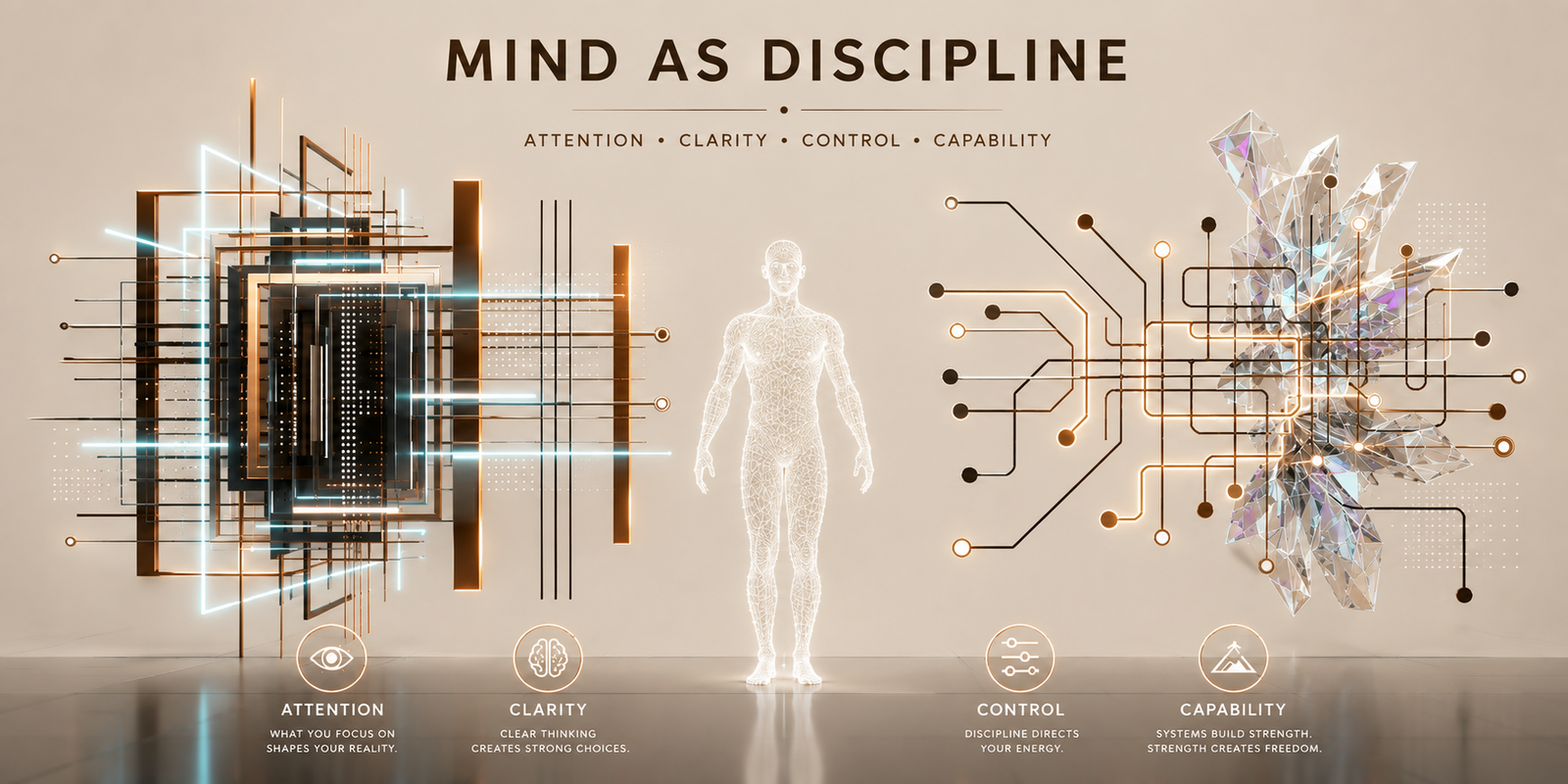
Mind as Discipline Starts With Admission Control
Attention discipline begins before the work session, before the timer, and before the productivity method. It begins with the conditions under which access is granted.
The mind cannot prevent every signal from appearing. Internal thoughts will surface. Other people will make requests. Devices will produce information. Emotions will change. The environment will remain imperfect.
Trying to eliminate arrival would require controlling life itself.
The stronger strategy is controlling admission.
This is where boundaries become operational rather than philosophical. A boundary around attention says that some things can exist without entering the current decision environment.
The email can exist unopened.
The message can wait unread.
The thought can be written down without being explored.
The emotion can be noticed without changing the plan.
The request can be legitimate and still receive an answer later.
That is not avoidance. Avoidance refuses necessary reality. Admission control decides when and how reality receives processing capacity.
The Three Attention Leaks That Keep the Gate Open
Attention rarely collapses because of one dramatic interruption. More often, it leaks through recurring permission structures. The same few patterns keep reopening the gate.
1. Open Intake
Open intake means too many systems have standing permission to interrupt. Messages, headlines, notifications, browser tabs, coworkers, group chats, email, internal reminders, and unfinished work all occupy the same field.
The problem is not simply volume. The deeper problem is that the system has no hierarchy.
When every signal can interrupt every task, the newest input gains an unfair advantage. Recency begins impersonating importance.
This is why the smallest alert can derail work that matters more. The alert does not need to be important. It only needs to arrive at the right moment and encounter an open gate.
A better system narrows the number of inputs with immediate access. Important communication remains available, but not every channel gets equal interruption rights.
2. False Urgency
False urgency is what happens when the mind starts treating immediacy as evidence of importance.
A request arrived now, so it feels as though it should be handled now. A message is unread, so leaving it unread feels irresponsible. An issue is emotionally charged, so delaying response feels dangerous.
But immediacy and importance are separate variables.
Some important things can wait an hour. Some urgent-looking things do not matter at all. A disciplined system needs enough separation to tell the difference.
Urgency should have to prove itself.
A signal does not become important merely because it arrived with speed, emotion, or a notification sound.
Once urgency stops receiving automatic authority, attention becomes less reactive. The mind is no longer reorganized around every incoming request.
3. Emotional Command
Emotion is one of the most powerful signals at the gate because it arrives from inside the system. There is no phone to silence and no tab to close.
Irritation can narrow attention around the source of irritation. Anxiety can keep scanning for what might go wrong. Boredom can make another input feel unusually attractive. Embarrassment can turn one awkward moment into a full internal investigation.
All of those signals may contain information. The problem begins when the signal receives automatic authority.
You can feel irritation without sending the message.
You can feel anxiety without abandoning the task.
You can feel boredom without opening another screen.
You can feel uncertainty without forcing an immediate decision.
The discipline is not emotional numbness. It is preserving enough space between feeling and action for judgment to remain involved.
The Gate Breaks When Different Signals Are Treated the Same
A useful attention system distinguishes among signals instead of using one universal response. Not everything needs suppression, and not everything needs engagement.
| Signal | Weak Default | Governed Response |
|---|---|---|
| Notification | Check immediately | Let the scheduled review window decide |
| New idea | Leave the task and explore it | Capture it, then return |
| Strong emotion | Act while intensity is high | Name it, then protect the decision |
| Someone else’s request | Reprioritize immediately | Evaluate actual urgency and responsibility |
| Unfinished obligation | Keep rehearsing it mentally | Place it in a trusted capture system |
| Boredom | Add stimulation | Stay with the chosen task long enough to recover depth |
This is what gate control looks like in practice. The signal is acknowledged, but acknowledgment does not automatically produce surrender.
Build Gate Rules Instead of Chasing Better Focus
People often try to improve attention with intensity. They promise themselves they will concentrate harder tomorrow. They download another timer, rearrange the desk, or start a new routine.
Some of those tools can help, but they are weaker than rules.
A rule removes negotiation before negotiation becomes expensive.
Use Closed Windows
A closed window means one defined task gets the primary access path for a bounded period. The goal is not artificial purity. The goal is to prevent unrelated inputs from continuously reopening the question of what you should be doing.
One task. One primary screen. One defined work interval. Other inputs wait unless they meet a real exception.
This works because attention no longer has to renegotiate priority every few minutes.
Create Timed Access for Recurring Inputs
Email, messages, news, administrative systems, and non-urgent updates do not require continuous access simply because continuous access is technically possible.
Set windows for them.
Once an input has a reliable future access point, the mind has less reason to keep checking whether something changed. The system knows when review will happen.
The principle is simple: availability does not have to mean immediacy.
Capture Without Following
Internal thoughts are harder because they do not respect schedules. An idea appears. A concern resurfaces. You remember something that needs to be done.
Trying not to think about it can create more friction than the thought itself.
A better move is capture.
Write the thought down. Put the task where you will see it. Record the question. Then return.
Capture tells the mind that the signal has not been lost without granting it immediate control of the present task.
Delay Authority During Emotional Peaks
Some moments are poor moments for expensive decisions. When anger, fear, embarrassment, or exhaustion is high, the system may still need to act, but it should be cautious about giving temporary intensity permanent authority.
A pause can be enough.
Do not solve the entire relationship tonight. Do not rewrite the strategy because one meeting went badly. Do not send the message simply because the response has already formed in your head.
The goal is not delay for its own sake. The goal is to restore enough cognitive room for the decision to become yours again.
Pressure Reveals Whether the Gate Was Real
Attention systems often look strong when the day is easy. The better test comes under load.
You slept poorly. The meeting ran long. A family issue appears. Work becomes more demanding. Something unexpected needs an answer. The clean morning plan starts taking pressure from several directions.
This is where ungoverned attention reverts to reaction.
When margin shrinks, whatever already had weak boundaries tends to break first. Notifications start getting checked more often. Small problems feel urgent. Emotional signals become harder to separate from instructions. The next action gets selected by pressure rather than priority.
That does not mean the gate failed because you are weak. It means the gate needs rules that can survive load.
A useful rule under pressure might be:
- No new commitments during overload. Capture the request and decide later.
- No high-cost messages while activated. Draft if needed, but delay sending.
- One recovery action before another input. Walk, breathe, drink water, close the screen, or reduce stimulation before opening something new.
- Return to one visible priority. When the day fractures, rebuild from one clear next action instead of trying to restore the entire plan at once.
This connects directly to Health as Discipline. Attention does not operate separately from physical capacity. Sleep loss, accumulated stress, poor recovery, and sustained load can reduce the margin available for clean cognitive control.
The gate still matters. But the gate also needs capacity behind it.
What Changes When Access Becomes Deliberate
The first change is not perfect concentration. It is reduced mental negotiation.
You spend less time deciding whether to check.
Less time deciding whether to respond.
Less time reconstructing what you were doing.
Less time allowing emotional intensity to rewrite a decision that was already clear.
The result is not a smaller life. It is a more legible one.
Some things remain outside because they do not matter. Some wait because they matter later. Some enter because they genuinely deserve the next unit of attention.
That creates a stronger relationship between attention and judgment.
You stop treating every signal as equal.
You stop confusing accessibility with obligation.
You stop assuming that what is loud must be important.
And you become more capable of deciding what gets through.
Run a Daily Attention Gate Audit
You do not need an elaborate productivity system to begin. You need to see where access is currently being granted without a decision.
Set one protected priority before opening external intake. Decide what deserves first access before messages, feeds, and requests begin competing for it.
Notice every unplanned entry. Ask whether the signal needs action now, later, or not at all.
Separate emotion from authority. Name what you are feeling before deciding what the feeling gets to change.
Check for gate drift. Identify which channels, people, thoughts, or systems have gained more access than they were supposed to have.
Close or capture open loops. Reduce the number of unresolved signals that will compete for tomorrow’s attention before the day begins.
The purpose of the audit is not perfection. It is visibility.
You cannot govern an access pattern you never notice.
Attention Control Is Part of a Larger Human System
The gate metaphor also explains why Mind as Discipline cannot stay isolated from the rest of Malik Rivers’ system.
Health as Discipline governs capacity. A depleted system has less reserve available to maintain boundaries under pressure.
Tech as Discipline governs delegation and technological authority. Digital systems increasingly decide which signals appear, how often they appear, what gets ranked first, and which forms of interruption become frictionless.
That means attention is not merely personal.
It is environmental.
It is physical.
It is technological.
And it still requires human governance.
Further Groundwork
Explore the full system of access, focus, margin, stress, adaptation, and reliable judgment.
Decision space matters because pressure becomes more powerful when reaction is immediate.
Useful constraints reduce unnecessary negotiation and protect capacity for higher-value choices.
Digital systems increasingly shape what reaches the gate before the user makes a conscious decision.
The Groundwork
You do not need to stop the world from producing signals.
You need a stronger distinction between what appears and what gets power.
The message can arrive without receiving the next ten minutes. The emotion can arrive without becoming the decision. The idea can arrive without dismantling the task already in front of you.
The gate works when attention remains capable of saying: I noticed you. You still do not get in yet.
Built by Malik Rivers
Malik Rivers is the Groundwork Daily builder for Education & Skills, examining disciplined thinking, physical capacity, learning, judgment, and intentional technology as parts of one governed human operating system.
His work connects three series: Mind governs access, Health governs capacity, and Tech governs delegation.
- Mind as Discipline — attention, cognitive margin, stress, adaptation, and reliable judgment.
- Health as Discipline — physical capacity, recovery, load, maintenance, and durability.
- Tech as Discipline — technology, automation, judgment, responsibility, and human authority.