
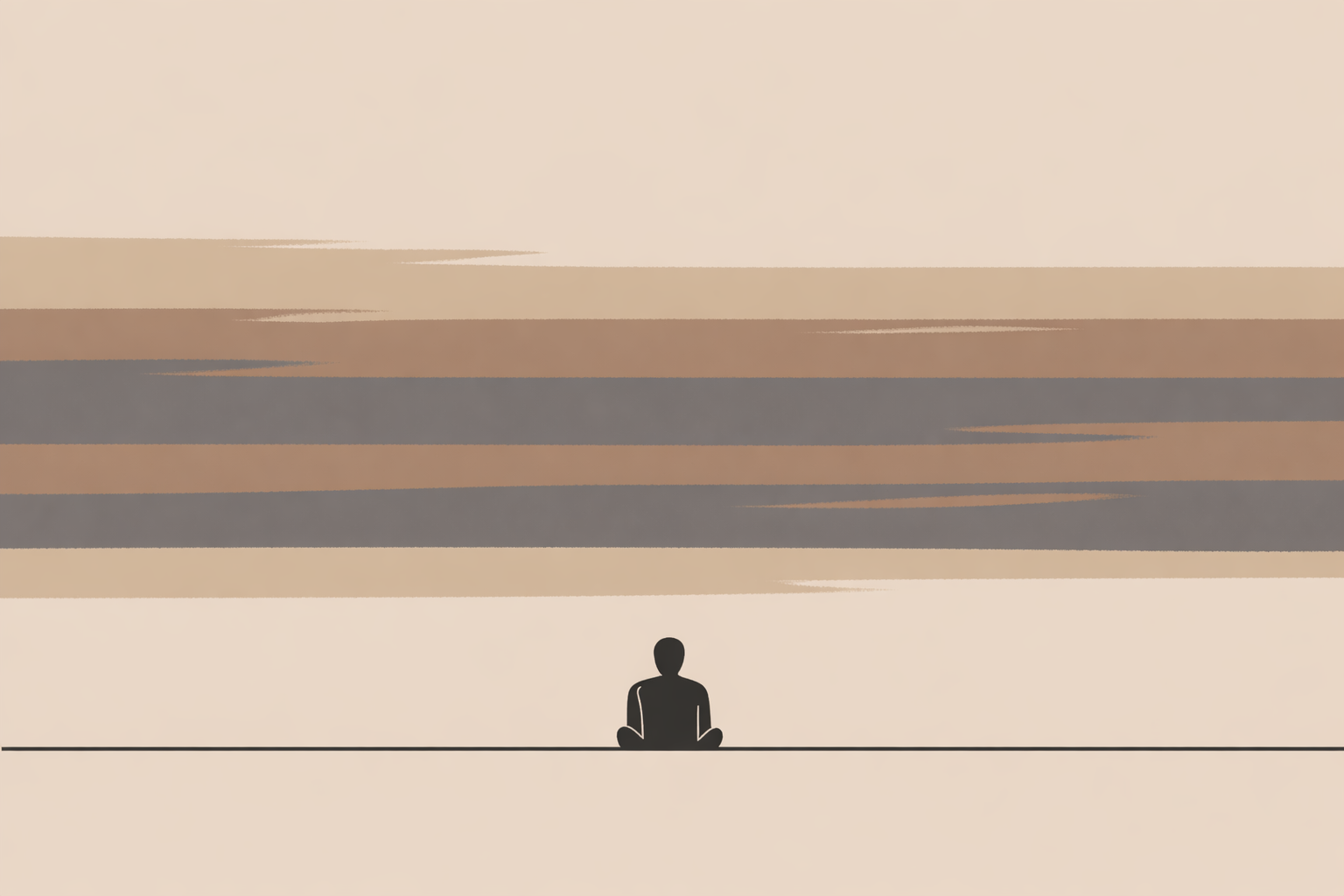
False calm appears when quiet has returned, but ease has not.
Nothing is exploding.
Nobody is arguing. The calendar looks manageable again. You are getting through the day without the urgency that defined the week before.
From the outside, everything looks settled.
Inside, though, something still has to be held carefully.
One interruption feels dangerous.
One uncomfortable conversation seems capable of disturbing the entire day. You are calm, but part of you is working to keep the calm in place.
That is the territory of false calm.
The quiet itself may be genuine. The mistake is assuming quiet proves the pressure underneath it has been resolved.
Current Reading
False Calm
Visible intensity is low, but flexibility remains limited. Calm is being maintained more than inhabited.
False Calm Is a Differentiation Reading
The Soul Weather Framework distinguishes canonical conditions from supporting readings that help readers tell similar experiences apart.
False Calm belongs to that second category.
It does not name a permanent condition or personality trait.
Instead, it asks whether present quiet reflects genuine internal room or whether pressure has merely stopped moving visibly.
The distinction sounds small.
In practice, it changes the forecast.
Auden Field Note
Peace has room to move. False calm survives by asking everything around it not to move too much.
Quiet and Ease Are Not the Same Thing
Quiet can be created in several ways.
Sometimes pressure genuinely resolves.
Sometimes the room simply becomes less demanding.
Other times, the system becomes very good at keeping every variable under control.
All three can look peaceful from the outside.
Only the first two may require little internal effort.
False Calm is different because steadiness depends on conditions remaining narrow enough to manage.
You Can Feel the Effort Underneath It
Maybe you can relax as long as nobody asks what you are really thinking.
Perhaps the week feels manageable only if nothing unexpected appears.
You may feel perfectly fine while alone, yet become instantly tense when someone changes the plan.
None of those examples means something is fundamentally wrong.
They simply suggest that the calm may have less range than it appears to have.
False Calm Is Not a Return to Baseline
The distinction becomes clearer when compared with The Soul Weather Report: Return to Baseline .
Baseline describes usable stability returning.
The system does not need to be joyful, inspired, or unusually energized.
It simply has enough internal room to respond to ordinary life without excessive strain.
False Calm can look similar at first.
The difference appears when movement enters the field.
Why Quiet Feels So Convincing
Most people are relieved when intensity decreases.
That relief is understandable.
After a difficult week, silence feels like proof.
No argument means the relationship must be better.
No deadline means work pressure must be gone.
No strong emotion means the issue must be resolved.
Sometimes those conclusions are accurate.
Yet the absence of noise tells us only that noise is absent.
It does not automatically tell us why.
Containment Can Look Like Resolution
Containment is not inherently bad.
There are moments when a person needs to hold a response until a better time.
A difficult conversation may need to wait until the room is private. A work problem may need enough structure to keep it from spilling into everything else.
Temporary containment can be wise.
Trouble begins when temporary containment becomes the permanent explanation for calm.
Nothing has actually moved.
Everything has simply been kept from moving.
Reading Rule
Do not measure calm only by how quiet the system looks. Notice how much movement the quiet can tolerate.
What False Calm Can Look Like
False Calm often announces itself through brittleness rather than visible distress.
These signs should be read carefully.
One difficult reaction does not prove the calm was false.
The pattern matters more than a single moment.
False Calm in Relationships
Relationships can become quiet without becoming repaired.
Sometimes two people stop arguing because they finally understand each other.
Sometimes they stop arguing because both have learned which subjects cannot be touched safely.
The visible result may look identical.
Nobody raises their voice.
The house feels peaceful.
Conversation remains polite.
Yet the quiet is doing different work.
Peace That Requires Silence Around the Truth Is Expensive
If maintaining peace requires two people to keep stepping around the same unresolved ground, the relationship may be calm while remaining constrained.
That does not mean every issue must be confronted immediately.
Timing still matters.
But a relationship should not have to become smaller and smaller simply to preserve the appearance of peace.
False Calm at Work
Workplaces experience false calm too.
A difficult employee leaves, so tension decreases.
A major deadline passes, so the team breathes again.
A manager steps in and controls every decision, reducing visible mistakes.
For a while, everything looks better.
But the underlying process may still be weak.
Control Can Hide Fragility
If the system works only because one person is watching everything, stability has not really been distributed.
If communication appears clean only because difficult questions have stopped being raised, the calm may be organizational rather than structural.
A quiet system should still be able to tolerate normal inquiry, disagreement, and variation.
False Calm Can Resemble Avoidance
This reading sits naturally beside The Soul Weather Report: Recovery vs. Avoidance .
Both readings ask what reduced strain is actually producing.
Recovery should gradually expand usable range.
Avoidance can preserve relief by keeping difficult contact outside the field.
False Calm describes what that relief can feel like internally when everything stays controlled enough.
The difference becomes visible when ordinary movement returns.
Applied Reading
Imagine two people who had a painful argument several weeks ago.
Since then, things have been pleasant.
They cook together.
They laugh.
They send warm messages during the day.
The relationship appears calmer.
But neither person mentions the subject that caused the conflict.
One evening, a harmless comment comes close to that territory.
Both bodies tighten.
The conversation changes immediately.
Nobody argues.
The subject simply disappears again.
The quiet is real. So is the pressure required to preserve it.
The Better Test Is Flexibility
Calm becomes more trustworthy when it has room around it.
You can be interrupted without feeling invaded.
A plan can change without destroying the day.
A difficult feeling can appear without forcing an immediate conclusion.
A disagreement can remain a disagreement instead of becoming a threat to the whole relationship.
That is flexibility.
It is different from never being disturbed.
True Calm Can Bend
The metaphor matters.
A rigid branch may look perfectly still in quiet air.
Wind reveals what kind of stillness it was.
The strongest branch is not always the one that never moves.
It is often the one that can bend without losing itself.
Do Not Manufacture Conflict to Test the Calm
A framework can become foolish when its reader becomes too eager to verify it.
You do not need to provoke a difficult conversation just to see whether you are truly calm.
You do not need to overload a peaceful week to prove you have recovered.
Ordinary life will provide enough movement.
Watch what happens when it does.
The test should be observational, not theatrical.
Today’s Practice
Ask Whether the Calm Has Room to Move
Think about one area of life that currently feels calmer than it did before.
Then ask:
- Effort: Does this calm require constant monitoring or control?
- Flexibility: Can a small change happen without the whole system tightening?
- Truth: Are there subjects, feelings, or demands that must remain untouched for peace to hold?
- Range: Is ordinary life becoming easier to engage with?
- Return: After a disruption, can the system settle again without extreme effort?
Do not search for a perfect answer.
Look for whether the calm is becoming more spacious or more dependent on control.
The False Calm Forecast
Current conditions favor observation rather than immediate correction.
The presence of calm is still useful.
It means visible intensity has decreased.
The next question is whether flexibility is returning with it.
If Flexibility Is Returning
The calm may be deepening into genuine baseline.
Ordinary movement becomes easier to absorb.
The reader does not need the entire environment to remain predictable in order to stay proportionate.
That is meaningful progress.
If Calm Still Depends on Control
Do not tear the system open.
Instead, notice what is still being held.
Some pressure may need more recovery.
Some conversations may need better timing.
Some expectations may need adjustment.
The answer is not disruption for disruption’s sake.
It is gradually reducing the amount of force required to maintain peace.
Sometimes We Call It Peace Because We Are Tired of Fighting
There is humanity in that.
After enough noise, nearly any quiet can feel sacred.
You stop pressing the issue.
You tell yourself it is fine.
Maybe you become very careful with your tone, your plans, your expectations, and the places where you let yourself need anything.
Life gets quieter.
And sometimes quiet is exactly what saves you for a while.
But eventually, another question arrives.
Am I at peace, or have I become very skilled at not disturbing what still hurts?
That question deserves gentleness.
It also deserves an honest answer.
Auden Field Note
Peace does not require every wound to vanish. But it should eventually require less of your life to stay untouched.
Stillness Should Make More Truth Possible
There is a spiritual danger in worshiping quiet simply because quiet feels clean.
Some silence gives truth room to speak.
Other silence keeps truth outside the room.
They can sound identical.
That is why stillness needs discernment.
A useful quiet does not erase complexity.
It gives complexity enough space to become understandable.
The aim is not a life in which nothing disturbs the soul.
The aim is a soul with enough room to meet what arrives without losing itself every time the weather changes.
Where False Calm Fits in the Soul Weather System
False Calm is one of the foundational differentiation readings of The Soul Weather Report.
It belongs near Return to Baseline, Recovery vs. Avoidance, and Residual Pressure because all four readings examine what happens after visible intensity decreases.
Their questions are different:
Together, those distinctions keep “feeling better” from becoming one vague category.
The framework becomes useful precisely because it asks what kind of better is actually present.
Receipts
The Soul Weather Report is an original Groundwork Daily editorial framework. “False Calm” is used here as non-clinical language for apparent quiet that may coexist with unresolved strain, reduced flexibility, or reliance on tightly controlled conditions.
The phrase is not a diagnosis, and one uncomfortable reaction does not prove that a person, relationship, or system is experiencing false calm.
For general background on stress and its effects on everyday functioning, see the American Psychological Association’s resources on stress .
A Note on Scope
The Soul Weather Report is an editorial framework for observation, reflection, and practical self-awareness.
It is not therapy, diagnosis, crisis intervention, personality typing, or a substitute for qualified medical or mental health care.
Persistent distress, substantial changes in daily functioning, safety concerns, or other serious symptoms may require appropriate professional support.
Closing Observation
Quiet matters.
Sometimes it is the first mercy after a loud season.
Let it be quiet.
You do not need to interrogate every peaceful afternoon to determine whether it qualifies as healing.
But over time, notice what the quiet asks from you.
Does it create more room?
Can life move around inside it?
Can a difficult thought enter without destroying the whole day?
Can another person disagree without the entire relationship suddenly feeling dangerous?
Can plans change without every internal alarm waking up?
If so, the quiet may be becoming something sturdier.
If not, do not shame the calm.
It may simply still be carrying more pressure than it knows how to release.
Real calm does not need the whole world to remain still in order to stay itself.
Further Groundwork
→
The Soul Weather Framework
→
The Soul Weather Report: Return to Baseline
→
The Soul Weather Report: Recovery vs. Avoidance
→
The Soul Weather Report: Residual Pressure

Meet the Builder
Auden Larke
Builder · Stillness & Soul
Auden Larke builds language for the weather people carry but do not always know how to name.
Through The Soul Weather Report, Auden explores pressure, quiet, visibility, flexibility, recovery, and the difference between a stillness that creates room and a stillness that survives only because nothing is allowed to move.
The work lives between structure and spirit. It asks readers to honor moments of calm without confusing silence with completion, and to let awareness become spacious enough for the truth of a condition to emerge without spectacle.
“Peace has room to move. False calm survives by asking everything around it not to move too much.”
Meet Auden Larke • The Soul Weather Report • Framework Guide • Stillness & Soul