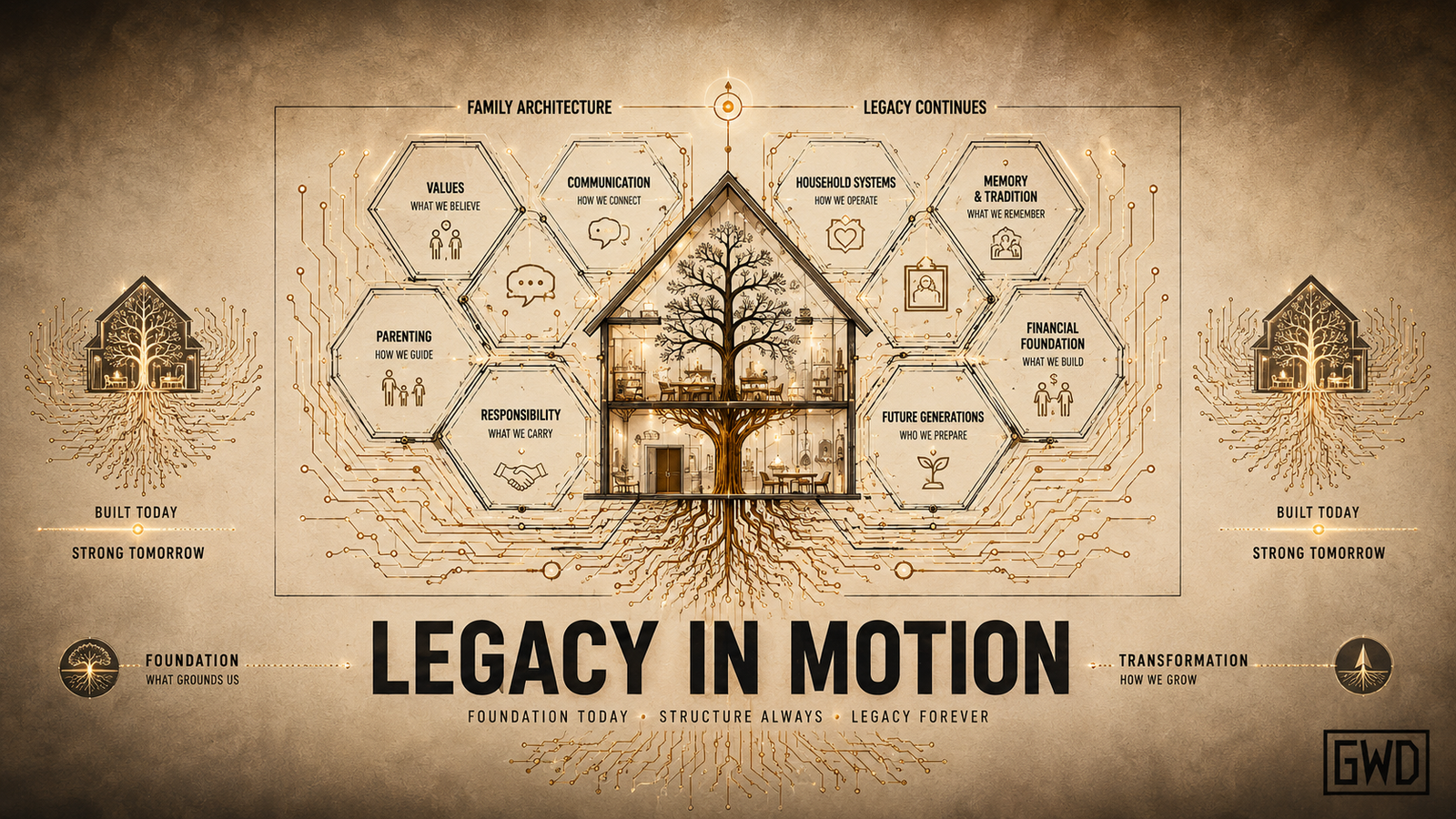
Legacy In Motion · Relationships, Respect & Repair
Love can create closeness. Respect determines whether that closeness remains safe when disappointment, anger, correction, and pressure enter the room.
Respect vs love in relationships is not really a debate about which quality matters more. It is a structural question about what happens to two people when affection is no longer enough to carry the moment.
Imagine a couple sitting at the kitchen table after a difficult conversation. Nobody is screaming. Nobody is leaving. The room is quiet enough to hear the refrigerator running.
Something important has gone wrong.
Maybe money was spent without a conversation. Perhaps a promise was broken. Maybe one person said something careless in front of family. Or perhaps somebody has been carrying a frustration for three weeks and finally put it on the table.
Both people are angry.
One of them knows exactly which insecurity would end the argument immediately.
They could use it.
Instead, they do not.
That decision may tell you more about the health of the relationship than the flowers, vacations, anniversaries, and affectionate texts that came before it.
Love creates closeness. Respect governs what happens to that closeness when pressure arrives.
When Feeling Meets Reality
Can love survive without respect in relationships?
For a while, yes.
That answer matters because people sometimes assume a damaged relationship cannot contain genuine love.
It can.
Two people may care deeply about each other while building habits that steadily damage trust. They may still laugh together. They may still be attracted to each other. In addition, they may genuinely miss each other when apart.
Yet the relationship can still become unstable.
Love can remain while the structure weakens
Consider a couple who has been together for twelve years.
They have history. They know each other’s families. Their photographs fill the hallway. Moreover, they have survived job changes, sickness, money problems, and seasons when life felt heavier than either expected.
There is love there.
However, every argument now includes ridicule.
One rolls their eyes before the other finishes speaking. Private weaknesses come back as weapons. An apology may arrive later, but the same line gets crossed again next month.
Love did not disappear.
Respect did.
Respect vs love in relationships asks a harder question
Asking whether two people still love each other is sometimes insufficient.
Instead, ask:
What has their love learned to permit?
That question moves the conversation away from sentiment and toward structure.
The Load-Bearing Beam
What respect actually does in relationships
Respect is not politeness.
Nor is it silence.
Respect does not require one person to become agreeable so the other can stay comfortable. Instead, it governs what happens when agreement disappears.
Respect is restraint when you have access
Intimacy gives people access to each other’s weak spots.
You may know exactly which sentence would embarrass your partner in front of friends. You may know which family wound still hurts. You may also know which failure they already feel ashamed of.
Respect means remembering that access is not permission.
In practice, respect says: I can be angry without using what you trusted me with as a weapon.
That is not softness.
It is discipline.
Respect separates behavior from human worth
Imagine one partner forgets an important payment.
The bank account is short. A late fee hits. The other person is frustrated because this was discussed before.
One response is:
“This cannot keep happening. We need a better system because this is putting pressure on both of us.”
By contrast, another response is:
“This is why I can never trust you with anything.”
Both responses communicate anger.
Only one confronts the problem while leaving the person’s dignity intact.
Legacy In Motion Framework
The Respect Under Pressure Test
Do not judge respect only when both people are getting what they want. Instead, watch what happens when the relationship becomes uncomfortable.
01
Disagreement
Can both people challenge each other without contempt, threats, ridicule, or character assassination?
02
Disappointment
Can frustration be expressed without humiliation, punishment, or deliberate emotional withdrawal?
03
Vulnerability
Does private information remain protected after somebody gets angry?
04
Boundaries
Can either person say no without paying an emotional price for it later?
05
Repair
Can someone admit harm, make a correction, and rebuild trust without turning accountability into a power struggle?
Respect is not proven by the absence of conflict. It is proven by the boundaries conflict is not allowed to cross.
When Honesty Gets Expensive
Why disrespect changes respect vs love in relationships
Disrespect does more than create bad feelings.
It changes the price of telling the truth.
Picture someone sitting in the car outside their own home for five extra minutes.
Nothing dramatic happened.
Still, they know a conversation is waiting upstairs.
More importantly, they know the pattern.
Conflict starts becoming predictable
A concern becomes an accusation. Then the accusation becomes a history lesson. Three unrelated mistakes enter the room. Eventually, neither person remembers what the original problem was.
So the person remains in the car.
Not because the issue disappeared.
Rather, honesty feels expensive.
Silence can become self-protection
Over time, people adapt.
They stop raising certain subjects. They edit details. They delay conversations. Eventually, they decide that silence is easier than another three-hour argument.
What looks like poor communication may therefore be the visible symptom of a deeper problem: communication stopped feeling safe enough to use.
This can help explain why some men withdraw instead of continuing to argue. Withdrawal is not automatically healthy or mature. However, repeated disengagement may signal that conflict no longer feels capable of producing resolution.
That pattern is explored further in Why Men Withdraw Instead of Argue .
What the Research Sees
Contempt is more than another argument style
Ordinary irritation and contempt are not the same thing.
Irritation says: I do not like what happened.
Contempt communicates something more corrosive: I am above you.
For example, contempt may appear through mockery, sarcasm, hostile humor, eye-rolling, name-calling, or treating another person’s perspective as beneath serious consideration.
The Gottman Institute identifies contempt as one of the most destructive conflict patterns in intimate relationships.
The practical distinction is important.
Conflict does not automatically destroy respect.
Degradation does.
Groundwork Daily Core Principle
Accountability Is a Form of Strength
Respect becomes visible when being wrong does not require somebody else to become small.
Accountability keeps respect from becoming performance
Relationships need people who can hear correction without treating correction as humiliation.
That means being able to say:
“I handled that badly.”
“You did not deserve that.”
“I understand why that damaged trust.”
“Here is what I am going to change.”
Those sentences are simple, but they are not easy.
Accountability requires enough strength to stop defending the version of yourself that created the harm.
What the principle means here
Applied here: love may motivate repair, but respect protects the person being repaired with. Accountability determines whether anything actually changes.
Intensity Is Not Stability
Why love without respect feels unstable
Love without respect can be intense.
Sometimes that intensity gets mistaken for depth.
The arguments may be enormous. Meanwhile, the reconciliations can feel equally powerful.
Friday feels like the relationship is ending. By Sunday, both people may feel as though nobody has ever understood them better.
That emotional swing can create the illusion that something profound must be happening.
Something powerful may indeed be happening.
However, power and stability are different things.
When the relationship becomes a weather system
In unstable relationships, people begin monitoring climate.
They wonder what mood the other person is in. They calculate whether tonight is safe enough to raise a problem. They may even rehearse a sentence several times before saying it.
As a result, both people can spend more energy managing the emotional weather than solving the actual issue.
The relationship still contains feeling.
What it lacks is dependable structure.
Structure Needs Warmth
Why respect without love feels empty
Respect cannot do every job either.
Consider the opposite household.
Bills are paid. Nobody screams. Responsibilities are divided. The calendar works. In addition, both people show up where they said they would.
From the outside, the relationship looks stable.
Yet the two people barely touch.
Curiosity has disappeared. Compliments are rare. Conversation is almost entirely logistical.
In other words, they have become excellent operators of the household and distant occupants of the relationship.
That matters too.
Respect can protect a structure that still needs life inside it
Love brings affection, admiration, desire, humor, tenderness, curiosity, and the experience of being emotionally chosen.
Respect keeps the structure standing.
Love makes somebody want to come home to it.
The Actual Goal
The real goal in respect vs love in relationships is alignment
Strong relationships do not choose between love and respect.
Instead, they ask each one to do its job.
Creates connection.
Protects dignity.
Repairs damage.
Protect the conditions around connection.
Keeps one person from carrying the whole structure.
Together, these create something more durable than romance alone.
Ultimately, they create a relationship capable of absorbing reality.
A durable relationship is not one where nobody gets hurt. It is one where hurt does not become permission to abandon dignity.
Look Beneath the Feeling
How to tell what may be missing in a relationship
If affection is present but honesty feels dangerous, examine respect.
When the relationship is orderly but emotionally cold, examine connection.
If every disagreement becomes a referendum on the entire relationship, examine the conflict structure.
Where apologies happen repeatedly without changed behavior, examine accountability.
If one person is always repairing while the other is always being forgiven, examine reciprocity.
On the other hand, if both people can disagree, remain truthful, preserve dignity, make corrections, and eventually find their way back to each other, the relationship has something more valuable than constant harmony.
It has repair capacity.
Common Questions
Respect vs Love in Relationships FAQ
Is respect more important than love in a relationship?
They perform different functions. Love creates emotional connection, while respect protects dignity, boundaries, fairness, and the conditions that allow trust to survive conflict.
Can you love someone you do not respect?
Yes. Emotional attachment can remain even after respect has deteriorated. However, affection without reliable respect often produces resentment, instability, or emotional distance.
Why does respect matter so much in relationships?
Respect protects dignity when agreement disappears. As a result, conflict can focus on the problem instead of becoming an excuse to humiliate, punish, or diminish the other person.
What are signs of disrespect in a relationship?
Patterns can include contempt, ridicule, public humiliation, punitive silence, repeated boundary violations, weaponizing private information, dismissing concerns, or treating disagreement as permission to degrade the other person.
Can respect be rebuilt after it is lost?
Sometimes. Rebuilding respect requires more than an apology. It requires accountability, changed behavior, clear boundaries, and enough repeated evidence for trust to begin recovering.
What does healthy disagreement look like?
Healthy disagreement allows people to name problems without threats, contempt, humiliation, or retaliation. Therefore, the goal is not avoiding anger. It is preventing anger from destroying the dignity required for repair.
The Groundwork
Respect vs love in relationships becomes clear when love is inconvenienced
Do not measure a relationship only by birthdays, vacations, gifts, good sex, affectionate texts, or the things people say when both of them feel loved.
Instead, watch the harder moments.
Somebody forgets.
Another person disappoints.
A boundary gets set.
Someone gets embarrassed.
Eventually, somebody has to admit they were wrong.
What happens then?
Can disagreement happen without contempt? Can correction happen without humiliation? Can vulnerability remain protected during anger? More importantly, can an apology become changed behavior?
Those questions reveal the structure underneath the feeling.
Love may bring two people together. Respect determines whether closeness can remain safe enough to last.
Continue Building
Follow the Relationship Architecture
Why dignity, restraint, reliability, and boundaries function as relationship structure.
Why Men Withdraw Instead of ArgueWhat disengagement can reveal about conflict, emotional cost, and failed repair.
What Men Want From Women in RelationshipsTrust, partnership, reciprocity, emotional steadiness, and what men may experience as respect.
Accountability Is a Form of StrengthThe Groundwork Daily principle behind correction, ownership, and repair.
Legacy In Motion
The way two people handle dignity under pressure does not stay inside one argument. Repeated often enough, it becomes the emotional architecture of a home.
People learn what disagreement costs. They learn whether saying no is safe. They learn what apology means. Eventually, they learn whether love requires somebody to lose.
What two people normalize in private can become somebody else’s definition of what love is supposed to feel like.