
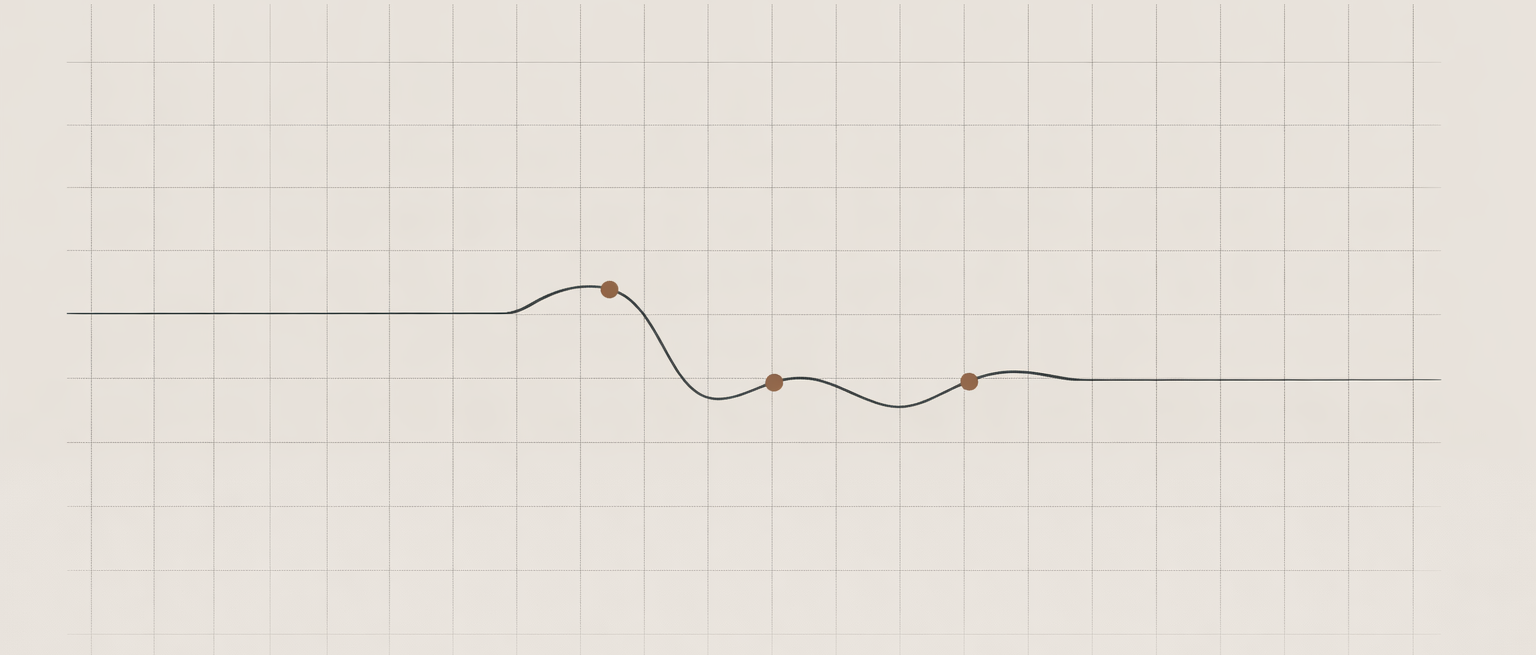
Pressure makes the latest event feel like the whole story. Pattern literacy creates enough distance to see what keeps returning underneath it.
Pattern literacy under stress is the skill of reading systems clearly when pressure rises. Most people react to events because events are loud. They arrive with dates, headlines, bills, arguments, deadlines, alerts, and consequences. A pattern is quieter. You usually have to see the same shape more than once before you can name it.
That difference matters. When every difficult moment feels isolated, instability can start to feel random. You respond to whatever happened last and hope the response is enough. But when you can identify what keeps repeating, what tends to precede it, and what allows it to continue, the problem changes. It becomes less mysterious.
That does not mean every pattern can be controlled. Some systems are larger than your authority. Some pressures are structural, institutional, economic, relational, or technological. Pattern literacy is not a promise that good observation gives you total control. It gives you something more useful: a better chance of knowing what kind of problem you are actually dealing with.
Stability is not built by reacting faster to every signal. It is built by learning which signals deserve weight, which patterns deserve intervention, and which forms of noise should never have been given authority in the first place.
Groundwork Principle
Read what repeats before reacting to what is loud.
Pattern Literacy Turns Instability Into Something You Can Read
Pattern literacy under stress is a disciplined method for interpreting instability without surrendering to it. It helps you identify what repeats, understand what sustains the repetition, and apply precise leverage before pressure becomes panic.
System Definition
Input
Instability across money, work, relationships, information, and other systems carrying real pressure.
Process
Repetition detection, incentive mapping, comparison, leverage, and disciplined measurement.
Output
Clearer interpretation, less distortion, and a response that fits the actual structure of the problem.
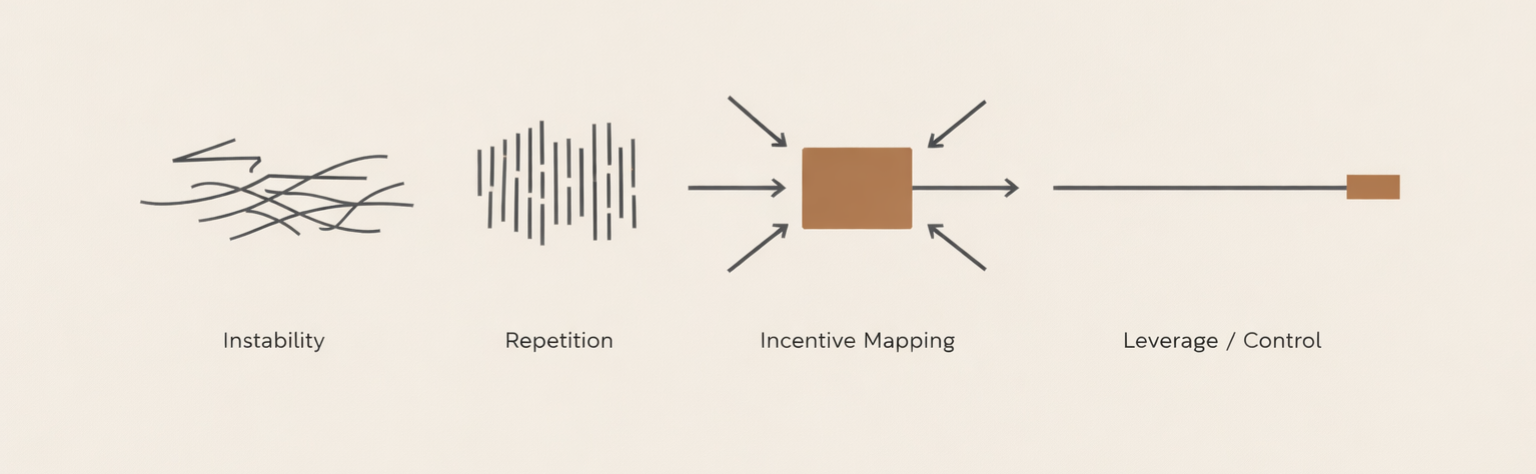
This is not a mindset slogan. It is a practical operating skill. When stress rises, pattern literacy keeps intensity from automatically becoming interpretation. Pressure can still be real. The consequences can still matter. But you are no longer required to treat every loud signal as a complete explanation.
Pressure Can Make the Latest Event Feel Larger Than the Pattern
Under pressure, attention can narrow toward what feels immediate, threatening, or unresolved. That can be useful when something requires fast action. It is less useful when the situation demands comparison, timing, judgment, or the ability to distinguish a recurring structure from one unusually intense event.
This is where people can begin confusing volume with velocity and intensity with permanence. A difficult week starts looking like a permanent future. One frightening headline becomes proof that everything is deteriorating. A single conflict becomes evidence that the entire relationship is broken. A bad month at work becomes a verdict on competence.
Pattern literacy interrupts that compression. Instead of asking whether everything is collapsing, it asks what has repeated, under what conditions it tends to repeat, what keeps the pattern alive, and whether the current event actually belongs to that pattern.
That is a discernment problem before it is a reaction problem. Not every signal deserves equal weight. Not every recurrence deserves the same explanation. Comparison restores proportion.
The American Psychological Association provides a broader overview of stress and its effects in its stress resources.
Repetition Turns Instability Into Evidence
Most instability does not arrive as a complete surprise. More often, it arrives as a recurrence that was ignored, misread, normalized, or explained away. Pattern literacy therefore begins before interpretation. First, establish whether the thing you are worried about is actually repeating.
Start with frequency, not feeling. Four ordinary parts of life can reveal more structure than a general sense that everything is going wrong.
Money
When does cash tighten? Which expenses recur? What strain appears monthly, seasonally, or quarterly?
Work
When does scope expand? When does urgency spike? When does responsiveness quietly become permanent availability?
Relationships
When does tension rise? Which themes return? What conflict keeps reopening even when the details change?
Information
When does anxiety increase? Which inputs change your state? What kind of content repeatedly captures more attention than it deserves?
Repetition is evidence, but it is not yet explanation. That distinction matters. Seeing a pattern gives you the right to investigate it. It does not give you permission to invent the cause.
Still, once recurrence becomes visible, the system often stops feeling completely random. You now have something to compare. That creates a better starting point for judgment.
Incentives Explain Why Bad Patterns Keep Surviving
After repetition comes incentive mapping. Systems persist because something keeps rewarding the current arrangement, even when the outcome is bad for some of the people inside it.
Media systems reward attention. Some workplaces reward over-availability because the immediate cost of saying yes is carried by the worker while the short-term benefit is captured by the organization. Debt structures can keep minimum progress feeling sufficient. Fragile relationships can reward avoidance because postponing an honest conversation is temporarily easier than having one.
Incentive mapping reduces confusion because it forces you to ask what the system is actually rewarding rather than what the system says it values.
That logic connects to The Expectation Gap. A structure can continue displaying the language of stability after the capacity required to deliver that stability has already weakened. Visible promises and operating reality are not always the same thing.
Once the reward structure becomes clearer, recurrence becomes easier to interpret. You begin to understand why telling people to do better often produces very little change when the system continues rewarding the behavior everyone claims to dislike.
Leverage Changes the Pattern Without Fighting the Whole System
Leverage is the point where observation becomes useful. You do not need authority over an entire system to change the part of the system you actually control.
Usually, useful leverage is not dramatic. It is specific enough to interrupt recurrence and small enough to repeat.
- If anxiety reliably spikes after morning scrolling, create a fixed exposure boundary before work begins.
- If burnout follows the same kind of deadline, renegotiate scope before commitment instead of after exhaustion.
- If income volatility repeats at predictable intervals, redesign liquidity timing before the cycle returns.
- If one relationship keeps producing the same unresolved tension, stop debating each incident as if it were new and address the recurring pattern.
Small structural changes often outperform emotional resolutions because the change happens closer to the mechanism. A declaration may change intention. Leverage changes the operating conditions around the next decision.
This is where Structure Builds Freedom becomes practical. Useful structure reduces the number of moments where you have to rediscover the same lesson under pressure.
Reactive Thinking Keeps You Trapped in Event Mode
Event mode asks what happened today. System mode asks what has happened repeatedly and under what conditions. The difference sounds small until you notice how much attention disappears into reacting to whatever happened last.
This is also where forecasting can become a trap. Constantly scanning for what might go wrong can feel like preparation because the mind remains busy. But vigilance is not the same thing as understanding.
As explored in Living in Forecast Mode, perpetual anticipation can degrade clarity. Forecast mode keeps asking what might happen next. Pattern literacy begins with what has already demonstrated a repeatable structure.
The second question tends to produce better options because it gives you evidence to work with. You are no longer negotiating with a cloud of possibilities. You are examining conditions that have already shown themselves more than once.
Stress can then become information instead of atmosphere.
Media, Work, and Money Reveal Patterns in Different Ways
Pattern literacy becomes more useful when it can travel. The underlying method remains the same, but the signals change according to the system being examined.
Media systems can manufacture a permanent sense of crisis
Media does not simply reflect instability. It selects it, sequences it, repeats it, frames it, ranks it, and often monetizes the attention produced by it. Because urgency attracts notice, exposure to crisis can become continuous even when the underlying events are separate, geographically distant, or moving at very different speeds.
That does not make the events unreal. It means the experience of receiving them is itself a designed environment.
As explored in Doom as Entertainment, fragility can become a format. Once that happens, people can mistake constant exposure for constant deterioration.
Pattern literacy treats media as architecture. What is being repeated? What receives prominence? What disappears quickly? What kind of material earns engagement? What emotional state does the sequence of information reliably create?
This is also where Mind as Discipline becomes relevant without becoming this article’s series. Attention has access points. A person who never governs those access points is allowing other systems to decide which signals receive repeated cognitive priority.
Limiting exposure is not automatically ignorance. Sometimes it is strategic filtration. The goal is not to know less. It is to prevent the architecture of delivery from deciding what deserves the most weight.
Work problems often become visible before the job disappears
Work often loses meaning before income disappears. Psychological withdrawal can begin while the job still looks intact from the outside. The meeting happens. The email gets answered. The paycheck arrives. But the relationship between effort, reward, control, and possibility has begun to change.
That dynamic appears in Role Without Reward. When reward structures become misaligned, effort can start feeling hollow long before economic displacement becomes visible.
Pattern literacy helps separate individual effort from structural breakdown. That distinction matters because people routinely internalize system failures as personal inadequacy. If the same scope problem, incentive problem, staffing problem, advancement problem, or authority problem keeps recurring, trying harder may be a poor diagnosis.
The useful response may be to reskill, renegotiate, reposition, document, protect capacity, or exit deliberately. The correct move depends on the system, but seeing the pattern prevents every recurrence from being processed as a fresh personal failure.
Money problems often have a timing pattern underneath them
The same logic applies to money. Discipline Before Dollars argues that resources tend to amplify the structure already present. Many financial problems therefore have a pattern layer: timing, recurring obligations, automatic behavior, inconsistent margins, or predictable decisions made under pressure.
If the same shortage keeps appearing at roughly the same point in the cycle, the shortage is not merely an event anymore. It is evidence about the system.
Pattern Literacy Should Be Taught as a Practical Skill
Traditional education can reward memorization without necessarily strengthening interpretation. Knowing more facts matters, but unstable environments demand something else as well: the ability to notice recurrence, test explanations, recognize incentives, compare signals, and change course when the evidence no longer supports the original assumption.
That is why pattern literacy belongs inside Education & Skills. Capability is not just what you know. It includes what you can notice, what you can test, what you can revise, and how reliably you can act when the situation is noisy.
Groundwork Daily’s Future Literacy framework approaches pattern recognition from a neighboring direction: how people read change and remain capable as conditions move. Its article How to Read the Patterns That Shape Your Future is especially useful for readers who want to extend this skill toward emerging signals and future change.
This article has a narrower job. It is concerned with recurrence under pressure. What keeps happening? What sustains it? What changes when you intervene? That distinction keeps the two assets useful instead of making them compete for the same intellectual territory.
A Monthly Audit Turns Observation Into Discipline
Pattern literacy does not develop through vague reflection. Memory edits too much. Emotion overweights whatever happened most recently. A useful practice needs a record and enough time for recurrence to become visible.
Use this protocol once per month for ninety days.
Monthly Pattern Audit · 90-Day Cycle
- Repetition: What happened more than once?
- Timing: What tended to happen immediately before it?
- Incentive: What rewarded or protected the pattern’s continuation?
- Leverage: What is the smallest structural action capable of interrupting it?
- Measurement: What changed after the adjustment was applied?
The execution rules matter as much as the questions.
- Run the audit for three consecutive monthly cycles before making large conclusions.
- Change one meaningful variable at a time when possible.
- Write the observations down. Memory is too flattering and too unreliable to carry the whole process.
- Measure what happened after the intervention, not what you intended to happen.
- Do not force causation where you only have correlation. A repeated association is a reason to investigate, not a license to overclaim.
Over time, the goal is not perfect control. It is reduced confusion, stronger judgment, and a cleaner relationship between evidence and response.
Skill Can Hold Even When Stability Does Not
Pattern literacy under stress does not eliminate instability. It does not guarantee that every system can be repaired from your position inside it. It does not turn uncertainty into certainty.
It does something more durable. It strengthens interpretation.
When you identify repetition, map incentives, test explanations, apply leverage, and measure the result, pressure becomes more than an emotional verdict. It becomes information you can sort.
Some systems will continue to fluctuate. Some environments will remain loud. Some problems will require authority you do not possess yet. The objective is not to fluctuate with every signal they produce.
Stillness Is Strategy matters here because the space between signal and response is where authorship survives. You need enough room to determine whether you are seeing an event, a pattern, or simply a story assembled too quickly under pressure.
Stability is not always available on demand. Skill is. Learn to read the structure before the structure teaches you the same lesson again.
Groundwork Architecture
The Principle and Condition Beneath This Work
This standalone article applies one governing Groundwork principle and one structural condition to the problem of interpreting systems under pressure.
Core Principle
Stillness Is Strategy
Decision space protects authorship. Pattern literacy requires enough distance from urgency to compare signals before committing to an interpretation.
Primary Condition · Weighs
Discernment
The structural job is deciding what deserves weight: recurrence, evidence, incentives, timing, consequences, and the limits of what the evidence can prove.
See the full Groundwork Daily Core Principles and Conditions architecture.

Meet the Builder
Malik Rivers
Builder, Education & Skills
Malik Rivers builds Groundwork Daily’s embodied-systems coverage, examining attention, physical capacity, judgment, learning, and technology as connected structures of human capability. His governed series include Mind as Discipline, Health as Discipline, and Tech as Discipline.
Receipts
Source Used in This Article
-
American Psychological Association: Stress
General reference on stress and its effects.
External links were live and accessible when this article was published or last substantively updated. Third-party pages may change, move, or be removed over time.