

Fairness vs equality in relationships becomes difficult when people assume equal dignity requires identical contribution. It does not. Equality establishes standing. Fairness determines how responsibility should move through a shared life.
Real relationships rarely operate under perfectly equal conditions. One person may earn more. Another may have more flexibility. One may be carrying a brutal season at work while the other has more room at home. Children, caregiving, health, money, career changes, and ordinary exhaustion can all change what each person can reasonably carry.
This is where the familiar promise of a 50/50 relationship starts to break down. The math sounds clean. Life usually is not.
Governing Idea
Equality protects standing. Fairness governs the load.
Two people can be equally important without contributing the same amount to every task, bill, season, or responsibility. The real test is whether the arrangement remains visible, legitimate, and open to review.

Fairness and Equality Have Different Jobs
Equality answers a question about standing. Does each person matter equally here? Does each person have a legitimate voice? Are both entitled to dignity, consideration, safety, and respect?
Those things should not depend on who earns more, who works longer hours, who is physically stronger, or who happens to have more capacity this month.
Fairness answers a different question. It asks how the work of maintaining the relationship and household should actually be distributed.
That includes the responsibilities everyone can see: income, bills, cleaning, childcare, transportation, meals, and home maintenance. It also includes the quieter work of remembering appointments, managing schedules, noticing what is running low, planning for problems, keeping family relationships connected, and initiating difficult conversations before resentment hardens.
Equality says neither person is inherently more important. Fairness says the work does not have to be identical for that equality to remain intact.
Equality Is a Floor, Not a Chore Chart
Trouble starts when equality gets translated into identical contribution.
If both people matter equally, the reasoning goes, then both should contribute exactly half of everything. Half the money. Half the housework. Half the parenting. Half the planning.
It sounds objective because it uses numbers. Yet identical percentages can hide very different burdens.
Imagine one partner works from home with a flexible schedule while the other has a long commute and unpredictable shifts. Requiring the same weekday household output from both may be mathematically equal while ignoring the structure of their actual lives.
Reverse those circumstances six months later and the arrangement may need to reverse too.
Equality should protect the relationship from hierarchy. It should not trap the household inside a rigid formula.
Why 50/50 Is Usually the Wrong Measurement
The problem with 50/50 is not that an even split is always bad. Sometimes it is simple, practical, and fair.
The problem is using an even split as proof that fairness exists.
A relationship can be divided evenly on paper while one person still carries most of the planning, remembering, anticipating, coordinating, and repairing.
The reverse can also be true. A relationship may look uneven from the outside while both people understand the arrangement and consider it reasonable.
Fairness does not mean equal effort. It means an arrangement both people can understand, defend, and revisit as life changes.
One partner may manage most household logistics while the other carries a larger financial obligation. One may do more during a demanding season because the balance is expected to move when circumstances change.
This is why a stable household needs more than division. It needs structure.
The Family Stability Framework approaches the same issue from another direction. Stability grows when roles, expectations, routines, and repair are clear enough to reduce unnecessary confusion.
Fairness Has to Account for the Actual Load
A fair system pays attention to capacity without turning capacity into permanent destiny.
If one person has more room to carry something today, using that capacity may be sensible. The mistake is allowing a temporary adjustment to quietly become a permanent expectation.
One person is better with money, so that person starts handling every financial detail. One person has a more flexible schedule, so appointments and school issues slowly become that person’s responsibility. One person is calmer during conflict, so repair begins depending on that person every single time.
At first, the arrangement may feel efficient. Later, it can become invisible.
Eventually the more capable person may discover that competence has become the reason nobody checks whether the load is still reasonable.
That is one pathway by which responsibility becomes resentment. The problem is not always that somebody refused to help. Sometimes the relationship simply stopped reviewing an arrangement that once made sense.
Four Tests of a Fair Arrangement
A household does not need to calculate every contribution. It does need enough structure to tell whether its agreements are still working.
Four tests can help.
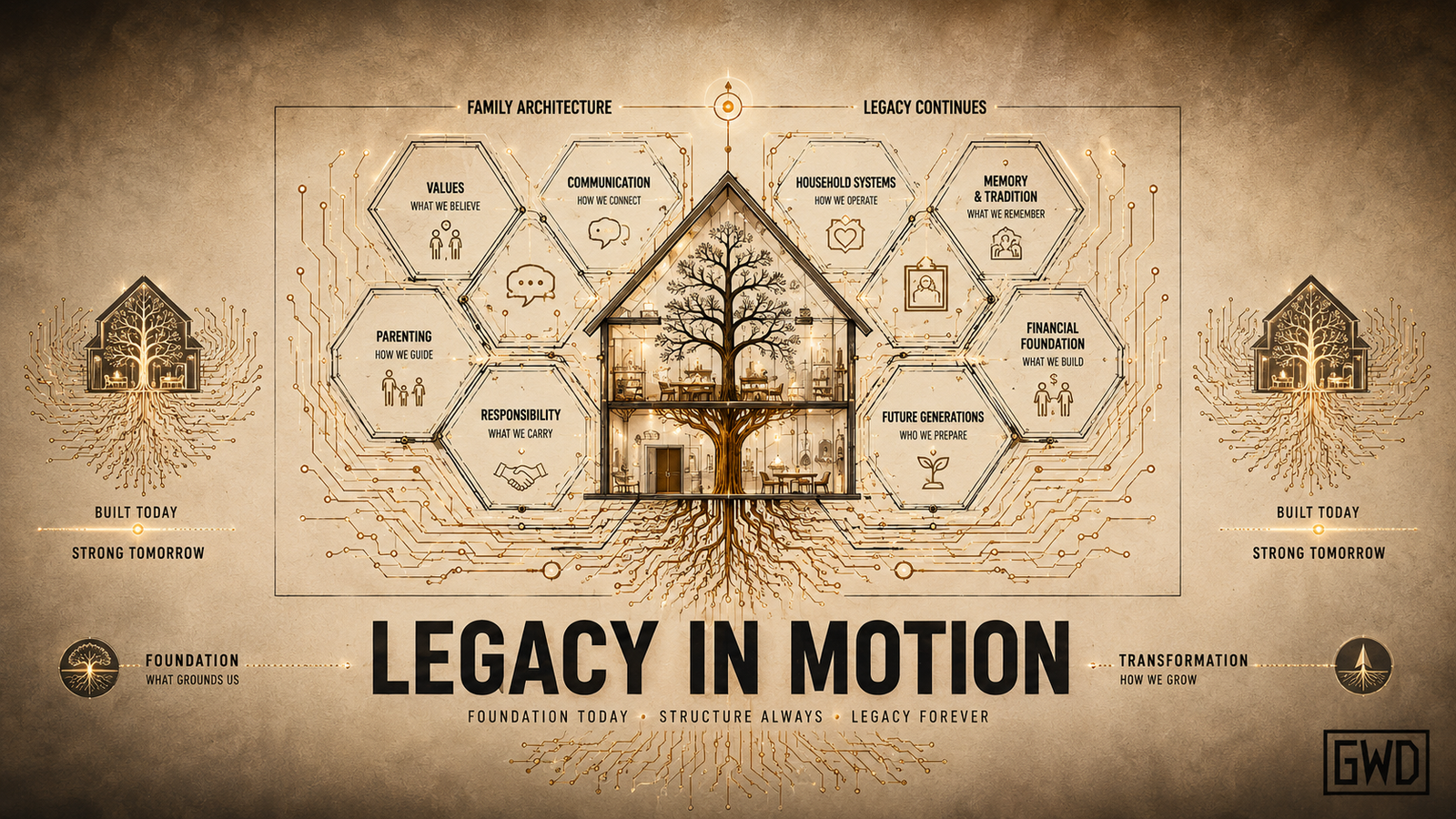
Legacy In Motion Framework
These are not four different definitions of fairness. Together, they test whether an arrangement can actually hold.
Clarity
Can both people explain what each person is responsible for without guessing or discovering the expectation only after something goes wrong?
Visibility
Does the relationship recognize planning, remembering, coordinating, emotional repair, and other work that is easy to overlook?
Rebalancing
Can responsibility move when employment, health, caregiving, parenting, finances, or available capacity changes?
Legitimacy
Can both people explain why the arrangement is reasonable, or is one person simply expected to accept it because that is how things have always been done?
One Person Cannot Declare the Arrangement Fair
That seems obvious, yet relationships do it all the time.
Someone says, “I pay more, so you should handle the house.” Another says, “My job is more stressful, so I should not have to deal with this.” Someone else says, “You are better with the kids,” “You are better with money,” or simply, “You always handle that.”
Any one of those arrangements might be reasonable.
What makes them dangerous is not the division itself. It is the assumption that one person’s explanation automatically settles the matter.
Legitimate fairness requires mutual recognition. Both people may not love every responsibility, but each should be able to see the logic of the arrangement and have a meaningful voice in changing it.
That is part of healthy interdependence. As Appreciating Interdependence explores, depending on one another is not automatically weakness. What matters is whether dependence remains reciprocal, visible, and structured well enough to preserve agency.
Household Economics
Money Makes the Fairness Question Harder to Hide
Money makes the discussion concrete because numbers are easy to compare.
If one partner earns $100,000 and the other earns $50,000, an equal dollar contribution to shared expenses may look neutral. Depending on the household, however, its impact on each person’s remaining capacity can be very different.
That does not mean every couple should split expenses according to income. Couples organize money in many legitimate ways. Some combine everything. Some use proportional contributions. Some divide specific bills. Some maintain substantial financial independence.
The important question is not whether the arrangement resembles somebody else’s.
It is whether the system protects both people from becoming structurally disposable.
A fair financial arrangement should be explainable. Both people should understand what is shared, what remains individual, how decisions are made, what obligations exist, and what happens when income changes.
This is where Legacy In Motion connects naturally to Marcus Vaughn’s work in Money Monday. Household money is not only about paying today’s bills. Repeated financial arrangements shape who has margin, who absorbs risk, who has options, and what a family can eventually carry forward.
Fairness Must Include Work That Does Not Leave a Receipt
Some contributions are easy to see because they produce an object, payment, or completed task.
The electric bill gets paid. Dinner is cooked. The floor is cleaned. A child is picked up. The car is repaired.
Other responsibilities disappear into the background precisely because somebody handled them before they became problems.
Somebody noticed the permission slip. Somebody remembered the birthday. Somebody compared insurance options. Somebody scheduled the appointment, followed up with the school, checked on an aging parent, or noticed that the couple had not spent meaningful time together in weeks.
Fairness becomes distorted when only visible output counts.
A useful fairness conversation therefore asks more than, “What did you do?”
It also asks: What are you carrying that I rarely have to think about because you carry it?
That question often reveals more than another argument about who washed the dishes last.
Revisit the Agreement Before You Revisit the Argument
Couples sometimes have the same fight for years because they keep debating individual incidents instead of inspecting the system producing them.
The argument may be about laundry, spending, bedtime, family visits, childcare, or a missed appointment. Underneath it may be an old agreement that no longer fits the household.
Maybe the division made sense before children. Maybe it made sense before a promotion, illness, layoff, business launch, caregiving obligation, or change in commute.
Maybe nobody ever made an agreement at all. The pattern simply formed, repeated, and eventually became tradition.
That is why relationship structure deserves intentional review. The Legacy In Motion relationship structure framework looks beyond whether two people care about each other and asks whether expectations, responsibility, boundaries, and direction are clear enough to support what they are trying to build.
A relationship should not need a crisis before its operating rules can change.
Structure Builds Freedom
Fairness is easier to negotiate when responsibility is visible before conflict begins.
Clear expectations do not make a relationship transactional. They reduce the emotional energy spent reconstructing who was supposed to do what, why an arrangement exists, and whether asking for change is legitimate.
The right structure leaves room for generosity because generosity no longer has to substitute for an operating system.
Explore Structure Builds Freedom →Put It on the Table
The Fairness vs Equality Relationship Audit
Move the conversation away from vague accusations and inspect the actual structure.
List the recurring financial, household, parenting, planning, caregiving, relationship, and administrative responsibilities.
Identify who currently carries primary responsibility. “We both do it” only helps if both people can explain what that means.
Ask whether the division reflects available time, money, energy, flexibility, skill, and other real constraints.
Identify what one person plans, remembers, anticipates, initiates, or repairs that the other rarely has to notice.
Ask whether both people believe the arrangement is reasonable. If not, identify the part that is difficult to defend.
Decide what change should reopen the conversation: work, money, caregiving, health, children, or a scheduled household review.
Fair Does Not Mean Nobody Ever Carries More
Every long relationship eventually includes seasons when one person carries more.
Pregnancy can do it. Illness can do it. Grief can do it. School, layoffs, new businesses, demanding projects, caring for parents, and raising children can all shift the balance for weeks, months, or sometimes years.
The goal is not to prevent those seasons.
The goal is to make sure sacrifice remains recognizable as sacrifice rather than quietly becoming somebody’s permanent job.
Strong partnership is not demonstrated by never needing one another. It is demonstrated by the ability to carry one another without losing sight of the person doing the carrying.
That is also where fairness becomes part of legacy.
Children learn from what adults normalize. They notice whose time matters, whose exhaustion is treated as legitimate, who gets thanked, who is expected to adjust, and whether responsibility ever moves when circumstances change.
Long before a family explains partnership, the household is already teaching it.
The Groundwork
Build for Legitimacy, Not Perfect Symmetry
A strong relationship does not need every contribution to match.
It does need both people to remain visible inside the arrangement.
Equality protects the idea that neither person’s dignity, voice, security, or future should become secondary simply because their contribution looks different.
Fairness takes that principle into ordinary life. It asks who is carrying what, whether the arrangement still makes sense, and whether both people have enough standing to question it when it no longer does.
“Can we both explain why this arrangement is fair today, and can either of us reopen it when today changes?”
The goal is not perfect symmetry. The goal is a partnership strong enough to keep responsibility visible, movable, and legitimate.
Receipts
Research Behind the Conversation
This article treats fairness as a household structure rather than a universal formula. The source below provides broader context on how married and cohabiting adults describe partnership, relationship satisfaction, household responsibilities, and communication.
How Married and Cohabiting Adults See Their Relationships
External links were live and accessible when this article was published or last substantively updated. Third-party pages may change, move, or be removed over time.
Continue Building
Follow the Structure Beneath Fairness
Fairness becomes clearer when responsibility, stability, resentment, and interdependence are examined together.
When Responsibility Becomes Resentment
What happens when a workable contribution slowly becomes an unreviewed expectation?
The Family Stability Framework
Move from individual tasks into the larger structure of roles, routines, expectations, and repair.
Appreciating Interdependence
Explore how healthy dependence can preserve agency rather than quietly eroding it.
Legacy is not only what a family leaves behind. It is what a family teaches through the way everyday life is built.

Meet the Builder
Marcus Vaughn
Economy, Ownership & Generational Structure
Marcus Vaughn writes about ownership, financial discipline, family structure, and generational continuity. Through Money Monday and Legacy In Motion, he examines the systems that turn income into stability, responsibility into structure, and today’s decisions into tomorrow’s inheritance.