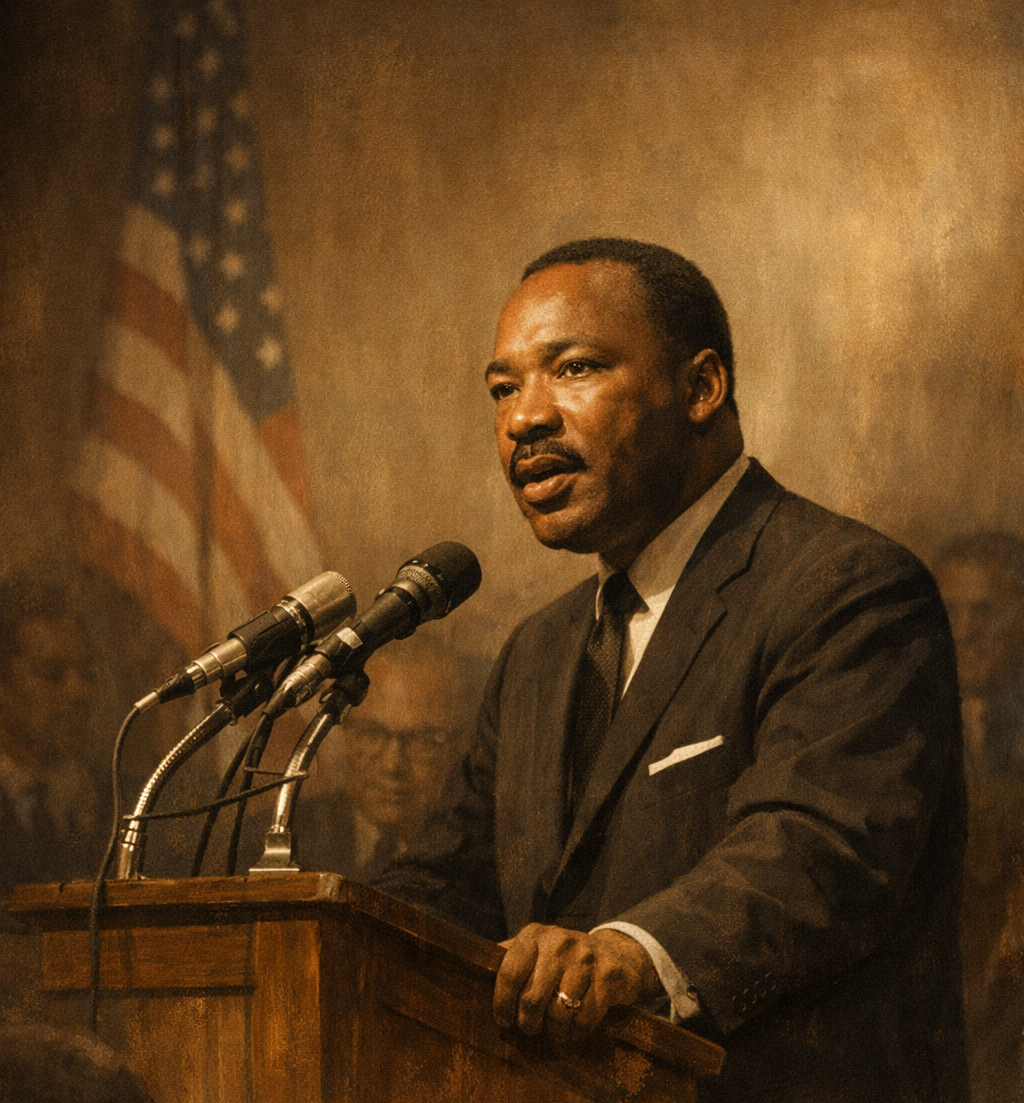
Dr. Martin Luther King Jr argued that emancipation without economic resources left millions with freedom to hunger.
When Dr. Martin Luther King Jr spoke about the history of Black Americans, he sometimes used a phrase that startled audiences. Many readers today search for the MLK freedom to hunger meaning because the phrase sounds both powerful and confusing.
King described emancipation as creating “freedom to hunger.”
At first glance the statement sounds harsh. Slavery ended in 1865, and millions of people who had lived under forced labor were finally free. So why would Martin Luther King Jr describe freedom in such bleak terms?
To understand the meaning of the phrase, it helps to look at the economic reality that followed emancipation.
King was not questioning the moral importance of freedom. He was pointing to a deeper truth about how freedom works in the real world. Political freedom without economic security can leave people exposed to poverty, instability, and hunger.
In other words, legal freedom alone does not automatically create economic opportunity.
The historical reality that followed emancipation helps explain why King used such stark language.
Freedom Without Resources
When slavery ended in the United States, roughly four million formerly enslaved people suddenly entered society as free citizens.
But freedom arrived without the resources that make independence sustainable.
It came without land.
It came without wages saved from generations of labor.
It came without access to capital, credit, or economic protection.
King argued that this created a profound contradiction. People were free in law but extremely vulnerable in practice.
In one speech he explained the situation plainly. Emancipation meant that formerly enslaved people were no longer owned by a slave master. Yet they were also left without the basic resources needed to survive.
They were free to seek work.
Free to travel.
Free to build lives of their own.
Yet they were also free to be hungry.
This was the deeper meaning behind the phrase.
Freedom without an economic foundation can become fragile freedom.
The Missing Economic Foundation
King often compared the experience of Black Americans to that of many European immigrants who arrived in the United States during the nineteenth century.
Those immigrants often faced hardship and discrimination. But many also had access to opportunities that were largely unavailable to formerly enslaved people.
Government policy played a major role in shaping those opportunities.
One example was the Homestead Act, signed into law in 1862. The Act distributed millions of acres of public land to settlers willing to farm it for several years. For families who qualified and could reach the land, the program represented a powerful wealth building opportunity.
Historical records from the National Archives show how the policy helped many settler families build long term security through land ownership.
Land ownership allowed families to produce food, accumulate property, and pass assets to the next generation.
Formerly enslaved people were technically eligible under the Act. In practice, however, the barriers were enormous. Many lacked the money needed to travel west, purchase tools, or survive the years before a farm became productive.
Violence, discriminatory laws, and the absence of institutional support made meaningful participation extremely difficult for most freed families.
While many settler families were building equity on government land, most formerly enslaved families remained in the South working land they did not own.
Many became sharecroppers or tenant farmers, systems that often trapped families in cycles of debt rather than allowing them to build wealth.
King believed this economic starting point mattered deeply. Without land, capital, or credit, it became far more difficult for newly freed communities to accumulate wealth across generations.
The phrase “freedom to hunger” captured that imbalance with brutal clarity.
The Moral Logic Behind the MLK Freedom to Hunger Meaning
King was also making a broader philosophical point.
In public debates about poverty, people often focus on individual behavior. Hard work matters. Discipline matters. Personal responsibility matters.
But economic systems matter too.
If a group of people begins life in a society without access to land, capital, education, or institutional protection, the path forward becomes steeper.
King believed the United States had never fully addressed this structural gap after slavery ended.
That belief shaped much of his later work. During the final years of his life, he spoke more frequently about poverty, economic inequality, and the need for policies that could expand opportunity across American society.
He believed addressing poverty required more than encouraging ambition. It required examining the systems that shape economic opportunity in the first place.
That is part of the larger argument explored in Freedom Without Capital: King’s Economic Argument .
Why the Phrase Still Resonates
The reason the phrase “freedom to hunger” still resonates today is that it highlights a tension that exists in many societies.
Freedom has both a legal dimension and a material dimension.
Legal freedom means a person is not owned or controlled by another person.
Material freedom means having access to the resources that allow a person to build a stable life.
King believed that meaningful freedom requires both.
Without political freedom, people live under domination.
Without economic foundations, freedom can become precarious.
Understanding this balance helps explain the deeper meaning behind King’s words.
The phrase “freedom to hunger” was not meant to diminish the importance of emancipation. Instead, it was meant to highlight the unfinished economic work that followed it.
King’s critique also connects to the logic behind the famous bootless man quote , where he challenged the idea that people can simply rise without resources.
A Larger Conversation
The phrase “freedom to hunger” was only one part of Martin Luther King Jr’s broader thinking about economic justice.
In later speeches he argued that addressing poverty required a deeper examination of economic systems and public policy. These ideas eventually shaped his support for a guaranteed income and his leadership in the Poor People’s Campaign during the final years of his life.
Seen in this wider context, the phrase becomes more than a historical observation.
It becomes a way of asking a deeper question about freedom itself.
Political rights matter.
But the economic foundations beneath those rights matter as well.
When those foundations are weak or missing, freedom can become far more fragile than it appears.
Understanding the MLK freedom to hunger meaning helps illuminate the larger argument King was making about justice, opportunity, and the structures that shape economic life.