
Pillars · Systems & Structure
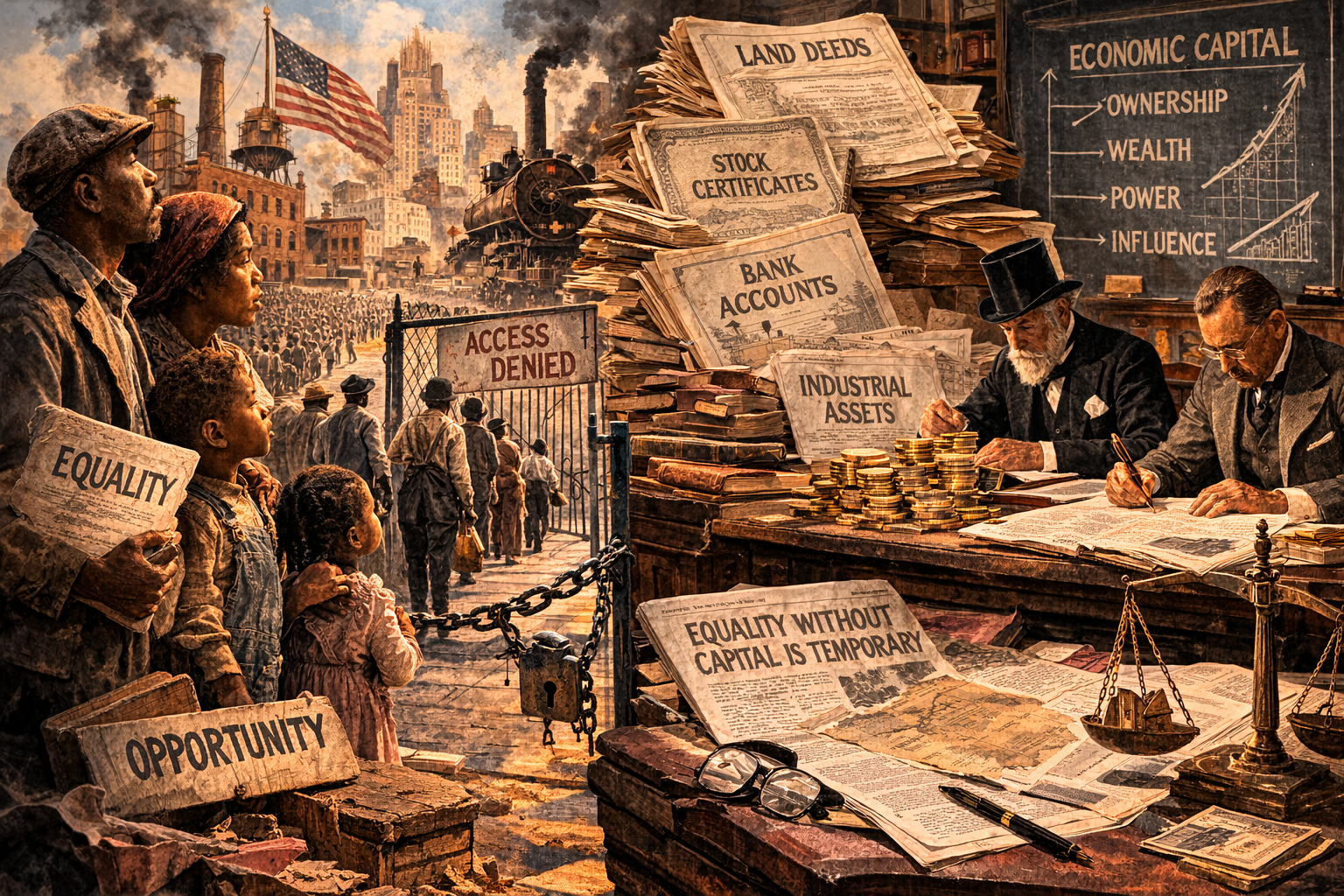
Capital before equality is a structural principle about what happens after legal barriers fall. Rights can create access, but savings, ownership, credit, assets, and financial resilience often determine whether people have the capacity to convert that access into durable opportunity.
Public debates about equality usually begin with rights. Can a person vote? Can a family purchase a home in a particular neighborhood? Can a worker compete for the same job? Can an entrepreneur enter the same market?
Those questions matter because legal exclusion can block participation before anything else becomes possible.
However, removing a barrier does not guarantee that everyone arrives at the newly opened door with the same resources.
One household may arrive with savings, home equity, investments, strong credit, and relatives who can provide financial help. Another may arrive with debt, little savings, no inherited assets, and almost no margin for failure.
Both households may possess the same legal right, yet their ability to use that right can still be radically different.
That gap between formal access and material capacity is the foundation of capital before equality.
The Architecture
Rights → Access → Capacity → Ownership → Leverage → Durability
Rights establish what people are allowed to do. Access creates an opening. Capacity determines whether they can act. Ownership builds an economic base. Leverage improves negotiating power. Durability determines whether progress can survive pressure and transfer forward.
Start With the Distinction
What Capital Before Equality Actually Means
Capital before equality does not mean that money matters more than rights.
Rights are foundational because discriminatory rules can prevent participation outright.
The principle makes a different argument. Once a barrier is removed, people still enter the system with different levels of economic capacity.
As a result, equal permission can produce unequal experiences when the resources available to act on that permission differ sharply.
Formal Equality and Material Capacity Are Different
Formal equality concerns rules. Economic capacity concerns resources.
For example, a law may allow two households to purchase property. Yet one household may have a down payment, strong credit, emergency reserves, and family support while the other does not.
Therefore, equal access to the transaction does not mean equal ability to complete it.
This is where capital formation inequality begins to matter. The rules may become more equal while the economic capacity needed to use those rules remains uneven.
Building the Economic Base
Capital Before Equality Starts With Capital Formation
Capital is more than cash sitting in an account.
In economic terms, capital can include productive assets such as businesses, equipment, real estate, financial investments, and other resources capable of generating income or increasing in value.
Savings matter too because they create liquidity and margin. Together, these resources can expand the range of choices available to a household or institution.
Capital Creates Options
A household with enough reserves to survive several months of unemployment may have time to search for a better job instead of immediately accepting the first available offer.
Likewise, a business with working capital may be able to purchase equipment, hire staff, survive a slow season, or expand into another market.
A family with home equity may possess another form of financial capacity. Investments can also provide resources that are not tied entirely to current wages.
None of these assets guarantees success. Nevertheless, capital expands the set of available moves.
The Hidden Advantage
Capital Formation Inequality Is Also an Inequality of Options
Wealth is often discussed as a number. That framing misses one of its most important functions.
Capital creates optionality.
A person with financial reserves can sometimes wait. A person without reserves may have to decide immediately.
One business may be able to reject unfavorable financing. Another may accept expensive credit because payroll is due.
Similarly, one family can relocate for a better opportunity while another may be unable to cover the cost of moving.
Consequently, capital formation inequality can become an inequality in the number and quality of choices available.
A Critical Difference
Capital Before Equality Requires Distinguishing Income From Wealth
One of the most common mistakes in discussions about inequality is treating income and wealth as interchangeable.
They are not.
Income is a flow of money earned during a period of time. Wealth, by contrast, reflects the value of assets after liabilities are considered.
A high-income household can still possess relatively little wealth if debt and expenses absorb most of its earnings. Meanwhile, a household with moderate income may hold substantial assets accumulated over decades.
Why the Difference Matters
Income primarily supports current consumption and saving.
Wealth can support the present while also creating future options.
Assets may appreciate. Investments can produce returns. Business equity may increase. Property can sometimes be transferred to another generation.
Therefore, two households with similar annual incomes can operate from very different economic positions.
Capital before equality is not simply an argument for higher wages. It is an argument for understanding the structural difference between earning income and accumulating assets.
What the Data Shows
Asset Ownership Helps Reveal Capital Formation Inequality
Federal Reserve data from the 2022 Survey of Consumer Finances illustrates how different household asset positions can become.
Median net worth among homeowners was about $396,200, compared with about $10,400 among renters and other non-homeowners.
The same survey also documented substantial differences in median wealth across racial groups. Median wealth was about $285,000 for White families and about $44,900 for Black families in 2022.
These figures do not prove that ownership alone causes every economic difference. However, they demonstrate why asset position matters when evaluating financial margin, resilience, and transferable wealth.
From Participation to Position
Ownership Is the Structural Center of Capital Before Equality
Access to work matters. Ownership changes the position from which work occurs.
Workers generally earn income by exchanging labor for compensation. Owners may also receive value from profits, equity appreciation, rents, investments, or business growth.
These roles are not mutually exclusive. A worker can own investments, property, or a business. Likewise, many business owners remain heavily dependent on their own labor.
The important difference is structural.
Ownership Can Create Accumulation Beyond Wages
Labor income usually requires continued participation. When work stops, the associated wage may stop as well.
Some assets behave differently. Investments may appreciate, businesses can retain equity, and property may increase in value or generate income.
As a result, ownership can create a pathway from current income toward longer-term accumulation.
That pathway is one reason capital formation inequality can persist even among people who participate in the same labor market.
Economic Position
Capital Creates Leverage, Not Just Wealth
Wealth is often treated like a scoreboard. Its more important function may be strategic.
Assets can change the terms on which people negotiate with institutions.
For instance, a household with savings may be able to reject a bad loan. A worker with financial reserves may have more freedom to leave a harmful workplace.
Similarly, a business with sufficient cash flow may be able to reject unfavorable financing. An institution with reserves can often plan farther ahead than one operating from funding cycle to funding cycle.
Scarcity Narrows the Decision Window
When resources are thin, decisions often have to be made quickly.
Someone with no emergency reserve may accept terms that a person with several months of savings can refuse.
Therefore, capital does not merely purchase goods. It can also create time, patience, and negotiating room.
Stability Under Pressure
Capital Before Equality Also Explains Economic Resilience
Economic systems should not be evaluated only during normal conditions. Pressure reveals structure.
A medical bill, job loss, business downturn, housing repair, or family emergency can affect households with similar incomes very differently.
A household with savings may absorb the expense without changing its long-term trajectory.
By contrast, a household without reserves may need to borrow, miss payments, sell assets, or delay another important expense.
The Same Shock Can Produce Different Futures
This is one way inequality compounds.
A family with capital may experience an emergency as a temporary setback. Another family may experience the same emergency as new debt, damaged credit, lost housing, or reduced educational opportunity.
Over time, repeated differences in the ability to absorb pressure can produce very different economic trajectories.
Capital therefore creates more than upside. It can also create protection against downside.
The Compounding Layer
Capital Formation Inequality Can Cross Generations
Economic position does not reset to zero every time a new generation is born.
Families can transfer property, businesses, savings, investments, education support, professional networks, and financial knowledge.
Even relatively modest transfers can alter a trajectory.
Small Transfers Can Change Timing
Help with a down payment can move homeownership forward by years. Tuition assistance can reduce student debt.
A family business may provide employment or ownership before an outside lender becomes involved. Emergency assistance can also prevent a temporary problem from becoming long-term debt.
None of these advantages guarantees a particular outcome. Still, each can change when a person begins accumulating assets and how much risk that person can absorb.
Starting Position Is Part of the System
Public narratives often focus on effort after adulthood begins. Yet economic trajectories can be shaped well before that point.
One person may enter adult life with debt and no assets. Another may begin with a paid education, family property, inherited investments, or access to startup capital.
Both still have to make decisions. Their starting positions are not the same.
Historical Consequence
Capital Before Equality Explains Why Legal Reform Can Outpace Material Change
This distinction becomes especially important when examining populations that were historically restricted from acquiring, protecting, or transferring assets.
Removing discriminatory law matters enormously.
Yet a legal change does not automatically recreate property that was never acquired, businesses that were never financed, or assets that were prevented from compounding.
Nor does reform immediately eliminate differences in inherited wealth, credit access, neighborhood conditions, or institutional networks.
Formal Reform and Material Repair Operate on Different Timelines
This is why arguments about historical inequality often talk past one another.
One side may correctly identify the removal of a formal barrier. Another may correctly identify material differences that remain after the law changes.
Those observations are not necessarily contradictory.
Legal equality can change rules quickly. Capital formation usually takes much longer.
The Structural Distinction
Access Tells You Whether the Door Is Open. Capacity Tells You Whether You Can Move Through It.
A scholarship may create educational access, but housing, transportation, food, time, and family obligations can still affect whether a student remains enrolled.
Likewise, a business loan program may create access to credit, while collateral, cash flow, and market position influence whether the business survives.
Fair housing law can prohibit discrimination, yet savings, debt, credit, and property prices still affect who can purchase.
Equality of rules and equality of capacity are related. They are not interchangeable.
Beyond the Household
Capital Before Equality Applies to Institutions Too
The framework does not stop with individuals and families.
Institutions also operate differently depending on their capital base.
A community organization with unrestricted reserves can hire staff, maintain facilities, commission research, and survive temporary funding gaps.
By contrast, an organization without reserves may spend much of its energy securing the next grant or contract.
Institutional Capital Changes Planning Horizons
A university with a large endowment has options that a tuition-dependent institution does not.
Similarly, a neighborhood with locally owned businesses, property owners, professional networks, financial institutions, and stable civic organizations possesses a different form of capacity than a neighborhood without those assets.
Ownership, therefore, is not only personal. Communities and institutions can possess, build, lose, or fail to develop capital as well.
Keep the Framework Honest
Capital Before Equality Does Not Explain Everything
Capital matters greatly, but it is not the only force shaping economic outcomes.
Institutions matter. Discrimination matters. Education, health, geography, labor markets, family obligations, public policy, social networks, and individual decisions matter too.
Moreover, ownership itself can fail.
Businesses collapse. Property can lose value. Investors make bad decisions. Debt can overwhelm an asset.
Capital creates capacity. It does not guarantee success.
Rights and Capital Are Complements, Not Substitutes
It would also be a mistake to suggest that assets can substitute for legal equality.
Wealth does not make discrimination acceptable. Property does not eliminate the need for voting rights. Business ownership does not replace equal protection.
Strong systems need both fair rules and broad economic capacity.
The purpose of capital before equality is to show why one without the other can remain incomplete.
Applied Groundwork
Five Questions for Testing Economic Capacity
The Capital Before Equality framework becomes more useful when it can be applied to real systems.
These five questions help separate formal access from durable capacity.
Identify the formal right or access that now exists.
Consider savings, credit, time, transportation, education, networks, and collateral.
Look beyond wages toward property, equity, businesses, and investments.
Resilience often determines who can survive setbacks and try again.
Durable systems leave assets, institutions, knowledge, or leverage behind.
The Groundwork
Capital Before Equality Is About What Happens After the Door Opens
Equality under law is essential. However, a society can remove a barrier without erasing every material difference that existed before the barrier fell.
That is the central insight behind capital before equality.
Rights establish permission, while access creates an opening. Economic capacity then influences whether people can act on that opening.
From there, ownership can create an economic base. Leverage can change negotiating power. Finally, durability determines whether progress survives pressure and transfers forward.
Capital formation inequality matters because those layers do not begin at the same point for every household, institution, or community.
None of this reduces justice to money. Instead, it makes the analysis more complete.
Equal rights open the system. Economic capacity shapes how much can be built once people enter it.
Continue Building
This asset is part of a larger Groundwork framework examining legal access, economic capacity, ownership, and durable institutional power.
→ Historical Mechanism: The Land America Never Gave
→ Economic Justice: The Poor People’s Campaign Explained
→ Leadership & Structure: Why Martin Luther King Jr. Became More Controversial After 1965
Build Better. Every Day.
Access matters. Capacity determines what can be built from it.
Groundwork Daily examines the systems beneath money, institutions, ownership, policy, and everyday life.
Pillars · Systems & Structure
Explore Systems & Structure
Continue through Groundwork Daily’s foundational work on structure, incentives, ownership, institutional capacity, and the systems that shape long-term outcomes.
