
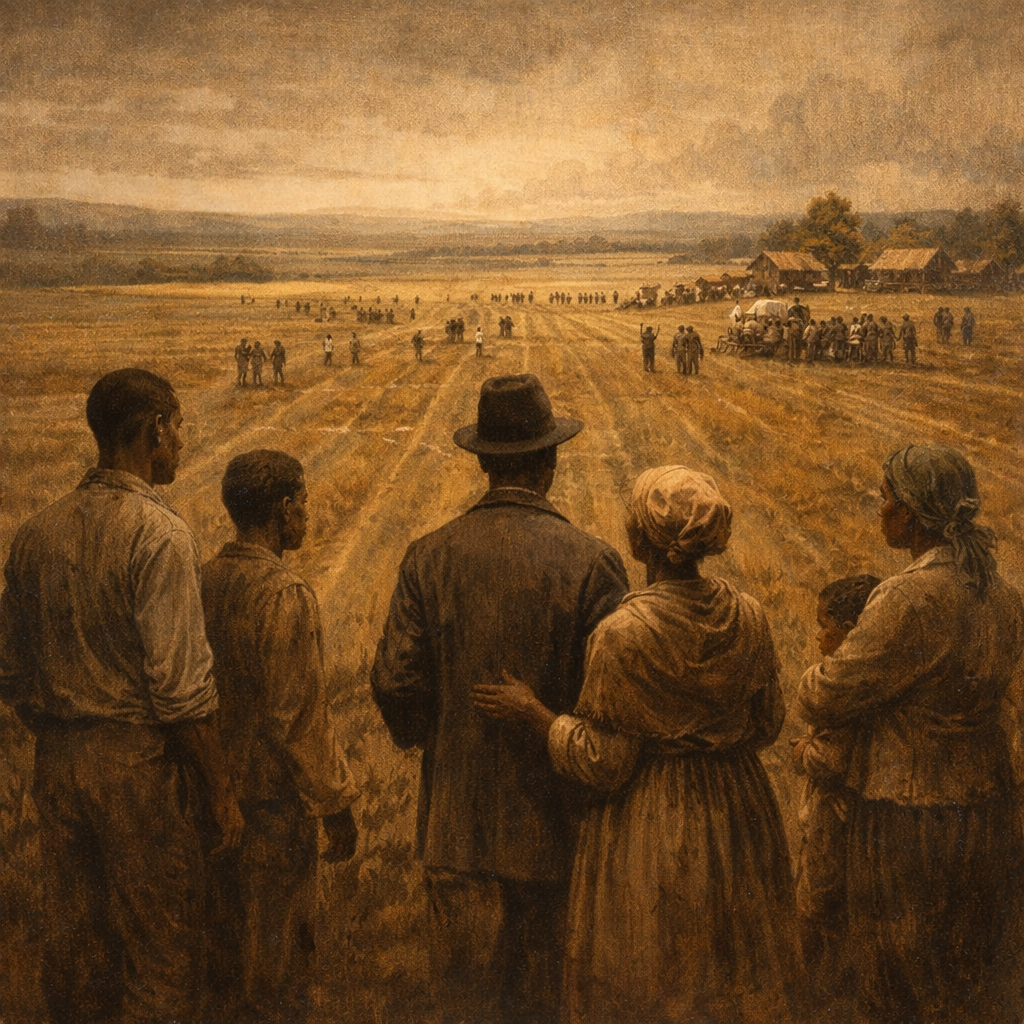
After the Civil War, millions of formerly enslaved Americans expected land as the foundation of freedom. The nation chose a different path.
When people ask how the Homestead Act wealth gap began, they are often referring to a promise that seemed to exist for a brief moment in American history.
In January 1865, Union General William Tecumseh Sherman issued Special Field Order No. 15, which temporarily set aside approximately 400,000 acres of coastal land in South Carolina, Georgia, and Florida for formerly enslaved families. Each family would receive up to 40 acres. The policy quickly became known as forty acres and a mule.
The order was not symbolic. It was a concrete attempt to convert emancipation into economic independence.
The order followed a January 12, 1865 meeting between Sherman, Secretary of War Edwin Stanton, and twenty Black ministers and community leaders in Savannah, Georgia. Those leaders made clear that land ownership was inseparable from meaningful freedom.
“The way we can best take care of ourselves is to have land, and turn it and till it by our own labor.”
— Garrison Frazier, spokesperson for the group, January 1865
Source: Reconstruction: America’s Unfinished Revolution, Eric Foner, 1988
By June 1865, roughly 40,000 freed people had settled on approximately 400,000 acres under the order.
Within months, President Andrew Johnson — himself a Tennessee slaveholder before the war — issued a blanket amnesty to former Confederates and ordered the land returned to its previous owners. Freedmen’s Bureau Commissioner Oliver Howard was personally sent to deliver the news to the settlers on the Sea Islands.
“The government… cannot keep its promise to you.”
— Oliver Howard, addressing freed settlers, 1865
Source: Been in the Storm So Long, Leon Litwack, 1979
Later civil rights leaders would revisit this same question of economic foundations. Martin Luther King Jr. argued that political rights alone could not eliminate poverty without addressing structural inequality, a theme explored in King’s economic justice argument.
The Homestead Act and Who It Served
The Homestead Act of 1862 allowed any citizen — or anyone who intended to become one — to claim 160 acres of federal land by settling and cultivating it for five years.
Between 1862 and 1934, when the program effectively ended with the Taylor Grazing Act, the federal government distributed roughly 270 million acres through homesteading and related land programs.
Historian Paul Gates documented this distribution extensively in History of Public Land Law Development (1968), published by the Public Land Law Review Commission. The figure is also supported by:
- National Archives: Records of the Bureau of Land Management
- U.S. Department of the Interior, Bureau of Land Management historical records
A landmark study by Trina Williams Shanks, published in The Homestead Act: A Major Asset-Building Policy in American History (2005, Washington University in St. Louis), estimated that approximately 46 million living Americans are descendants of Homestead Act recipients. Shanks specifically noted that the program’s benefits were distributed along racial lines, with Black Americans largely excluded through a combination of legal, economic, and violent barriers.
→ Read the Shanks study via Washington University
Why Freed People Were Effectively Excluded
The exclusion was not written explicitly into the Homestead Act’s text. It operated through overlapping mechanisms.
1. Capital Requirements
Claiming land required filing fees, travel costs, equipment, seed, and the financial ability to survive without income for the five-year cultivation period. Freed people emerged from slavery with virtually no capital.
Source: Slavery by Another Name, Douglas Blackmon, 2008
2. Violence and Intimidation
The postwar South was characterized by systematic racial terror. The Ku Klux Klan, founded in 1865, and similar organizations targeted Black landowners specifically, burning farms and murdering families who attempted to accumulate property.
3. Collapse of the Freedmen’s Bureau
The Bureau of Refugees, Freedmen, and Abandoned Lands, established in 1865, was the primary federal agency intended to assist freed people with land claims, labor contracts, and legal protection. It was chronically underfunded, politically opposed by President Johnson, and largely dismantled by 1872.
Source: National Archives — Freedmen’s Bureau Records
4. The Sharecropping Trap
Without land or capital, most freed people in the rural South entered sharecropping arrangements that kept them in cycles of debt. Landlords controlled credit, supplies, and record-keeping. Studies of Reconstruction-era labor contracts show that sharecroppers rarely escaped debt.
Source: The Half Has Never Been Told, Edward Baptist, 2014, Basic Books
The Homestead Act Wealth Gap and Compounding Inequality
Land ownership functions as economic infrastructure in several compounding ways.
| Function | Mechanism |
|---|---|
| Income production | Farming, leasing, resource extraction |
| Credit access | Land used as loan collateral |
| Savings storage | Appreciating asset over time |
| Intergenerational transfer | Passed to children as inherited wealth |
The connection between land policy and the Homestead Act wealth gap becomes clearer when we examine how property ownership compounds across generations.
The Federal Reserve’s Survey of Consumer Finances consistently shows that real estate is the largest single component of wealth for most American families.
According to the Federal Reserve’s Survey of Consumer Finances, the median white family holds approximately $188,200 in wealth while the median Black family holds approximately $24,100. That gap, roughly 8 to 1, has remained persistent for decades.
→ Federal Reserve: Survey of Consumer Finances, 2022 (PDF)
The connection between post-Civil War land policy and present-day wealth disparities is also documented by the Brookings Institution and by economists Darrick Hamilton and William Darity Jr., whose work in stratification economics traces a direct structural line between post-emancipation land policy failures and contemporary racial wealth inequality.
- Brookings Institution, Examining the Black-White Wealth Gap, 2020
- Hamilton & Darity: Baby Bonds and the Racial Wealth Gap, Russell Sage Foundation
The Political Decision Behind It All
The reversal of Sherman’s order and the failure to implement meaningful land redistribution was not administrative oversight. It was a deliberate political choice with identifiable actors and documented reasoning.
Eric Foner, the foremost historian of Reconstruction, describes the period in detail in Reconstruction: America’s Unfinished Revolution, 1863–1877 (1988), Harper & Row — widely considered the definitive scholarly account of the era.
“With the overthrow of Reconstruction, the South’s ‘redeemers’ effectively ended the black community’s brief experiment in self-determination.”
— Eric Foner, Reconstruction, 1988
A more recent and accessible account appears in Henry Louis Gates Jr.’s Stony the Road: Reconstruction, White Supremacy, and the Rise of Jim Crow.
Henry Louis Gates Jr., Stony the Road (2019), Penguin Press
Further Reading and Primary Sources
| Source | Type | Access |
|---|---|---|
| Eric Foner, Reconstruction (1988) | Scholarly history | Library / Purchase |
| National Archives: Freedmen’s Bureau Records | Primary source | archives.gov |
| Equal Justice Initiative, Reconstruction in America (2020) | Research report | eji.org |
| Brookings Institution, Racial Wealth Gap (2020) | Policy research | brookings.edu |
| Trina Williams Shanks, Homestead Act study (2005) | Academic paper | Washington University |
| Federal Reserve, Survey of Consumer Finances (2022) | Federal data | federalreserve.gov |
| Bureau of Land Management, land history | Federal records | blm.gov |
| Douglas Blackmon, Slavery by Another Name (2008) | Pulitzer-winning history | Library / Purchase |
Conclusion
The failure to redistribute land after emancipation was not a missed opportunity in isolation. It was one decision inside a broader political settlement that preserved the economic structure of the plantation South while granting legal freedom without material foundation.
The compounding effects of that decision — measured in wealth gaps, credit access, homeownership rates, and inherited assets — remain statistically visible more than 150 years later.
Understanding the history does not require accepting any single policy conclusion. But it does require acknowledging that the starting line was not equal, and that the distance between where different groups of Americans began in 1865 has shaped where their descendants stand today.
Economic foundations matter because freedom without material stability can easily collapse into insecurity. Civil rights leaders would later make this argument directly. Martin Luther King Jr. argued that legal freedom without economic security created fragile freedom — a theme explored in King’s economic justice argument. Without those foundations, freedom could easily resemble what King once described as freedom to hunger.
Further Groundwork
Freedom Without Capital: King’s Economic Argument
