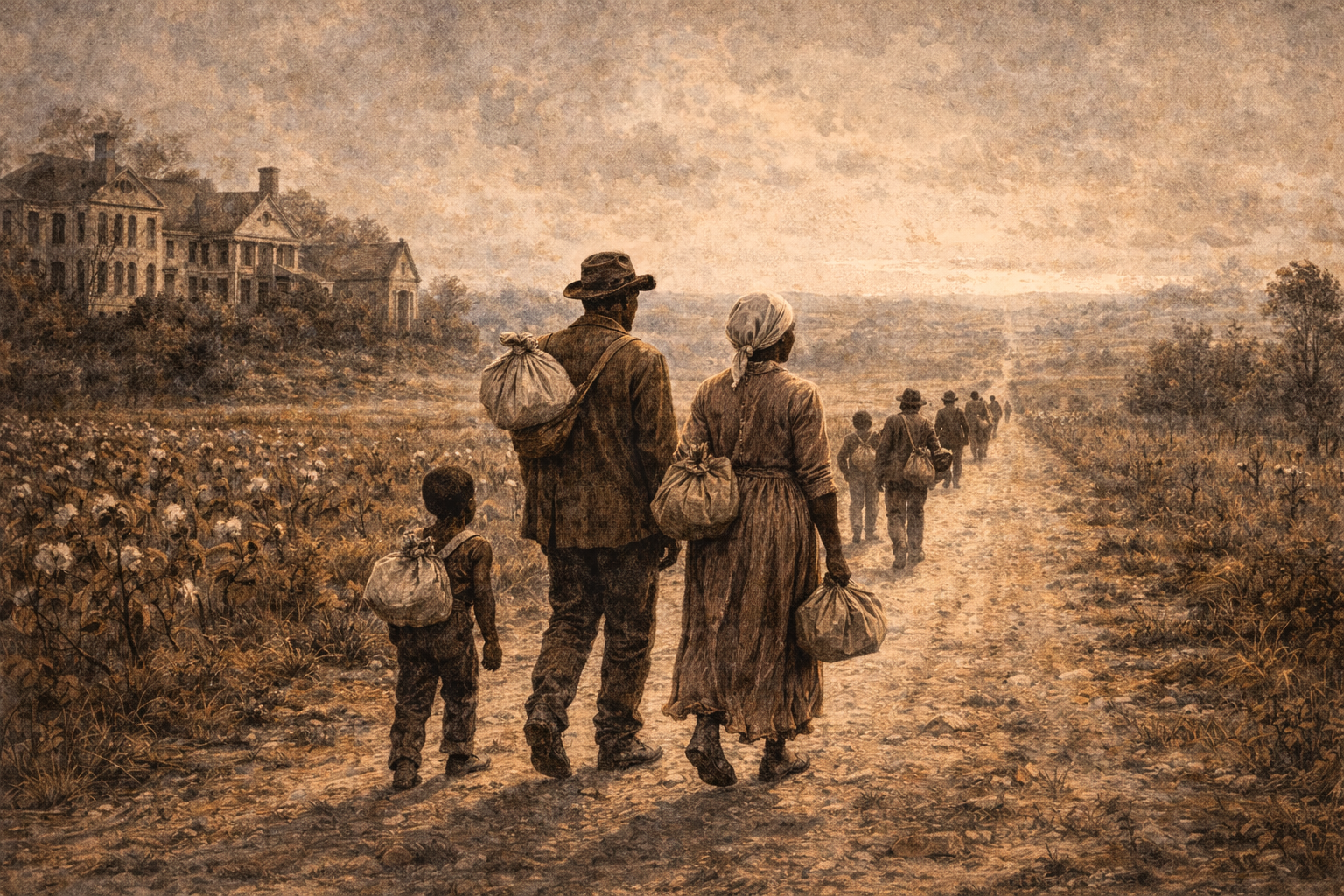
After emancipation, freedom arrived before land, wages, or economic security.
America loves a good freedom story.
Chains break. The music swells. Somebody gives a speech. Everybody nods like justice just clocked in for work and started fixing things.
But history is not a movie montage. When slavery ended in 1865, four million people walked out of bondage and straight into the world’s most awkward group project.
Step one: congratulations, you’re free.
Step two: good luck figuring out how to survive.
The real question was never just “Are you free?” It was “What can freedom actually build with no land, no tools, and no money?”
Freedom is powerful. Freedom is sacred. But freedom without land, money, or tools can feel a little like being dropped in the middle of the ocean and told you’re now free to swim anywhere you want.
Technically true. Practically complicated.
The Missing Starter Kit
Most newly freed families left plantations with almost nothing. No savings. No property. No livestock. Not even guaranteed wages in many cases.
Imagine leaving a job today with no paycheck, no bank account, no home, and somebody saying, “Alright, now go build a life.”
That’s roughly what the end of slavery looked like for millions of people.
There were rumors that land might be distributed. Folks started talking about “forty acres and a mule” like it was the world’s most overdue starter kit.
Land meant food. Land meant a house. Land meant you didn’t have to beg anybody for work tomorrow.
As the essay The Land America Never Gave lays out, that promise quietly disappeared as the country decided reconciliation with former slave owners was politically easier than building an economic foundation for the people who had just been freed.
The Fine Print of Freedom
This is where the story gets uncomfortable.
Ending slavery solved the moral catastrophe of human ownership. It did not automatically solve the economic question of survival.
Freedom gave people the right to work. But if you did not own land, tools, or businesses, working usually meant working for the same landowners who had controlled the plantations before.
That is how systems like sharecropping showed up. On paper it looked like independence. In reality it often meant debt, unstable income, and a constant struggle to stay ahead of the harvest.
You were free. But your landlord owned the land. The merchant owned the credit. And the crop decided whether you ate well that year.
That is a very different kind of freedom than the speeches usually describe.
The Capital Problem Nobody Mentions
There is a simple economic rule that rarely shows up in inspirational history lessons.
Ownership changes everything.
If you own land, a business, or equipment, you are building something that can grow. If all you have is labor, you are starting from scratch every single morning.
That difference matters across generations.
The article Capital Before Equality explains the idea clearly. Legal rights can open doors, but capital determines how far someone can walk once they get inside.
Think about it like this. Freedom gives you the keys to the car. Capital puts gas in the tank.
Without the gas, you are still technically free to drive.
You are just not going very far.
And if everyone else’s car came with a full tank and a head start, it is not just about how hard you drive. It is about what you started with.
Why This Still Matters
None of this takes away from the importance of emancipation. Ending slavery was one of the most important moral victories in American history.
But history gets clearer when we stop pretending that one decision solved every problem overnight.
Freedom was the beginning of the journey, not the finish line.
Newly freed communities built schools, churches, businesses, and entire neighborhoods under conditions that would have crushed a lot of people. The resilience alone deserves its own monument.
At the same time, the economic foundation that could have stabilized those communities never fully arrived.
You can still see that missing starter kit today in the racial wealth gap, where Black families on average hold a fraction of the assets white families do.
That missing foundation shaped generations.
The Real Lesson
There is a quiet lesson hiding inside this part of history.
Freedom is necessary. But freedom works best when it arrives with tools.
Land. Capital. Education. Ownership. Those things turn freedom from an idea into a functioning life.
Without them, freedom can still exist. It just has to work a lot harder.
And sometimes it has to work while it is still hungry.
“My grandmother used to say something simple: freedom is good, but freedom with groceries is better.”
— remembered wisdom