
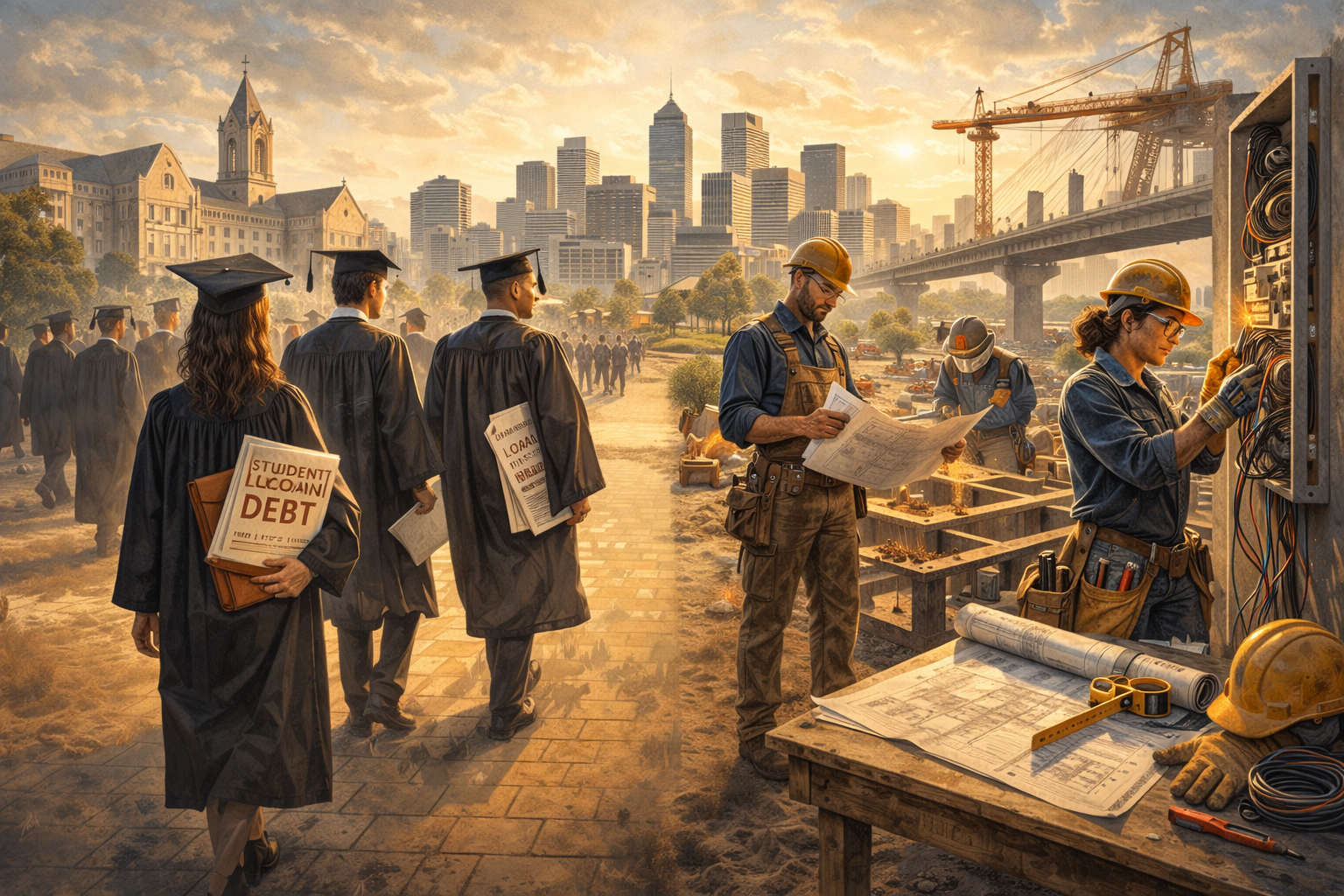
College prestige decline is happening right in front of us, and a lot of people are pretending not to notice.
For decades the cultural script was simple. Go to college, get the degree, and your life opens up like a luxury hotel lobby. Respect. Opportunity. Stability.
Parents repeated it. Schools repeated it. Politicians repeated it. Television repeated it.
But a funny thing happens when a cultural promise runs into economic reality.
A lot of graduates are now holding a diploma in one hand and a five-figure student loan bill in the other.
Meanwhile the electrician who wired the building is buying a house.
The prestige ladder we built
For most of the late twentieth century, college functioned as a cultural VIP pass. A degree meant you had made it into the “serious people” club.
The logic sounded reasonable at the time. The economy was shifting toward professional work, universities expanded rapidly, and more families wanted their children to access opportunity.
So the message hardened into a rule.
If you were ambitious, you went to college. If you skipped college, people assumed you settled for less.
That story held power for a long time. But stories eventually collide with math.
Debt changed the prestige equation
The problem is not education. Learning will always matter. Knowledge always matters.
The problem starts when the price of the ticket keeps rising but the ride stops delivering what it promised.
Student loan debt in the United States now exceeds $1.7 trillion according to the Education Data Initiative. Millions of graduates enter adulthood already carrying financial pressure.
That changes how people think about prestige.
Prestige feels different when the monthly payment arrives every thirty days.
The workers who never stopped building
While the culture was busy worshiping diplomas, something interesting happened.
The people who actually build the country never stopped working.
Electricians wire hospitals. Welders fabricate bridges. Mechanics keep transportation moving. Construction crews turn empty land into neighborhoods.
The U.S. Bureau of Labor Statistics continues to project strong demand for skilled trade occupations as experienced workers retire and infrastructure investment grows.
Turns out societies still need people who know how to fix things.
And when those people become scarce, their value rises fast.
Prestige finally met reality
Here is the uncomfortable part nobody wants to say out loud.
For years we treated college like the only respectable path in America. If you went into the trades people looked at you like you missed the exit ramp to success.
Meanwhile the guy “who missed the exit” is wiring half the city and billing $90 an hour.
Reality has a funny way of humbling cultural narratives.
When student loans show up every month and the electrician down the street just bought a boat, people start asking new questions about prestige.
Not disrespectful questions. Just honest ones.
Because the truth is simple.
Societies eventually rediscover the value of the people who actually know how to build things.
Bridges do not care about prestige. Power grids do not care about prestige. Homes do not care about prestige.
They care about skill.
The Groundwork
The college prestige decline does not mean education has lost value. It means the economy is rediscovering something it temporarily forgot: practical skill matters.
Further Groundwork
Why Skilled Trades Are Rising Again
Why infrastructure demand is increasing the economic importance of skilled trades.
College vs Apprenticeship: The New Labor Pipeline
How modern workforce systems combine academic education with hands-on training.
Receipts
Education Data Initiative
Student loan debt statistics in the United States.
U.S. Bureau of Labor Statistics
Employment projections for skilled trades and labor markets.
Real talk.
Prestige built on paperwork fades fast.
The people who can actually build the world never go out of style.
