
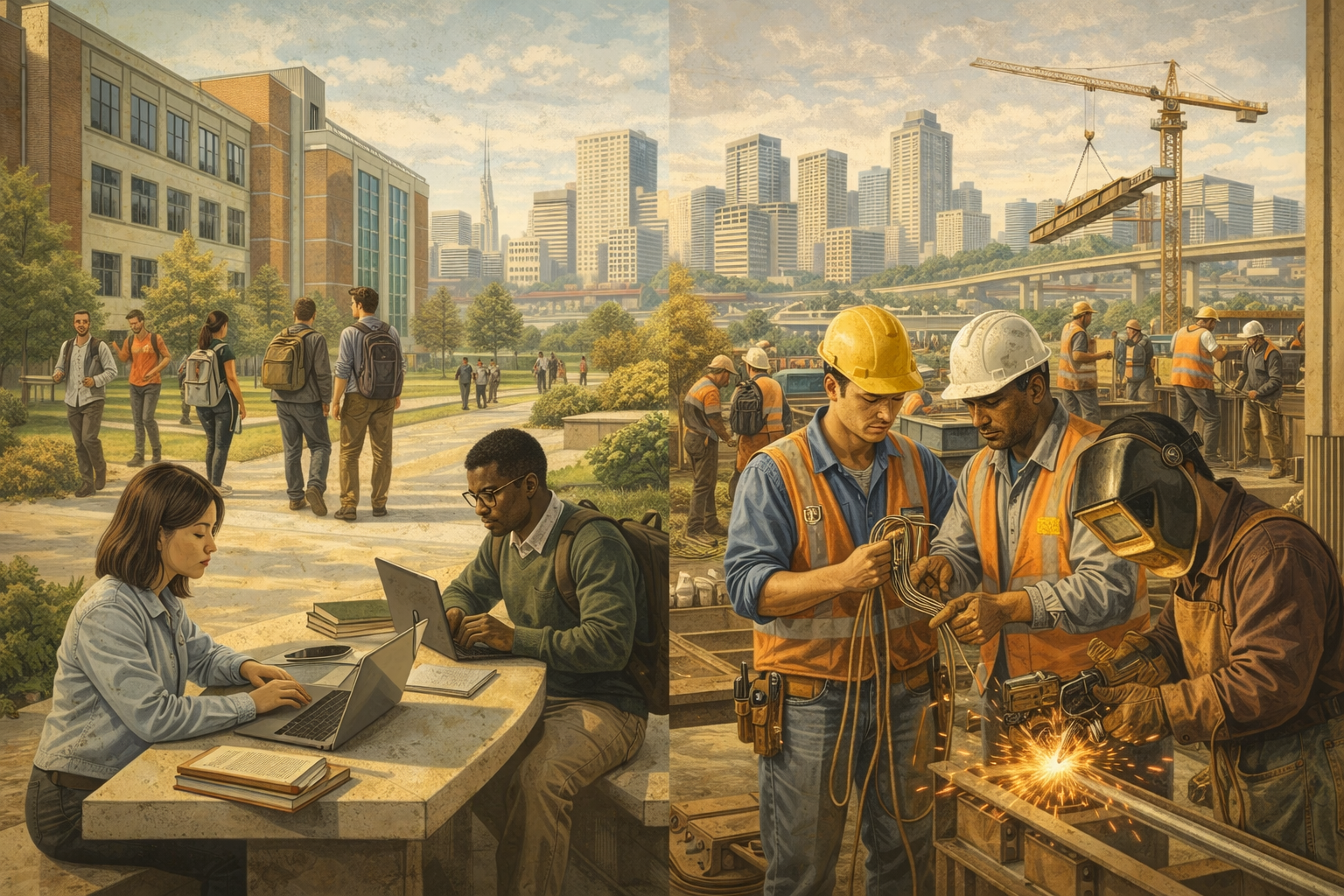
College vs apprenticeship has become one of the most important workforce debates in America. For decades, college was presented as the primary path to economic stability. Today, rising education debt, skilled labor shortages, infrastructure investment, and changing employer needs are forcing a harder question: what kind of training actually prepares people for the economy being built now?
The answer is not simple. College still matters. Apprenticeships still matter. However, the weak thinking is pretending one pathway can carry the entire workforce pipeline by itself. Modern economies need engineers, analysts, planners, researchers, electricians, technicians, welders, mechanics, builders, and operators. In other words, a functioning society needs both intellectual expertise and practical competence.
Table of Contents
- How the workforce pipeline changed
- The cultural mistake behind the labor shortage
- Why apprenticeships are returning
- College vs apprenticeship comparison
- The college pathway still matters
- Why the debate matters for future workers
- Building a stronger labor pipeline
- What families should consider
- The Groundwork
How the workforce pipeline changed
For much of the late twentieth century, education policy emphasized expanding college enrollment. The belief was simple: more degrees would produce a stronger economy.
In many fields, that assumption proved correct. Engineers, medical professionals, scientists, researchers, lawyers, educators, architects, and analysts often require deep academic preparation. Therefore, universities remain essential institutions for advanced knowledge, technical innovation, research, and professional credentialing.
However, the college-first model created an unintended consequence. As enrollment expanded, fewer young people entered skilled trades, technical apprenticeships, and hands-on professions. Over time, this weakened the workforce pipeline for construction, manufacturing, energy, infrastructure maintenance, transportation, and repair work.
Today, the result is visible. Employers across the country report difficulty finding electricians, welders, mechanics, HVAC technicians, machinists, and industrial maintenance workers capable of sustaining complex physical systems.
That problem is not cosmetic. It is structural. A country can design ambitious infrastructure plans, but without enough skilled workers to build and maintain them, the plan remains paper.
The cultural mistake behind the labor shortage
America spent decades telling young people that physical labor represented failure. That message was not always stated directly. Still, it moved through school counseling, family expectations, media narratives, and status culture.
College became the respectable path. Skilled labor became the backup plan. As a result, that framing weakened the labor pipeline.
Skilled work is not lesser work. Instead, it is applied intelligence under pressure. It requires judgment, repetition, standards, safety awareness, discipline, and problem-solving in real conditions.
The cultural mistake was treating hands-on competence as less valuable than academic credentialing. Now, the economy is paying the invoice.
Why apprenticeships are returning
Apprenticeship programs are gaining attention because they rebuild the practical side of the labor pipeline. Unlike traditional classroom pathways, apprenticeships combine education with paid work experience.
This model allows workers to learn directly inside the industries where their skills will be used. Instead of separating training from employment, apprenticeship systems integrate both.
- workers learn technical skills in real environments
- workers gain supervised experience from skilled professionals
- workers earn wages while building competence
- workers receive structured classroom or technical instruction
- workers can transition directly into stable careers
Apprenticeship.gov describes registered apprenticeships as paid jobs that combine on-the-job learning, classroom instruction, mentorship, and portable credentials. That matters because it shifts training from a debt-first model to an earn-while-you-learn model.
Still, this does not make apprenticeships perfect. Some programs are difficult to access. In addition, some trades require years of training. The work can also be physically demanding, and some industries still need stronger recruitment, safety standards, and retention strategies.
Even with those limits, the model solves one major problem: it connects learning to productive work immediately.
College vs apprenticeship comparison
| Category | College Pathway | Apprenticeship Pathway |
|---|---|---|
| Training Style | Academic instruction, research, lectures, labs, and theory | Paid hands-on work, mentorship, classroom training, and field experience |
| Income During Training | Often unpaid unless paired with work-study, internships, or outside employment | Paid wages while learning |
| Debt Exposure | Can be significant, depending on school choice, aid, completion, and borrowing | Often lower because training is tied to employment |
| Primary Strength | Theoretical expertise, professional preparation, research capacity | Applied competence, technical mastery, direct workforce entry |
| Best Fit | Medicine, law, engineering, research, education, finance, policy, design, and advanced technical fields | Construction, electrical work, plumbing, HVAC, manufacturing, logistics, maintenance, and technical trades |
| Risk Point | Debt without completion or weak labor-market alignment | Limited awareness, uneven access, physical demands, and industry variability |
The college pathway still matters
The rise of apprenticeships does not eliminate the importance of universities. That would be an overcorrection.
Complex economies require people who can design systems, conduct research, manage institutions, build software, analyze policy, provide medical care, interpret law, develop technology, and coordinate large-scale organizations.
College produces theoretical expertise. Apprenticeship produces applied competence. Together, both forms of knowledge sustain modern economies.
The stronger argument is not anti-college. Rather, the stronger argument is anti-default. College should be chosen because it fits the goal, not because the culture ran out of imagination.
Why the debate matters for future workers
The college vs apprenticeship discussion matters most for young people choosing career pathways. For decades, the social narrative implied that success required leaving hands-on work behind.
That assumption is fading because the labor market is exposing the weakness in that old story. Skilled trades can offer strong wages, long-term job security, entrepreneurship opportunities, and practical independence. Meanwhile, universities continue to produce professionals who design the technologies, policies, systems, and institutions shaping the future.
The key insight is that different talents require different training environments. Some people thrive in academic research. Others develop mastery through repetition, field conditions, tools, mentorship, and visible output.
A serious workforce system does not shame either path. Instead, it builds both.
Building a stronger labor pipeline
The healthiest workforce systems recognize diversity in talent, training, and economic need. Strong economies develop multiple training pathways rather than forcing everyone through a single model.
For that reason, policymakers increasingly treat workforce training as economic infrastructure. When education systems align with industry needs, labor shortages decline and economic stability improves.
As infrastructure investment, domestic manufacturing expansion, energy modernization, data center growth, semiconductor production, and logistics networks expand, demand for technically skilled workers becomes even more important. Consequently, the labor pipeline now affects not only employment outcomes, but national economic resilience itself.
That is the part too many conversations miss. This is not only about individual career choice. It is about whether the country can maintain the systems it depends on.
What families should consider
Families should stop asking only one question: “Are you going to college?”
That question is too narrow.
The better question is: “What pathway gives you the strongest return for your talent, temperament, goals, and financial reality?”
That requires looking at the full picture:
- the total cost of training
- the likelihood of completion
- the expected income after training
- the debt required to enter the field
- the physical, academic, and emotional demands of the work
- the long-term growth path
- the opportunity for ownership or advancement
That is the practical framework. Not prestige. Not pressure. Not family bragging rights. Instead, fit, math, discipline, and long-term stability should lead the decision.
The Groundwork
Healthy economies do not survive on theory alone. They survive when intellectual knowledge and practical skill move through the same workforce pipeline.
Further Groundwork
The Apprenticeship Policy Shift
How apprenticeship policy reform is reshaping workforce development.
Why Skilled Trades Are Rising Again
The economic forces driving renewed demand for skilled labor.
The Skilled Worker Economy
Why practical capability is regaining importance in the modern economy.
Receipts
Apprenticeship.gov
Federal apprenticeship resources, registered apprenticeship pathways, and earn-while-you-learn program information.
Bureau of Labor Statistics Occupational Outlook Handbook
Employment outlook, wage data, and occupational projections across college and skilled labor pathways.
Federal Reserve: Higher Education and Student Loans
Federal data on education debt, student loan burdens, and household financial well-being.
