
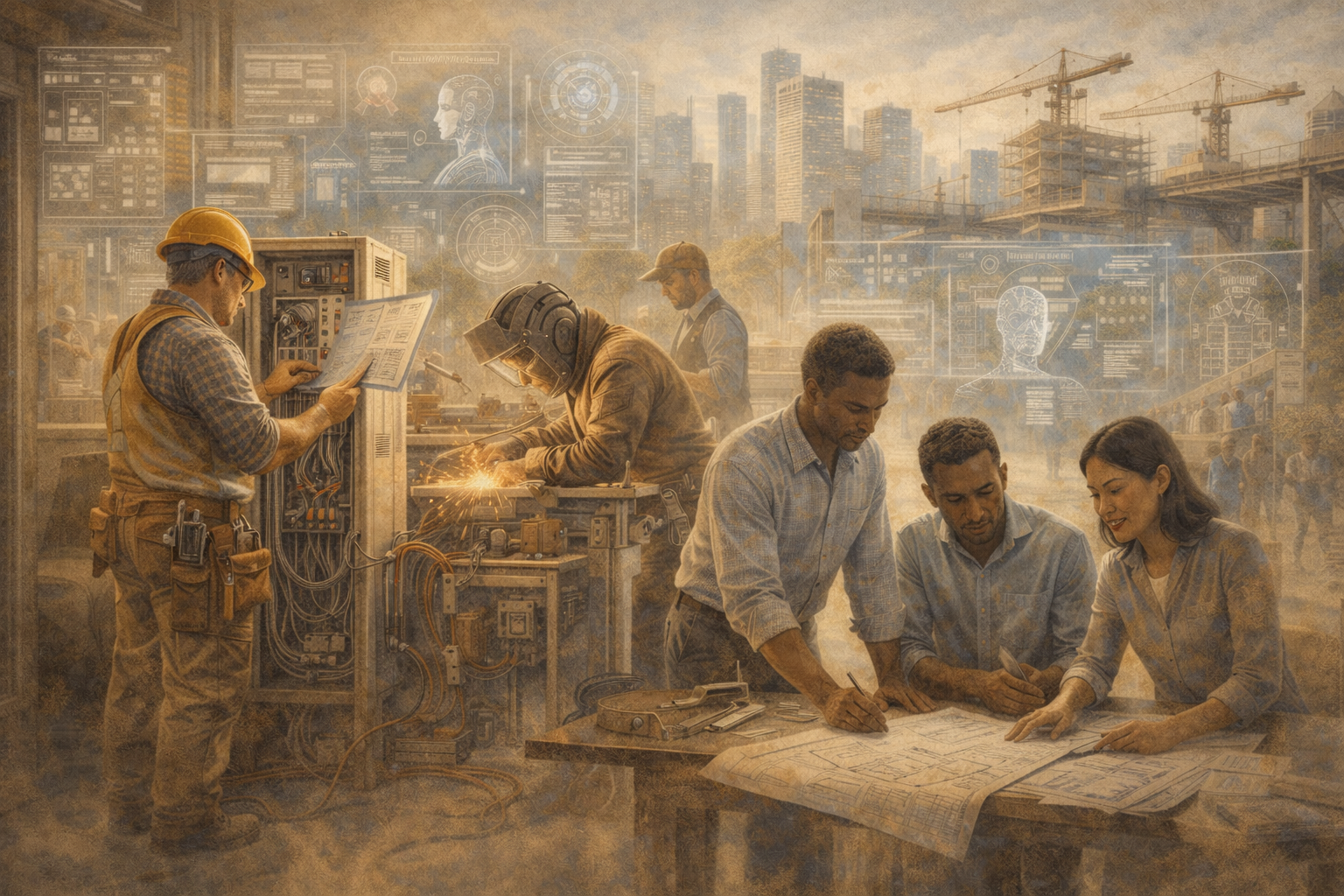
The future economy will not reward people simply for accessing information. It will reward people who can still function when conditions become unstable, systems fail, and judgment matters more than speed.
Human skills future is becoming one of the defining economic questions of the modern era. As artificial intelligence expands into writing, analysis, automation, customer service, and pattern recognition, anxiety is spreading through both white-collar and blue-collar industries.
People are asking a direct question:
What skills will still matter when machines become faster, cheaper, and more capable?
The answer is less dramatic than headlines suggest.
AI can process information at extraordinary speed. It can summarize reports, generate content, identify patterns, optimize workflows, and automate repetitive tasks. But speed is not judgment. Pattern recognition is not wisdom. And automation is not the same as human capability under real-world pressure.
That distinction matters because the future economy will not be shaped only by what AI can do. It will be shaped by where AI struggles.
The workers who remain valuable will not necessarily be the people who resist technology. They will be the people who understand where human capability still carries economic leverage.
Future-proof skills are built around human capability
Many conversations about artificial intelligence become trapped in extremes. One side treats AI as an unstoppable replacement for human labor. The other dismisses the technology entirely.
Both positions misunderstand the real transition taking place.
The future of work is not becoming less human. It is becoming less dependent on purely repetitive human labor.
That difference is critical.
Tasks built entirely on repetition, predictable patterns, and stable inputs are increasingly vulnerable to automation. But environments involving ambiguity, live decision-making, physical unpredictability, social coordination, and responsibility remain difficult to automate fully.
This is why future-proof skills are increasingly tied to durable forms of human capability:
- Judgment under uncertainty
- Adaptability during disruption
- Hands-on problem solving
- Communication and team coordination
- Practical intelligence in unpredictable environments
- Leadership under pressure
- Systems thinking across changing conditions
The future economy will reward people who can combine technical fluency with human decision-making that software still struggles to replicate.
Why AI struggles in high-responsibility environments
One of the biggest misconceptions about artificial intelligence is the belief that intelligence alone determines economic value.
It does not.
In many industries, the real issue is responsibility.
The higher the cost of failure becomes, the harder it is to fully remove human oversight from the process.
This is especially true in environments involving:
- Public safety
- Infrastructure systems
- Healthcare
- Transportation
- Construction
- Emergency response
- Facilities management
- Industrial maintenance
- Electrical systems
- Operations leadership
These environments contain unstable variables, incomplete information, changing physical conditions, and legal accountability. Machines may assist the process, but responsibility still lands on people.
An AI tool can identify possible outcomes. A human supervisor still carries the burden of deciding what risk is acceptable.
An automated system may detect equipment failure. A technician still has to interpret physical conditions in the field.
A machine can optimize a workflow. A leader still has to stabilize a team during uncertainty.
This is why many jobs AI cannot replace are not protected by nostalgia. They are protected by complexity, liability, trust, and real-world unpredictability.
Judgment remains one of the most valuable human skills
One of the strongest long-term advantages human beings retain is judgment.
Judgment is the ability to interpret incomplete information, weigh tradeoffs, assess consequences, and make decisions when conditions are unclear.
That sounds simple until systems become unstable.
Real life rarely behaves like a clean dataset. Equipment fails unexpectedly. People communicate imperfectly. Conditions shift mid-process. Priorities collide. Emergencies compress decision-making into seconds.
AI performs best when patterns remain stable and inputs remain legible. Human judgment becomes most valuable when the script stops working.
This is why experienced supervisors, technicians, operators, tradespeople, project managers, and field leaders continue to carry economic value beyond task execution alone.
They are not simply following instructions.
They are interpreting reality in real time.
That capability remains one of the strongest anchors in the human skills future.
Adaptability matters more than static expertise
The modern economy changes faster than most institutional training systems.
Software evolves. Industries restructure. Workflows shift. Entire categories of labor transform within a decade.
That means adaptability is becoming one of the most valuable skills for the future economy.
Adaptability is not motivational language. It is operational capability.
It is the ability to absorb new information, adjust behavior quickly, learn unfamiliar systems, and continue functioning without paralysis when conditions change.
Workers who can transfer capability across tools, environments, and industries will increasingly outperform workers trained only for one fixed process.
This is also why practical learning pathways matter. Articles like College vs Apprenticeship: The New Labor Pipeline and How Apprenticeships Build Real Skills point toward a broader truth:
Skill formation is not just about credentials.
It is about building flexible capability that remains useful when industries evolve.
Hands-on problem solving remains difficult to automate
Many discussions about AI focus almost entirely on digital work. That creates a distorted picture of the economy.
The physical world still runs on skilled human labor.
Buildings require maintenance. Infrastructure requires repair. Systems require inspection. Equipment requires diagnosis. Machines fail in unpredictable ways.
This is why hands-on problem solving remains one of the hardest forms of labor to automate fully.
An electrician troubleshooting a live systems issue is not merely following instructions. A mechanic diagnosing an unfamiliar equipment failure is not operating from a fixed script. An HVAC technician interpreting environmental inconsistencies inside a building is combining technical knowledge with physical observation and judgment simultaneously.
These are forms of practical intelligence that emerge from repetition, field exposure, correction, timing, and experience.
AI can assist these workers.
But assisting labor is not the same as replacing it.
This is one reason skilled trades continue to hold long-term economic relevance inside an increasingly automated economy.
According to the U.S. Bureau of Labor Statistics, many skilled trade sectors continue facing long-term labor shortages even as automation expands across other parts of the economy.
Team coordination and trust still shape real work
Many AI discussions reduce productivity to individual output.
That framework is incomplete.
Most meaningful work still depends on coordination between people.
Projects move through teams. Organizations depend on trust. Operations require communication under pressure. Leadership requires emotional regulation during instability.
This means so-called “soft skills” are not secondary abilities. In many environments, they are infrastructure.
People who can communicate clearly, stabilize teams, coordinate handoffs, manage conflict, and maintain accountability continue to create organizational value that software struggles to reproduce.
Trust remains difficult to automate.
So does maturity.
So does the ability to keep systems functioning when uncertainty rises.
What the data says about skills for the future economy
The broader labor data increasingly supports this shift toward durable human capability.
The OECD, the World Economic Forum, and workforce researchers across multiple industries continue identifying similar trends:
- Analytical thinking remains one of the highest-demand skills globally.
- Adaptability and resilience continue increasing in employer importance.
- Leadership and social influence remain difficult to automate.
- Technological literacy matters most when combined with human judgment.
- Skilled labor shortages persist across infrastructure and maintenance sectors.
The future economy is not separating technical skills from human skills.
It is rewarding workers who can combine both.
The human skills future belongs to capable people
The strongest workers in the AI economy may not be the people who know the most information.
They may be the people who can still operate effectively when ambiguity rises, systems fail, pressure increases, and responsibility becomes unavoidable.
That is the deeper shift taking place.
Artificial intelligence will absolutely reshape workflows. It will alter hiring patterns, change productivity expectations, and automate many repetitive tasks.
But the future still belongs to people who can interpret reality, solve physical problems, coordinate with others, adapt under pressure, and make responsible decisions when conditions become unstable.
That is why the future of work still depends on human capability.
Not capability built on panic.
Capability built on structure.
The Groundwork
The workers who survive the AI economy will not be the people who resisted technology. They will be the people who built capability deeper than the software itself.
Further Groundwork
College vs Apprenticeship: The New Labor Pipeline
How different learning pathways are reshaping the future workforce.
How Apprenticeships Build Real Skills
Why capability still develops through repetition, correction, and hands-on labor.
Why Skilled Workers Became Invisible
How culture undervalued the workers whose practical intelligence keeps systems operational.
Receipts
World Economic Forum · Future of Jobs Report
Global workforce research on the fastest-growing durable skills in the AI economy.
OECD Skills Research
Research on workforce transitions, skill durability, and future labor demands.
U.S. Bureau of Labor Statistics
Labor market data on skilled trades, workforce shortages, and occupational demand.
Pew Research Center · Internet & Technology
Research on technology adoption, workplace shifts, and digital labor patterns.
Frequently asked questions about the human skills future
What skills will matter most in the future economy?
Judgment, adaptability, communication, leadership, practical intelligence, and hands-on problem solving are becoming increasingly valuable because they remain difficult to automate fully.
What jobs are hardest for AI to replace?
Jobs involving physical unpredictability, liability, leadership, human trust, field diagnosis, and live decision-making remain difficult to automate completely.
Can AI replace skilled trades?
AI can assist skilled trades, but many trades involve physical environments, real-time problem solving, and unpredictable conditions that still require human judgment and experience.
What are future-proof skills?
Future-proof skills are durable capabilities that remain valuable even as industries, technologies, and workflows evolve over time.
Why are human skills still important in the age of AI?
Because organizations still depend on people who can make decisions under pressure, coordinate teams, solve unfamiliar problems, and operate responsibly when systems become unstable.
