

Policy becomes parenting when public institutions begin carrying, regulating, financing, or enforcing responsibilities that directly shape how households care for children, manage risk, organize work, and maintain daily stability. The phrase is a metaphor. The underlying question is institutional: why does government take on family responsibilities, and what happens when it does?
That question cannot be answered with a slogan about “big government” or “family decline.” Modern societies divide responsibility among households, markets, voluntary associations, schools, employers, religious organizations, nonprofits, local institutions, and the state. Political economy has long treated that division as one of the defining features of welfare systems. 1 2
As conditions change, the division changes too. Employment patterns shift. Family structures change. Housing costs rise. Populations age. Care work becomes harder to absorb privately. New public risks emerge. At the same time, communities gain or lose institutions that once coordinated support.
Therefore, the better question is not whether responsibility belongs to families or government in the abstract. The better question is which institution can carry a specific responsibility reliably, fairly, and at the necessary scale.
Research note
This framework does not assume that public intervention is evidence of private failure. Government may substitute for lost capacity, supplement existing capacity, regulate harmful behavior, insure shared risks, or invest so families and communities can carry more themselves. Those mechanisms must be separated before any serious judgment is made.
What Does “Policy Becomes Parenting” Actually Mean?
The phrase becomes useful only after removing the literal interpretation.
Government is not a parent. A public agency does not reproduce the intimacy, attachment, memory, duty, or moral authority of a household. Nor should policy analysis pretend that bureaucratic administration and family relationships are interchangeable.
Instead, the comparison concerns functions.
Parents allocate resources, establish boundaries, manage risks, enforce expectations, provide care, and intervene when behavior threatens long-term well-being. Governments also allocate resources, establish legal boundaries, insure risks, enforce standards, and intervene when conduct produces public harm.
The similarity is functional, not relational.
Welfare-state research has repeatedly shown that societies distribute social protection differently among the family, the market, and the state. Gøsta Esping-Andersen’s comparative work is especially important here because it treats these institutions as interacting parts of a welfare regime rather than isolated actors. 1
Policy becomes parental in function when public systems begin carrying household-level risks, rules, or resources at institutional scale.
Family, Market, Civil Society, and the State
The biggest weakness in ordinary political debate is the assumption that society contains only two actors: individuals and government.
It does not.
Between the household and the state sits a dense institutional layer usually described as civil society. It includes religious institutions, unions, neighborhood associations, libraries, nonprofit organizations, clubs, volunteer networks, mutual-aid groups, professional associations, local businesses, and other organizations that coordinate people without functioning as government.
Research on civil society and social capital emphasizes the role these organizations can play in collective action, cooperation, economic development, and democratic governance. 3
Institutions Can Govern Without Becoming Government
Elinor Ostrom’s work is useful because it challenged the assumption that collective problems always require either private ownership or centralized government control. Her research documented cases in which users created durable rules and governance arrangements themselves. 4
That insight matters far beyond natural resources. Families and community institutions also create rules, expectations, monitoring, trust, and correction. Their authority is different from state authority, but they still govern behavior.
Consequently, public policy often enters a system that already contains multiple forms of governance.
Why Government Takes On More Family Responsibilities
Public responsibility expands for many reasons. Some involve institutional failure. Others involve economic change, demographic change, new legal rights, or deliberate decisions to socialize risks that were once left to households.
One major transformation has been the relationship between paid work and household care. U.S. Bureau of Labor Statistics data show that women’s labor-force participation rose dramatically during the second half of the twentieth century. Participation among mothers also increased substantially. 5
That shift changed the economics of childcare, after-school supervision, parental leave, elder care, and household time.
It did not make working families weaker. It changed the amount of unpaid labor available inside many homes.
Family Policy Expanded Alongside Social and Economic Change
OECD data show that modern family policy can include cash transfers, childcare and early-education services, parental-leave support, tax benefits, and other forms of assistance. 6
This matters because public intervention is not one thing. A childcare subsidy does not perform the same function as a child-protection investigation. A tax credit does not operate like a work requirement. A school lunch program does not carry the same authority as a family court.
Treating all of them as “government replacing parents” destroys analytical precision.
Four Ways Public Policy Enters Family Life
A useful framework begins by separating four functions that are often collapsed into one argument.
| Function | What Government Does | Typical Logic | Core Question |
|---|---|---|---|
| Supplementation | Adds resources to an existing household or community function. | The existing institution remains responsible but lacks enough capacity. | Does support help the original carrier remain functional? |
| Substitution | Performs a function another institution is unable or unwilling to perform. | A critical responsibility would otherwise go unmet. | Is substitution temporary, necessary, or becoming permanent? |
| Regulation | Sets rules because private choices create harm, risk, or public cost. | Individual autonomy has consequences beyond the individual. | Is the restriction proportional to the public risk? |
| Capacity Building | Invests in people or institutions so they can carry more responsibility later. | Public resources strengthen lower-level systems rather than replacing them. | Does intervention increase future independence and durability? |
This distinction prevents a common analytical error. A program that supplements family income should not be evaluated as though it were a coercive regulatory intervention. Likewise, a protective intervention cannot be assessed as though it were simply another cash benefit.
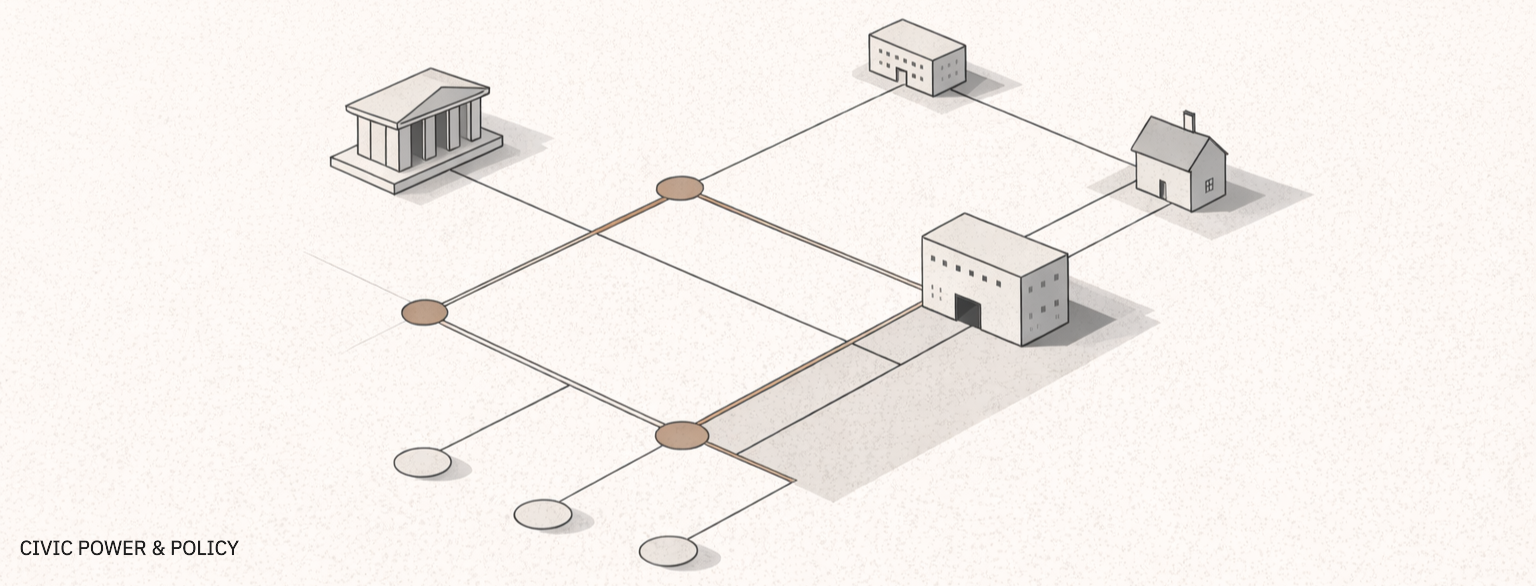
The Responsibility Transfer Model
Groundwork’s contribution is to organize these findings into a simple institutional sequence.
The model begins with a need. Someone has to carry it.
Next comes the expected carrier. That may be the individual, a household, an employer, an insurer, a school, a community organization, a market provider, or government.
Then comes the decisive variable: capacity .
Can the expected institution carry the responsibility reliably without unacceptable degradation?
If not, pressure accumulates. Eventually, another institution receives the load.
Responsibility does not disappear when capacity fails. It transfers.
Responsibility Is Not the Same as Capacity
Political arguments often confuse moral responsibility with operating capacity.
A family may accept responsibility for an aging parent and still lack the income, time, physical ability, housing, or medical knowledge required for full-time care.
A school may accept responsibility for education while lacking the staff needed to address hunger, unstable housing, mental-health crises, transportation failures, and chronic absenteeism simultaneously.
A nonprofit may understand a neighborhood better than a public agency while still lacking stable funding, professional staff, or the legal authority necessary to protect residents.
Therefore, saying an institution “should” handle a problem does not prove that it can.
Capacity Must Be Reliable, Not Heroic
Families and local institutions often stretch during emergencies. However, emergency effort is not the same as sustainable capacity.
Once a system operates beyond capacity for too long, quality falls. Burnout rises. Maintenance slips. Care becomes inconsistent. Waiting lists grow. Informal work becomes concentrated in fewer people.
At that point, responsibility transfer becomes increasingly likely.
Three Real Examples of Policy Becoming a Care System
The framework becomes clearer when applied to programs with different purposes.
School Meals
The National School Lunch Program and School Breakfast Program supplement household food provision by ensuring children can access meals through school. USDA research treats access to healthy, balanced meals as a central program objective. 7
This is supplementation. The school does not become the family. Instead, public infrastructure absorbs part of a nutritional risk because learning cannot be separated cleanly from whether children are fed.
Earned Income Tax Credit
The Earned Income Tax Credit uses the tax system to supplement earnings for qualifying low- and moderate-income workers and families. Eligibility is tied to earned income, household characteristics, and other statutory rules. 8
Here, government does not replace work. Policy changes the return to work and increases household resources through the tax system.
Child Welfare
Child welfare represents a more coercive form of state involvement. The federal Children’s Bureau administers programs that support state and tribal child-welfare systems, while states retain major responsibility for investigation, protection, foster care, and related services. 9
This is not ordinary supplementation. It is protective intervention after legal thresholds involving child safety have been crossed.
TANF
Temporary Assistance for Needy Families combines cash assistance with rules involving work participation, state administration, and time limits. The 1996 welfare reforms replaced Aid to Families with Dependent Children with TANF and changed both program structure and expectations. 10 11
TANF therefore shows policy acting as both support and behavioral governance.
TANF Shows How Policy Can Mix Support and Control
Welfare reform is a useful case because it demonstrates why the phrase “policy becomes parenting” can be analytically useful when handled carefully.
TANF does not merely transfer money. Its statutory design connects assistance to state-administered work expectations and time limits. HHS historical material describes the shift from AFDC to TANF as a move toward stronger work requirements, sanctions, and limits on long-term receipt. 10
Congressional Research Service analysis likewise emphasizes that federal TANF requirements operate largely through states, which retain significant discretion in how those rules reach individual families. 11
That Changes More Than the Benefit
Once eligibility depends on conduct, documentation, participation, and time, public policy begins shaping household behavior rather than simply transferring resources.
Whether that design improves employment, creates hardship, produces better incentives, or excludes families becomes an empirical question. It should not be answered by metaphor alone.
More broadly, economic research has documented how the U.S. safety net shifted toward working families and in-work tax credits after welfare reform. 12
Public Support Can Strengthen Family Capacity
One of the weakest assumptions in debates about family policy is that government assistance automatically reduces private responsibility.
Sometimes the opposite happens.
Childcare support can make employment possible. Nutrition assistance can free limited household income for rent or utilities. Health coverage can prevent medical costs from overwhelming a family budget. Tax credits can increase the resources available to working households.
In these cases, policy may increase the amount of responsibility a household can carry rather than replacing the household.
The Evidence on Children Matters
A major National Academies review concluded that inadequate family economic resources can harm children’s development and later outcomes. The same review evaluated multiple policy approaches, including tax credits, childcare subsidies, nutrition programs, housing assistance, and cash support. 13
Research by Hilary Hoynes and Diane Whitmore Schanzenbach also reviews evidence that childhood access to major safety-net programs can improve long-term outcomes. 12
That evidence complicates any simple claim that formal assistance necessarily weakens informal institutions.
When Policy Substitutes for Local Capacity
Supplementation and substitution are not the same.
A program substitutes when it does work that another institution can no longer perform or has stopped performing.
Sometimes substitution is necessary. If a child faces abuse, the state cannot wait indefinitely for informal correction. If a communicable disease creates population-level risk, households cannot independently operate a national surveillance system. If financial markets cannot insure a social risk efficiently, public insurance may emerge.
However, long-term substitution raises a different question.
Does the public system eventually rebuild capacity closer to the household or community, or does the substituted function become permanently centralized?
Centralization Can Solve One Problem and Create Another
Large systems offer scale, resources, legal authority, and consistency. Yet they also operate at greater distance from individual lives.
That distance can create rigidity. Rules designed for millions of people cannot respond to every household with the flexibility of a trusted local relationship.
Therefore, policy design always involves tradeoffs between uniformity and discretion, scale and proximity, access and control.
Why Strong Civil Society Still Matters
Strong public institutions and strong civil society are not opposites.
A durable system usually needs both.
Civil-society scholarship emphasizes that voluntary associations can build social capital and facilitate collective action. 3
At the same time, Theda Skocpol’s work on American civic life warns that organizations can shift from broad membership and participation toward professional management. 14
That distinction matters for Groundwork.
A neighborhood can have many nonprofits and still lack broad participation. A city can have many programs and still lack durable relationships. A family can have access to services and still remain socially isolated.
Service Delivery Is Not the Same as Social Fabric
Professional systems can deliver expertise and resources. Informal networks create trust, memory, reciprocity, and belonging.
A healthy society should not expect either one to reproduce everything the other does.
Administrative Burden Is the Hidden Cost of Formalization
When responsibility moves into a formal system, process follows.
Agencies need definitions. Definitions create eligibility standards. Standards require evidence. Evidence creates forms, deadlines, interviews, verification, and compliance procedures.
Pamela Herd and Donald Moynihan describe these demands as administrative burdens. Their framework identifies learning costs, compliance costs, and psychological costs that people can experience when interacting with government programs. 15
This insight is essential because program generosity on paper and program accessibility in practice are not identical.
Formal Systems Need Rules, but Rules Have Costs
Documentation can protect public money and reduce fraud. Verification can promote fairness. Eligibility standards can keep programs focused on intended populations.
However, every additional requirement can also exclude eligible people, consume staff time, or make assistance harder to use.
Therefore, policy design must evaluate the administrative cost imposed on both the institution and the household.
The Strongest Counterargument: Some Risks Should Be Public
The framework fails if it assumes every public responsibility began as a private responsibility that families lost.
That is historically and analytically wrong.
Societies sometimes decide that certain risks should be shared because private exposure produces unacceptable inequality or because markets cannot distribute the risk efficiently.
Social insurance, public education, infrastructure, public health, environmental regulation, civil-rights enforcement, and courts cannot be reduced to family substitution.
In those cases, government may be the appropriate institutional carrier from the start.
Welfare Systems Are Designed Around Different Divisions of Risk
Comparative welfare-state scholarship shows that countries make different institutional choices about how much social protection is carried by families, markets, and the state. 1 16
Those differences are not simply measures of responsibility. They reflect political choices about rights, markets, work, care, taxation, and social risk.
That is why “families should handle it” is not a sufficient policy argument.
Policy Can Also Change the Institutions Beneath It
Responsibility transfer does not move in only one direction.
Once policy enters a system, it can change the incentives of families, employers, markets, nonprofits, and local governments.
A childcare subsidy may increase labor-force participation. A tax credit may change the payoff to employment. A housing subsidy may affect where a family can live. A work requirement may change both labor-market behavior and program participation.
In other words, policy responds to institutions and then reshapes them.
That feedback loop is why family policy should be studied as a system rather than a collection of isolated programs.
Policy does not enter a neutral household. It changes the incentives around the household too.
How to Evaluate Policy That Reaches Into Family Life
The phrase “policy becomes parenting” should lead to better questions, not louder conclusions.
A useful evaluation can move through eight steps.
- Identify the need. What human need, risk, harm, or instability is the policy responding to?
- Identify the expected carrier. Is the responsibility normally carried by individuals, households, markets, employers, schools, civil society, or government?
- Measure capacity. Can that institution reliably carry the load under current conditions?
- Diagnose the gap. Did capacity fall because of behavior, economics, demographics, market failure, institutional decline, discrimination, legal change, or another pressure?
- Classify the intervention. Is policy supplementing, substituting, regulating, insuring, or building capacity?
- Measure administrative burden. What learning, compliance, financial, and psychological costs does the intervention create?
- Measure outcomes. Does the policy improve safety, income, health, employment, child development, autonomy, or institutional durability?
- Track responsibility after intervention. Does capacity grow closer to the household and community, or does responsibility remain permanently centralized?
These questions do not guarantee agreement. They create a better disagreement.
The Groundwork
Policy becomes parenting when formal institutions begin performing functions that directly shape the resources, rules, risks, and responsibilities of household life.
Sometimes that happens because families or communities lost capacity. Sometimes it happens because markets failed. Sometimes the public decided a risk should be shared. Sometimes government intervenes because harm requires legal authority that no private institution should possess.
Those are different mechanisms. They should not be confused.
A serious civic framework therefore avoids two fantasies.
The first fantasy says strong families make government unnecessary. They do not. Courts, infrastructure, public health, civil rights, environmental protection, national defense, and many forms of social insurance solve problems that household discipline cannot solve.
The second fantasy says formal systems can replace every weakened family or community institution. They cannot. Administration can allocate money, enforce rules, and deliver services. It cannot manufacture every form of trust, belonging, reciprocity, or care.
The stronger goal is institutional balance.
Families should have enough capacity to carry family responsibilities. Civil society should remain strong enough to coordinate people outside the state. Markets should be used where incentives and competition can work. Government should carry public responsibilities that require scale, legal authority, shared insurance, or universal standards.
That is where Structure Builds Freedom becomes more than a phrase.
Freedom grows when responsibility is matched to institutions capable of carrying it.
The question is not who should do everything. The question is whether each layer can carry what belongs there.
Continue Building
This article defines the framework. Continue into the mechanisms and policy applications below.
→ Application: Policy Is Parenting at Scale
→ Case Study: Welfare Reform and Family Policy
→ Civic Method: Building Institutional Literacy
References & Research Notes
Sources Behind the Framework
Citations are numbered in the text. Sources include academic books, peer-reviewed and policy research, federal agencies, and international comparative data.
- Esping-Andersen, Gøsta. The Three Worlds of Welfare Capitalism. Princeton University Press, 1990; and Social Foundations of Postindustrial Economies. Oxford University Press, 1999. Esping-Andersen’s work examines how family, market, and state institutions divide social risk and welfare responsibilities across different political economies.
- OECD. OECD Family Database. Organisation for Economic Co-operation and Development. The database tracks family benefits, childcare, parental leave, public spending, household structure, and related indicators across advanced economies.
- Woolcock, Michael. “Civil Society and Social Capital.” In The Oxford Handbook of Civil Society, edited by Michael Edwards. Oxford University Press, 2012, pp. 197-208. The chapter reviews how civil-society organizations and social capital relate to collective action, development, and democratic governance.
- Ostrom, Elinor. Research recognized by the 2009 Sveriges Riksbank Prize in Economic Sciences in Memory of Alfred Nobel. Ostrom demonstrated that communities can create durable self-governing institutions for shared resources rather than relying exclusively on privatization or centralized government.
- U.S. Bureau of Labor Statistics. Women in the Labor Force and historical Current Population Survey data. BLS documents the large increase in women’s labor-force participation during the second half of the twentieth century, including substantial growth among mothers.
- OECD. Public Spending on Family Benefits and the OECD Family Database. OECD classifies family support through cash transfers, family services, childcare and early education, leave systems, and tax-based support.
- U.S. Department of Agriculture, Food and Nutrition Service. School Nutrition Dietary Assessment Study III. USDA research examines the National School Lunch Program and School Breakfast Program, including meal quality, school environments, and the contribution of school meals to students’ diets.
- Internal Revenue Service. Earned Income Tax Credit program guidance. The EITC is a refundable tax credit for eligible low- and moderate-income workers and families, with benefits tied to earnings, filing status, and qualifying children.
- Administration for Children and Families, Children’s Bureau. Agency materials on federal child-welfare programs. The Children’s Bureau administers federal programs supporting state and tribal child-welfare systems and related child and family services.
- U.S. Department of Health and Human Services, Office of the Assistant Secretary for Planning and Evaluation. Aid to Families with Dependent Children and Temporary Assistance for Needy Families: Overview. The historical overview documents the transition from AFDC to TANF and the increased use of work requirements, sanctions, and time limits.
- Congressional Research Service. Temporary Assistance for Needy Families Block Grant: A Primer. CRS explains TANF financing, federal requirements, state discretion, work participation rules, and statutory time limits.
- Hoynes, Hilary W., and Diane Whitmore Schanzenbach. “Safety Net Investments in Children.” Brookings Papers on Economic Activity, Spring 2018, pp. 89-150. NBER Working Paper 24594. DOI: 10.3386/w24594. The authors review the changing composition of U.S. child safety-net spending and research on the long-term effects of childhood program access.
- National Academies of Sciences, Engineering, and Medicine. A Roadmap to Reducing Child Poverty. National Academies Press, 2019. DOI: 10.17226/25246. This consensus report reviews evidence on child poverty, labor markets, family structure, government programs, and policy approaches to reducing poverty.
- Skocpol, Theda. Diminished Democracy: From Membership to Management in American Civic Life. University of Oklahoma Press, 2003. Skocpol examines changes in voluntary membership organizations and the professionalization of American civic life.
- Herd, Pamela, and Donald P. Moynihan. Administrative Burden: Policymaking by Other Means. Russell Sage Foundation, 2018. DOI: 10.7758/9781610448789. The authors develop the framework of learning costs, compliance costs, and psychological costs in citizen-state interactions.
- Moffitt, Robert A., ed. Economics of Means-Tested Transfer Programs in the United States. University of Chicago Press, 2015. Related NBER Working Paper 21751, DOI: 10.3386/w21751. The collection reviews the institutional design and economic research surrounding major U.S. means-tested programs.
What Carries This Framework
Policy becomes parenting when responsibility moves among institutions. The structural question is whether the receiving institution has enough capacity, authority, and alignment to carry the load well.
Structure Builds Freedom
Usable freedom grows when roles, responsibilities, authority, and expectations are organized well enough that disorder does not consume every decision.
Capacity
Capacity defines what a person, household, organization, community, or institution can reliably carry without unacceptable degradation.
Explore the full Core Principles and Conditions behind Groundwork Daily.

The Groundwork Desk builds research-driven explainers and cross-category frameworks for questions that sit above a single Builder lane. Its work examines how institutions divide responsibility, how incentives shape behavior, how capacity moves under pressure, and what happens when one part of a system can no longer carry its share of the load.
When Policy Becomes Parenting establishes a framework for studying responsibility transfer among households, markets, civil society, and government. The purpose is not to argue automatically for more or less government. It is to identify which institution is carrying a function, why that responsibility moved, and whether the resulting structure actually holds.
→ More from The Groundwork Desk
→ Explore Civic Power & Policy
