Learning how to think clearly is no longer a luxury. It is a stability skill.
Every day pulls attention in several directions. Work demands focus. Family requires presence. Digital systems compete for response. Meanwhile, unresolved obligations continue running in the background.
Before long, the mind gets crowded. The day gets noisier. Judgment becomes harder to protect.
You cannot think cleanly while reacting to every input as though it deserves equal weight. Therefore, one of the earliest Future Literacy capabilities is learning how to create enough cognitive space to distinguish signal from noise.
This is not about forcing yourself to concentrate harder. It is about changing the structure around the thinking.
This second article in Groundwork Daily’s Future Literacy series introduces two practical tools: the Clarity Ladder and the Ten-Minute Clarity Reset. Together, they provide a repeatable way to reduce noise, define the real problem, separate emotion from decision, and choose a structural next move.
Why Clear Thinking Breaks Down
Clarity often disappears before people notice what caused it.
Modern digital and work environments routinely fragment attention across messages, alerts, tasks, feeds, meetings, decisions, and unfinished obligations. At the same time, emotional pressure can keep unresolved problems active in the background.
The result is not simply “distraction.” It is competition for limited cognitive capacity.
Before the mind can decide what matters, it has to sort incoming information. Before it can act, it often has to distinguish a real problem from an emotional reaction, an open loop, or somebody else’s urgency.
When too many signals remain active at once, judgment becomes harder to protect.
Clear thinking begins by understanding the forces that repeatedly interfere with it.
The Three Forces That Pull Thinking Apart
Three forces appear repeatedly when clarity begins to fail: noise, entanglement, and drift.
1. Noise
Noise is any signal consuming attention without helping you understand or solve the real problem.
Notifications can become noise. Feeds can become noise. Opinions, alerts, repeated checking, vague requests, and unnecessary context can also become noise.
Each individual signal may seem small. However, the accumulation creates switching costs and forces the mind to keep reorienting.
Eventually, attention becomes fragmented enough that even simple decisions feel heavier than they should.
What to Do About Noise
Do not start by asking yourself to focus harder. First, reduce the number of things competing for focus.
Try this: close unnecessary tabs, silence nonessential alerts, move the phone out of immediate reach, and decide which channel actually matters for the next block of work.
2. Entanglement
Entanglement is the cognitive weight created by unresolved tension, unfinished conversations, unclear obligations, and emotional residue.
These issues do not disappear simply because you are doing something else. Instead, they can remain active in the background and keep drawing attention away from the task in front of you.
A difficult conversation, uncertain bill, unresolved deadline, or ambiguous request can therefore consume bandwidth long after the immediate event has passed.
What to Do About Entanglement
Make the unfinished issue visible.
Write down what remains unresolved. Then identify whether it requires a decision, a conversation, a boundary, a scheduled action, or simply acceptance that no action is available yet.
Once the issue has a defined status, the mind no longer has to keep rediscovering it.
3. Drift
Drift occurs when activity continues without a clear hierarchy of importance.
A calendar can be full while direction remains weak. Messages can be answered while meaningful work remains untouched. A person can stay busy all day and still finish without knowing what actually moved.
That is the difference between activity and structure.
What to Do About Drift
Give the day an explicit priority before incoming demands establish one for you.
Ask one question: What meaningful outcome needs to be more true by the end of this block of time?
That answer provides a reference point for deciding what deserves attention and what can wait.
The Clarity Ladder
The Clarity Ladder is a four-step Future Literacy framework for restoring order when thinking becomes scattered.
Use it when attention is fragmented, when decisions feel rushed, or when emotional pressure is making the real problem harder to see.
1. Reduce Inputs → lower the amount of competing information.
2. Name the Real Problem → define what actually needs attention.
3. Separate Emotion From Decision → acknowledge the feeling without making it the strategy.
4. Choose the Next Structural Action → make one move that reduces future friction.
Step One: Reduce Inputs
Begin by lowering stimulation.
Close excess channels. Silence unnecessary notifications. Shut unused browser tabs. Move away from feeds and message streams that are not relevant to the decision in front of you.
Input control matters because the brain cannot give undivided attention to several competing streams at once.
The first move toward clarity is therefore environmental: make fewer things available to interrupt the thinking.
Step Two: Name the Real Problem
Next, describe the problem in one sentence.
Do not begin with everything that feels wrong. Instead, identify the condition that actually requires a decision or response.
“Work is overwhelming” is difficult to act on.
“I have three deliverables due by Friday and no agreed priority order” is much more useful.
Precision converts broad pressure into something the mind can work with.
Step Three: Separate Emotion From Decision
Feelings are part of the landscape, but they do not automatically determine the route.
First, identify the emotional state. Then identify the decision.
You may be frustrated and still need to schedule a conversation. You may be anxious and still need to review the numbers. You may be disappointed and still need to decide what happens next.
Separating those two layers protects the decision from becoming a reflexive extension of the feeling.
Step Four: Choose the Next Structural Action
A structural action makes the system easier to operate afterward.
It may close an open loop, create a deadline, clarify ownership, establish a boundary, simplify a workflow, schedule a conversation, or remove a recurring source of friction.
The goal is not merely to feel calmer. It is to change something in the environment so the same pressure does not immediately rebuild itself.
One well-chosen structural action can restore more control than ten minutes of anxious rethinking.
The Ten-Minute Clarity Reset
The Clarity Ladder is the framework. The Ten-Minute Clarity Reset is the fast operating version.
Use it when the day starts to tilt, when several pressures collide, or when you notice yourself reacting faster than you are thinking.
Minutes 1–2: Reduce Inputs
Silence notifications. Close unrelated tabs. Put the phone away from your immediate line of sight.
Then give your attention one environment instead of several competing environments.
Minutes 3–5: Write What Is True
Write plainly for three minutes.
Do not polish the language. Do not build an argument. Instead, name the facts, the pressure, and what remains unresolved.
Once the situation is visible outside your head, the mind has less information to keep carrying internally.
Minutes 6–8: Sort the Landscape
Separate the pressure into four buckets:
- Noise: information that does not help solve the problem.
- Obligation: something you actually owe or need to handle.
- Emotion: what you are feeling about the situation.
- Problem: the condition that requires a decision or action.
Sorting matters because vague pressure becomes easier to manage once its parts are distinguishable.
Minutes 9–10: Choose One Structural Action
End the reset by selecting one action that changes the situation.
Close one loop. Set one boundary. Ask one clarifying question. Schedule one conversation. Review one number. Finish one small but consequential task.
Completion can reduce cognitive load when an open loop is contributing to the pressure. More importantly, a structural action gives the mind evidence that the situation is being governed rather than merely endured.
How the Clarity Ladder Works in Real Life
Clear thinking becomes more useful when it survives ordinary pressure. The same framework can be applied across work, family, money, relationships, and digital overload.
Work Pressure
Work pressure often creates the impression that everything matters at once. As a result, reaction begins replacing prioritization.
Use the Clarity Ladder to reduce incoming channels, identify the actual deliverable, separate anxiety from the deadline, and choose the action that creates measurable progress.
Sometimes the structural move is completing the work. In other cases, it is clarifying priority with a manager before spending hours on the wrong task.
Family Demands
Family pressure rarely arrives as one clean request. Instead, schedules, expectations, care responsibilities, money, and emotion can stack together.
Begin by distinguishing what is truly urgent from what merely feels immediate.
Then identify whether the underlying problem is a scheduling conflict, unclear role ownership, poor communication, or insufficient capacity.
The structural response may be a calendar change, a direct conversation, or a clearer division of responsibility.
Financial Stress
Financial pressure often arrives as broad anxiety even when the immediate problem is specific.
Reduce noise first. Then identify the actual pressure point: cash-flow timing, debt, an upcoming bill, lost income, overspending, or inadequate reserves.
From there, choose one structural move. Review the numbers, establish a temporary spending boundary, contact a creditor, move a due date when possible, or define the next income action.
A defined financial problem is easier to address than undifferentiated financial fear.
Relationship Conflict
Relationship tension can expand beyond the original issue because several emotions and older grievances become attached to the same conversation.
Before trying to solve everything, identify the actual point of disagreement.
Then separate what you feel from what you need to communicate or decide.
A useful structural action might be scheduling a calmer conversation, clarifying a boundary, making a specific request, or agreeing on what question needs to be resolved first.
Digital Overload
When attention feels scattered, inspect the digital environment.
Open tabs, notifications, feeds, unread messages, and multiple apps can convert attention into fragments.
Rather than performing a complete digital overhaul, create one boundary: one inbox window, one notification rule, one clean workspace, or one period when the phone is physically out of reach.
Small structural boundaries can restore more clarity than another productivity app.
How to Know Your Thinking Is Becoming Clearer
Clear thinking does not usually feel dramatic. Instead, it tends to show up as reduced friction.
You React Less Automatically
More space appears between the incoming signal and your response.
That pause is not indecision. It is room for judgment.
You Define Problems Faster
Instead of carrying a broad sense that “everything is wrong,” you can identify the actual constraint more quickly.
That makes the next move easier to see.
Open Loops Stay Open for Less Time
Unanswered questions, unclear tasks, unresolved decisions, and minor administrative problems receive a defined status earlier.
As a result, fewer unfinished issues compete for background attention.
Your Environment Creates Less Friction
Tools become easier to use. Messages become clearer. Work has better boundaries. Decisions have more structure.
Over time, clarity becomes less dependent on having a perfectly calm day.
How Clear Thinking Connects to Future Literacy
Future literacy begins with the ability to read changing conditions accurately enough to respond.
That becomes difficult when every signal feels urgent, unresolved emotion is distorting interpretation, or attention is spread across too many competing inputs.
This is why clarity comes near the beginning of the Future Literacy sequence.
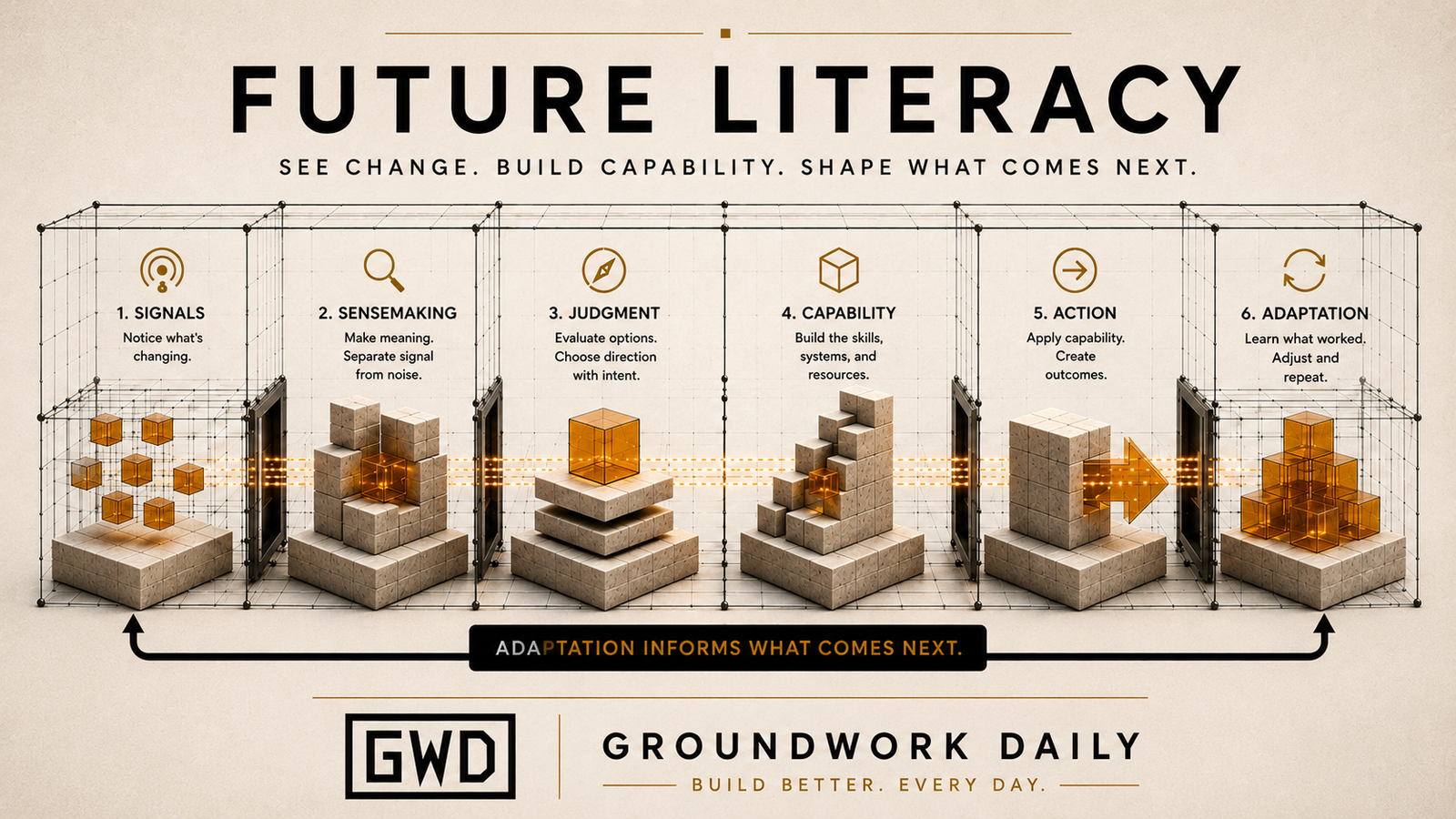
The Skill Stack You Actually Need in 2026 establishes the larger capability system. This article develops the clarity layer of that stack.
The next article, The Bandwidth Trap, moves one level deeper by examining why usable cognitive capacity can disappear even when a calendar does not look full.
Together, the sequence moves from capability → clarity → bandwidth → structure → adaptation.
The Path Forward
Thinking clearly when everything pulls at you is not about applying more force.
It is about creating enough structure for judgment to work.
Reduce unnecessary inputs. Define what is actually happening. Separate emotion from decision. Then choose a move that changes the structure instead of merely relieving the feeling for a few minutes.
Repeated often enough, those moves become mental infrastructure.
Eventually, clarity becomes less dependent on mood, energy, or ideal conditions because the environment itself supports better thinking.
Reduce the noise. Name what is true. Make the next structural move.
Further Groundwork
The Skill Stack You Actually Need in 2026
Return to the first Future Literacy article and the seven capabilities that form the foundation of the series.
The Bandwidth Trap
Continue into the next Future Literacy layer: why usable cognitive capacity can disappear even when your calendar does not look full.
The Quiet Bandwidth Audit
Identify the open loops, environmental friction, and recurring demands quietly consuming cognitive capacity.
Structure Builds Freedom
Explore how practical systems reduce recurring friction and make better decisions easier to sustain.
Education & Skills
Explore the broader Groundwork Daily category for learning, capability, technology, and practical skill development.
Receipts
Pew Research Center · Information Overload
Research context on information abundance, access, and how people experience information overload in digital environments.
Harvard Business Review · Cognitive Overload at Work
Analysis of how workplace systems and information demands can overload attention and weaken effective cognitive performance.
OECD Skills Outlook 2025
Research on adaptive problem solving, information-processing skills, learning, and capabilities associated with resilience in changing environments.