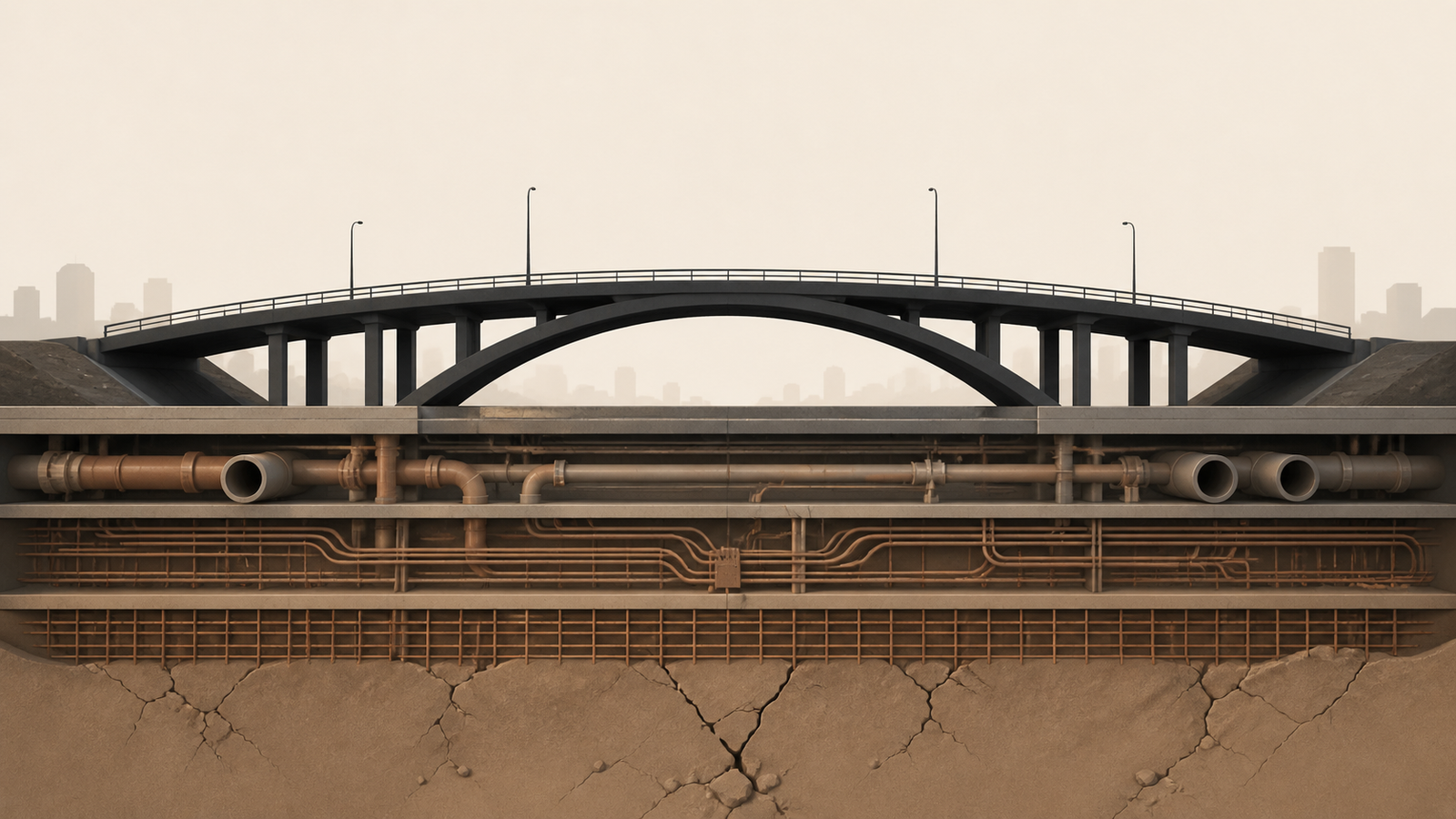
Civic infrastructure systems are the physical, financial, operational, and governance structures that make public life work. Roads, bridges, pipes, transit systems, schools, libraries, courts, public buildings, inspection schedules, capital plans, maintenance records, and accountability systems all belong to the same civic architecture.
Civic Infrastructure Is the Hidden Architecture of Public Trust
Civic infrastructure is easy to ignore when it works. People get to work. Children drink clean water. Emergency vehicles move. Businesses open. Families trust that the systems beneath daily life will hold.
However, when infrastructure fails, the damage is never only technical. It becomes economic, political, social, and moral.
A broken system teaches people that public promises are weak. A neglected system teaches communities that leadership is reactive. A preventable crisis teaches residents that maintenance was treated as optional until suffering made it urgent.
What Civic Infrastructure Systems Really Mean
Civic infrastructure systems are not just roads, bridges, trains, pipes, schools, libraries, courts, and public buildings. That definition is too narrow because it mistakes the visible object for the operating system behind it.
A bridge is infrastructure. However, the inspection schedule that keeps it safe is also infrastructure. A subway line is infrastructure. Likewise, the capital plan that replaces signals before they fail is infrastructure.
A water system is infrastructure. In addition, the corrosion control policy, testing protocol, public notification process, and enforcement structure are also part of the system that protects people before harm becomes visible.
This is why civic infrastructure belongs inside Building Institutional Literacy. Public systems cannot be understood only by what people see. They must be understood by the structures that make visible services reliable.
Civic Infrastructure Systems Are Built in Layers
The first layer is physical. This is the layer most people recognize: pavement, rail tracks, water mains, bridges, broadband lines, drainage systems, public facilities, and energy grids. It is the concrete, steel, wire, pipe, and space that makes civic life possible.
The second layer is operational. This is where the real test begins. Who inspects the asset? Who maintains it? How often? What happens when something is flagged? Is there a repair threshold? Is there a service standard? More importantly, is the issue logged, tracked, funded, and resolved?
The third layer is financial. Every civic system has a cost structure, whether leaders name it or not. There is the cost to build, the cost to operate, the cost to maintain, the cost to replace, and the cost of failing to act.
The fourth layer is governance. This layer determines whether the first three layers survive contact with reality. Governance sets standards, assigns responsibility, requires reporting, triggers intervention, and creates consequences when warnings are ignored.
Without governance, infrastructure becomes a wish list wearing a hard hat.
The Infrastructure We Never See
Some of the most important civic infrastructure is not visible from the street. It lives inside databases, procurement rules, inspection logs, permitting systems, emergency communication plans, maintenance software, public works schedules, code enforcement records, and interagency agreements.
These systems are not glamorous. Still, they determine whether public assets are understood, maintained, repaired, replaced, and funded on time.
A city can have roads without a reliable pavement condition index. It can have buildings without updated facility condition assessments. It can operate water systems without transparent public reporting. It can run transit assets without enough maintenance capacity. In each case, the visible system exists, but the management system is weak.
That weakness matters because infrastructure fails first in records, budgets, and routines. The public usually sees the failure later.
This connects directly to Operating vs Capital Budgets. A city cannot maintain infrastructure responsibly if it does not separate daily operating needs from long-term capital replacement.
The National Signal Is Clear
The American Society of Civil Engineers gave U.S. infrastructure an overall C grade in its 2025 Report Card. That is not collapse, but it is not strength either.
ASCE estimated that bringing all 18 infrastructure categories into a state of good repair would require $9.1 trillion in investment. That number matters because it tells the truth behind the familiar complaint that things are falling apart.
Things are not falling apart because no one noticed. They are falling apart because replacement cycles, maintenance cycles, and funding cycles have been out of alignment for decades.
The deeper issue is not only the size of the investment gap. It is the culture that created it. Public systems often reward short-term balance over long-term durability. They patch instead of replace. They defer instead of decide.
As a result, deterioration gets described as a future problem while residents are already living inside the consequences.
The Math Leaders Avoid
Civic infrastructure failure is not primarily an engineering problem. It is a budgeting problem disguised as a technical one.
Every system operates on a lifecycle curve: build, operate, maintain, replace. Failure begins when the system is funded as if it only needs to operate, while silently accumulating the cost of maintenance and eventual replacement.
Consider the logic. A city may approve a public asset because it solves an immediate need. The project opens. The announcement is made. The public sees progress.
However, the real obligation begins after the ribbon is cut. Pavement starts aging. Pipes begin corroding. Signals become outdated. Facilities require staffing, inspections, cleaning, repair, compliance work, insurance, utilities, technology upgrades, and eventual replacement.
If those costs are not built into the operating model from the beginning, the system is underfunded on day one. The failure may not appear for years, but the math is already broken.
This is how false efficiency enters public management. Leaders defer a $3 maintenance obligation and appear to save money. The budget looks cleaner. The pressure eases. The report balances.
Nevertheless, the $3 does not disappear. It becomes deferred cost. Over time, it compounds into a $15 or $20 emergency repair, often under worse conditions, with less flexibility, more public anger, and higher operational disruption.
That is not savings. It is delayed liability.
Why Maintenance Rarely Wins Elections
If the math is this clear, the obvious question is why infrastructure neglect keeps happening. The answer is not ignorance. It is incentives.
Public systems often reward visible expansion over invisible maintenance. A new project creates a headline. A repair creates a report. One builds political capital. The other consumes it.
A new station, park, school wing, technology program, or public facility can be framed as vision. By contrast, replacing corroded pipes, upgrading old signals, improving drainage, or modernizing back-end systems is harder to sell because the best outcome is that nothing bad happens.
That is the curse of prevention. When prevention works, people forget it was necessary.
Leadership cycles are short. Infrastructure cycles are long. The person who defers maintenance often avoids the consequence. The person who inherits the system absorbs the failure.
Consequently, civic infrastructure suffers from a structural misalignment between political reward and operational truth.
- Short-term incentives favor expansion.
- Long-term stability requires maintenance.
- Accountability often arrives after the decision-maker has moved on.
Until that misalignment is addressed, infrastructure failure will remain predictable.
This is why Civic Budgeting Priorities matters. Budgets reveal whether leaders are funding the systems people depend on or only the announcements people can see.
Infrastructure Is Institutional Memory
Infrastructure does not only live in assets. It also lives in records.
Inspection reports, repair histories, asset inventories, GIS maps, procurement files, capital plans, work orders, compliance logs, and staff knowledge all form institutional memory.
When that memory is strong, leaders can see risk before it becomes a crisis. They know which systems are aging, which assets are failing, which repairs are recurring, and which costs are being carried forward.
However, when institutional memory is weak, every leadership transition becomes dangerous. New officials inherit assets they do not understand. Staff retire and take operational knowledge with them. Records sit across disconnected systems. Meanwhile, old warnings lose context.
This is why documentation is infrastructure. A city that cannot explain what it owns, what condition it is in, and what it costs to sustain is not managing infrastructure. It is guessing.
Accountability depends on memory. Without memory, every failure looks sudden.
Case Study: Flint and the Cost of Governance Failure
Flint, Michigan remains one of the clearest modern examples of infrastructure failure becoming public harm. The physical system mattered, but the crisis was not only about pipes. It was also about decisions, oversight, enforcement, and delay.
When Flint changed its water source in 2014 without proper corrosion control, lead leached from aging service lines into the drinking water. The crisis exposed tens of thousands of residents to risk and became a national symbol of what happens when cost-saving logic outruns public protection.
The most important lesson from Flint is not that old pipes are dangerous. That is obvious. The harder lesson is that old pipes become catastrophic when leadership systems fail at the same time.
Infrastructure can survive age when governance is alert. It cannot survive age, denial, poor testing, weak enforcement, and delayed response all operating together.
By 2025, Michigan had completed replacement of nearly 11,000 lead water pipes in Flint, closing a major physical chapter of the crisis. However, replacement does not erase the institutional lesson.
The public cost of Flint was not limited to construction. It included bottled water distribution, litigation, health monitoring, lost trust, family anxiety, civic anger, and a permanent warning to every city with aging water infrastructure.
The federal response also shows how one local failure can force national correction. The EPA’s Lead and Copper Rule Improvements require drinking water systems to identify and replace lead pipes within 10 years.
That is infrastructure policy written in the shadow of harm. It should not have required a crisis to get there, but civic systems often learn late because prevention rarely has a constituency until failure creates one.
Case Study: The I-35W Bridge Collapse
On August 1, 2007, the I-35W bridge in Minneapolis collapsed during evening rush hour. Thirteen people died and 145 were injured.
The National Transportation Safety Board determined that the probable cause involved inadequate load capacity from a design error in gusset plates, combined with increased bridge weight from previous modifications and concentrated construction loads on the day of collapse.
This case matters because it complicates the lazy version of the infrastructure conversation. Not every failure is simply old stuff breaking.
Sometimes failure sits inside assumptions that were never retested with enough rigor. A design flaw can remain invisible for decades. Added loads can change the risk profile.
Therefore, maintenance, inspection, engineering review, documentation, and construction coordination all become part of the same safety chain.
The civic lesson is brutal but necessary: public systems cannot rely on inherited confidence. They need verification. They need updated load calculations. They need records that survive leadership turnover.
A bridge is only as safe as the discipline surrounding it.
Case Study: New York Transit and Deferred Repair
New York’s Metropolitan Transportation Authority offers another kind of infrastructure lesson. The system is not defined by one dramatic collapse. Instead, it is defined by the pressure of scale.
Millions of riders rely on a network where signals, tracks, stations, tunnels, rolling stock, elevators, drainage systems, power systems, and control rooms all have to work together.
When one asset class weakens, the rider experiences it as delay, crowding, inaccessibility, or unreliability.
The MTA’s 2025-2029 Capital Plan totals $68.4 billion, with more than 90 percent dedicated to rebuilding and improving the existing system.
That detail matters because it tells a larger story about civic infrastructure in mature cities: the biggest need is often not expansion. It is keeping the core system alive, safe, accessible, and reliable.
That is not glamorous, but it is the work. A city cannot build its way into the future while neglecting the machinery that carries the present.
State-of-good-repair investment is not a maintenance footnote. It is an economic development strategy, a labor strategy, an accessibility strategy, and a public trust strategy.
Every delayed train is not just an inconvenience. It is lost time, missed wages, childcare strain, business disruption, and frustration converted into civic cynicism.
Failure Does Not Happen in One Moment
Infrastructure failure follows a timeline, not a single event.
First, early warning signs appear. Minor defects. Small delays. Rising maintenance tickets. Unusual service interruptions. Repeated work orders.
Then the issue is normalized. It is marked as not critical. It is placed on a future list. Staff learn to work around it. Users learn to tolerate it.
Next, maintenance is deferred because the budget is tight or the competing priority is louder. After that, system performance starts to decline. Delays become routine. Outages become expected. Temporary repairs become permanent operating conditions.
Eventually, failure becomes visible. At that point, urgency replaces planning, emergency funding replaces maintenance, and public anger replaces trust.
By the time the public sees the crisis, the key decision was usually made years earlier. It happened when leaders chose to monitor instead of repair. It happened when a warning became background noise. It happened when an unfunded need was carried forward without consequence.
What Strong Civic Infrastructure Requires
Strong civic infrastructure requires leaders to stop separating vision from maintenance. A public vision that does not fund maintenance is theater. A growth plan that does not account for replacement costs is fragile.
A budget that balances by deferring repairs is not balanced. It is borrowing from the next crisis.
Five Disciplines of Infrastructure Management
First, every major public asset needs a condition score. Leaders cannot manage what they have not measured. Buildings, roads, bridges, pipes, vehicles, technology systems, and public facilities should be tracked by condition, useful life, repair history, and replacement timeline.
Second, budgets must separate operating costs from capital needs. Too many systems blur the difference between keeping something open today and making sure it survives tomorrow. That blur creates false comfort.
Third, maintenance has to be funded before expansion. Expansion without maintenance is civic vanity. It gives the appearance of progress while increasing the surface area of future failure.
Fourth, public reporting must become plain language. Residents should not need an engineering degree to understand whether their water system, transit system, public building, or road network is improving or deteriorating.
Fifth, accountability must have a name. Every system needs a responsible owner, a reporting cadence, and an escalation path. If no one owns the system, the system owns the public.
This is the operating logic behind Accountability Is a Form of Strength. Accountability is not attitude. It is a structure.
Lifecycle Discipline vs. Political Cycles
Strong infrastructure systems align lifecycle planning with financial discipline. They treat maintenance as non-negotiable and replacement as inevitable.
Weak systems treat infrastructure as a fixed asset instead of a living system. They assume stability instead of engineering it.
This is where civic infrastructure becomes a leadership test. Not a question of vision, but a question of discipline. Not what can be announced, but what can be sustained.
A system that cannot maintain what it already owns has no business expanding without a maintenance plan attached to the expansion.
The real measure of leadership is not whether a project opens. It is whether the project can still serve the public safely, reliably, and affordably twenty years later.
The Community Impact
Civic infrastructure is often discussed as a government issue, but residents experience it as daily life.
A bus that does not arrive on time can cost someone a shift. A flooded street can close a small business for the day. A broken elevator in a transit station can isolate a disabled rider.
Likewise, a contaminated water system can change a child’s health trajectory. A neglected public building can reduce access to services that were promised on paper but weakened in practice.
This is why infrastructure is not neutral. Poor systems punish people with the least flexibility first.
Wealth buys alternatives. Private cars replace unreliable transit. Bottled water replaces public water. Private schools replace struggling public facilities. Remote work softens commuting failures for some workers.
However, the people closest to the system absorb the full cost of its weakness.
That is the civic equity issue underneath infrastructure. The question is not only whether a road, pipe, school, or station works. The question is who suffers first when it does not.
That is why civic infrastructure also connects to Community Economic Empowerment. Communities cannot build durable opportunity when the physical and institutional systems beneath them are unstable.
The System: Updated
Civic infrastructure is not a side issue. It is the operating foundation of public life.
When it works, people call it normal. When it fails, people call it betrayal.
The next generation of civic leadership will not be judged only by what it announces. It will be judged by what it maintains.
Infrastructure is where policy becomes physical. It is where budgets become lived experience. It is where accountability either holds weight or collapses under pressure.
The standard is simple: build the system, fund the maintenance, name the risk, track the outcome, and tell the public the truth before failure does.
The Groundwork
Civic infrastructure systems are the hidden architecture of public trust. Strong communities do not only build new things. They maintain what already carries daily life, document risk before it becomes crisis, and govern infrastructure as a living system.
FAQ
What are civic infrastructure systems?
Civic infrastructure systems include the physical assets, maintenance practices, funding structures, records, governance standards, and accountability systems that make public life function.
Why does infrastructure fail?
Infrastructure often fails because maintenance is deferred, warnings are normalized, funding is delayed, records are weak, and governance systems do not assign clear responsibility.
What is deferred maintenance?
Deferred maintenance happens when needed repairs are postponed. It may reduce spending in the short term, but it usually increases cost, risk, and disruption later.
Why is infrastructure maintenance hard to fund?
Maintenance is hard to fund because it is less visible than new construction. Political systems often reward announcements more than prevention, even though prevention protects public trust.
What is state of good repair?
State of good repair means public assets are maintained at a condition level that allows them to operate safely, reliably, and efficiently over time.
Why does infrastructure matter for equity?
Infrastructure matters for equity because weak public systems harm people with the least flexibility first. When transit, water, schools, roads, or public buildings fail, wealthier residents often have more alternatives.
How can leaders improve civic infrastructure?
Leaders can improve civic infrastructure by tracking asset conditions, funding maintenance, separating operating and capital budgets, reporting risk clearly, and assigning accountability to named owners.
Understand the Systems Beneath Public Life
Groundwork Daily explains the infrastructure, budgets, institutions, and accountability systems that shape civic life.
Subscribe for clear analysis that turns public complexity into practical institutional literacy.
Subscribe to Groundwork Daily