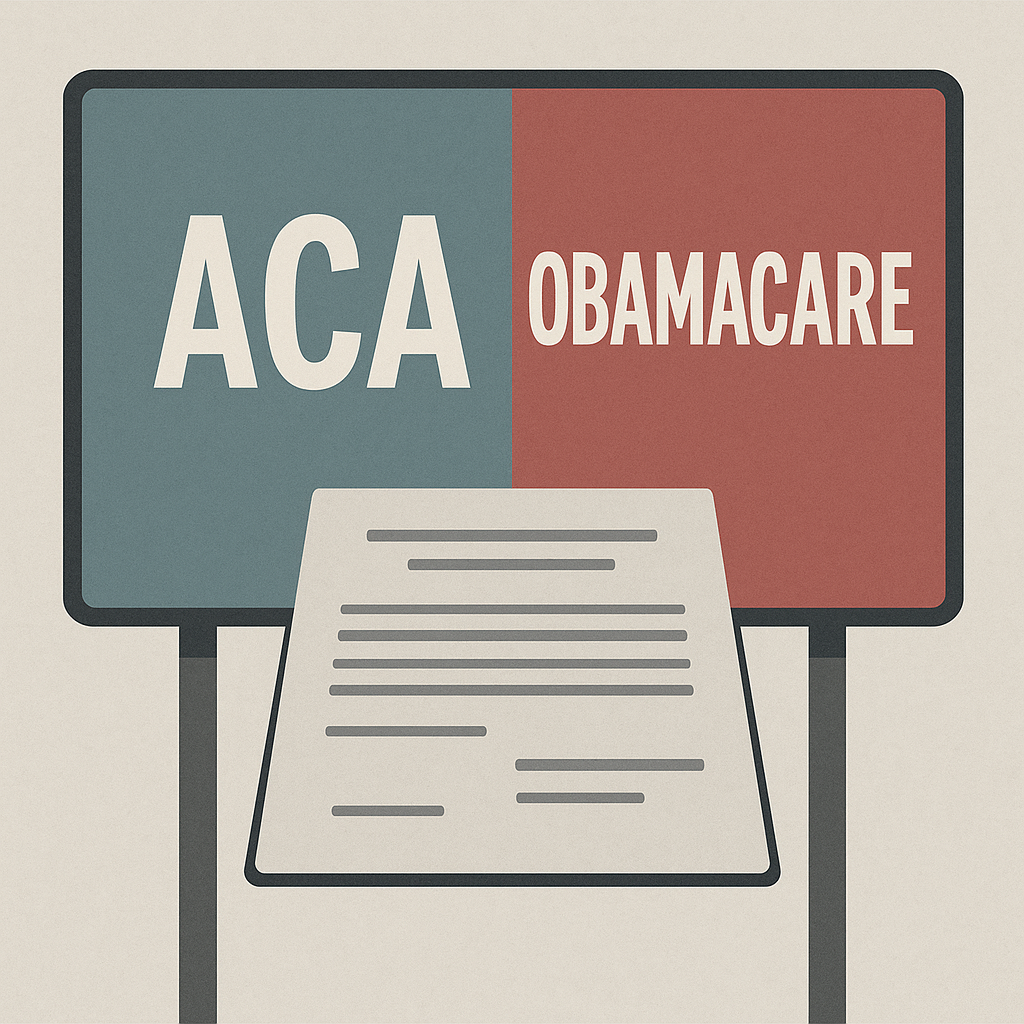
Obamacare and ACA confusion shows how political branding can separate people from the policies they use. The Affordable Care Act, often called Obamacare, is the same federal healthcare law, yet public reaction often changes depending on which name is used.
Obamacare and ACA Confusion Is a Policy Literacy Problem
Structure determines outcomes, while language determines alignment. When people support a policy under one label and reject the same policy under another, the issue is not only knowledge. Instead, the deeper issue is system design.
That distinction matters because public policy does not operate through names alone. It operates through eligibility rules, subsidies, insurance regulations, state decisions, federal funding, enrollment systems, and political incentives.
The ACA and Obamacare Are the Same Law
The Affordable Care Act and Obamacare refer to the same law. The formal name is the Patient Protection and Affordable Care Act, while the political nickname is Obamacare. That distinction should be simple, but years of political branding have made it more complicated than it needs to be.
Some people support the ACA but oppose Obamacare. Others reject the law as a political brand while relying on benefits connected to the same structure. That contradiction is not random. It reveals how labels can override function.
In policy literacy, this matters because citizens cannot defend, reform, or evaluate a system they cannot identify. This connects directly to Building Institutional Literacy, because people need to understand what institutions do before they can judge what those institutions are called.
Political Branding as a Sorting Tool
Political branding works because it simplifies complexity. A complicated healthcare law becomes one label. Over time, that label carries emotion, party identity, media repetition, and cultural meaning. Eventually, the label becomes a shortcut.
As a result, people may stop evaluating the policy and start evaluating what the label signals. This is how a policy perception gap forms. The same law can produce different reactions depending on presentation, which makes the problem larger than communication.
It is a governance problem because policy cannot be held accountable when citizens are reacting to a brand instead of a structure. Once the label becomes stronger than the function, public debate begins to drift away from reality.
Why Labels Move Faster Than Details
Policy details are slow, but labels are fast. A label can travel through television, social media, speeches, headlines, campaign ads, and casual conversation. By contrast, a detailed explanation requires time, context, and attention.
In modern media systems, speed often wins. However, that does not mean the faster message is more accurate. It simply means the faster message gets repeated more easily and becomes familiar before the slower explanation catches up.
This is the same incentive pattern discussed in Pander Economics. When the system rewards simple emotional signals, complex truth has to fight uphill.
Identity Sorting Replaces Policy Evaluation
When individuals support the ACA but oppose Obamacare, the variable is not policy. The variable is identity. The name functions as a signal, and that signal activates alignment or rejection before the policy is evaluated.
This is identity sorting. It happens when people use group membership, party affiliation, cultural signals, or trusted messengers to decide what to believe. Sometimes that shortcut is efficient. However, it can also become dangerous.
If identity cues replace policy understanding, citizens can end up opposing systems they rely on. They can also defend systems that do not serve them well. Therefore, the core issue is not intelligence. It is information design.
If the system trains people to react to labels, then labels will govern perception. That is a weak foundation for democratic decision-making.
Medicaid Naming Variations Create Similar Confusion
The same pattern appears in Medicaid. Many states operate Medicaid through state-branded names, which means residents may know the local program name without recognizing the federal structure behind it.
That matters because people may support their specific coverage while opposing “government healthcare” in the abstract. The benefit feels local, but the system is public. As a result, branding can hide the structure that makes the benefit possible.
When naming obscures structure, accountability gets weaker. Citizens may not know which level of government funds the benefit, administers the benefit, regulates the benefit, or threatens the benefit. Consequently, feedback breaks.
People may praise the outcome while rejecting the system that produces it. That is not a personality flaw. It is what happens when a public system becomes difficult to see.
Enrollment and Political Narrative Can Split Apart
Usage does not always defeat narrative. That is the uncomfortable lesson. Millions of people enroll in ACA Marketplace plans while public debate around the law remains politically polarized.
As of 2025, KFF reported that ACA Marketplace enrollment had more than doubled from 11.4 million people in 2020 to 24.3 million people in 2025. That number matters because millions were using the system even while public opinion toward the law remained politically divided.
The system holds because benefits are experienced individually while narratives are consumed collectively. A person may receive a subsidy, choose a plan, and use coverage. Yet that same person may also live inside a media environment where the law is described negatively.
Personal experience does not always override group identity. Therefore, policy literacy must be repeated. People need clear explanations of what a law does, who it affects, how it is funded, and what happens if it changes.
Without that clarity, public debate becomes untethered from lived experience. The person may know the benefit, but not the system behind the benefit.
Why the Year of the Data Matters
Health policy data needs a date because the structure can change quickly. Enrollment, subsidies, premiums, deductibles, eligibility rules, and public opinion can shift when Congress changes funding, courts alter rules, agencies update guidance, or states administer programs differently.
For example, later KFF reporting using federal data showed ACA Marketplace enrollment falling from a high of 22.1 million people in 2025 to 19.2 million people in February 2026 after enhanced premium tax credits expired. That does not erase the 2025 growth story. Instead, it proves the larger point.
Policy outcomes depend on policy structure. When the structure changes, behavior changes. Premiums rise, plan choices shift, enrollment falls, and political narratives adjust. Therefore, any serious discussion of ACA enrollment should state the year, the source, and what the number is measuring.
This is why dated receipts are not cosmetic. They protect trust. They show readers when the claim was true, what source supports it, and how later developments affect interpretation.
Why the Confusion Persists
There is no strong incentive to resolve healthcare confusion. Political actors often benefit from simplified narratives. Media systems reward emotionally charged framing because it increases attention, while campaigns benefit from clear enemies.
In addition, algorithms benefit from conflict, interest groups benefit from selective framing, and public explanations require more patience than most media formats reward. Meanwhile, policy explanation is slow.
It requires definitions, history, eligibility rules, funding structures, trade-offs, implementation details, and plain language. Complex explanations lose to repetition when the public system does not defend clarity.
Precision loses to speed. Again, this is not a failure of intelligence. It is a function of system design.
Voting Against Structural Outcomes
The long-term effect is misaligned decision-making. Individuals may support policies that reduce access to benefits they currently use. This is often framed as voting against self-interest, but that framing is too shallow.
A more accurate framing is voting based on misidentified systems. If the system is not recognized, it cannot be defended. Likewise, if the system is misunderstood, it can be dismantled without the public fully understanding what is being removed.
This is where When Systems Make Decisions becomes relevant. Systems shape outcomes even when people cannot see the machinery.
Civic power begins when the machinery becomes visible. Until then, people are often voting on symbols while living inside structures.
Clarity Is Infrastructure
Clarity is structural. When citizens cannot identify the systems they depend on, accountability breaks. Policy becomes narrative, outcomes become secondary, and voters lose the ability to connect benefits, costs, and authority.
Reducing the gap between label and function is a requirement for stable civic participation. That requires consistent naming, accessible explanations, local messengers, and repeated exposure to accurate information.
It also requires humility. People do not need to memorize every provision of a law. However, they do need to know what system they are using, who created it, who funds it, who can change it, and how it affects their household.
That is basic policy literacy. Without it, public opinion becomes easier to manipulate and harder to translate into responsible governance.
What Better Policy Communication Requires
A better information system would not rely on slogans to explain healthcare. It would connect labels to function, explain the ACA through what it does, and make program ownership clear.
In practice, that means civic communication must answer the basic questions people need before they form a durable opinion. The goal is not to make everyone agree. The goal is to make disagreement more accurate.
A Stronger Civic Explanation Would Answer
- What is the policy called?
- What does the policy actually do?
- Who uses it?
- Who pays for it?
- Which government level administers it?
- What benefits would change if the policy changed?
- Who has authority to expand, reduce, or repeal it?
These questions separate label from function. More importantly, they turn politics back into governance.
This is the same core discipline behind Structure Builds Freedom. People gain agency when the structure becomes legible.
The System: Updated
Policy confusion is not accidental. It is a predictable outcome of how information is framed, distributed, repeated, and rewarded.
When naming overrides function, citizens engage with perception instead of structure. That weakens accountability at every level because people cannot protect what they cannot accurately identify.
The correction is not louder debate. It is clearer systems. Policies must be understood by what they do, not only what they are called.
That requires consistent naming, dated data, accessible explanations, and repeated verified information across trusted channels. Going forward, the standard is simple: identify the system, trace the incentive, separate the label from the function, and date the evidence.
Only then can decisions reflect reality instead of reaction. Clarity is not preference. It is infrastructure.
The Groundwork
Obamacare and the ACA are the same law. The fact that many people respond differently to each label reveals a deeper systems problem: branding can overpower policy literacy when public information is designed around identity instead of function.
FAQ
Are Obamacare and the ACA the same thing?
Yes. Obamacare is a common nickname for the Affordable Care Act. They refer to the same federal healthcare law.
Why do people confuse Obamacare and the ACA?
People often confuse them because political branding can change how a policy is perceived. The formal policy name and the political nickname can trigger different reactions.
What is the Affordable Care Act?
The Affordable Care Act is a federal healthcare law passed in 2010. It created health insurance marketplaces, expanded coverage rules, and changed parts of the private insurance system.
Why does policy branding matter?
Policy branding matters because labels can shape public opinion before people understand what the policy actually does.
How does identity affect policy perception?
Identity affects policy perception when people respond to party signals, cultural cues, or trusted messengers before evaluating the policy itself.
Why should ACA enrollment data be dated?
ACA enrollment data should be dated because enrollment changes when subsidies, premiums, eligibility rules, and policy structures change. Dated sourcing helps readers understand what was true, when it was true, and what later developments changed.
What is policy literacy?
Policy literacy is the ability to understand what a public policy does, who it affects, how it works, who funds it, and who has the authority to change it.
Learn the System Behind the Label
Groundwork Daily explains the policies, institutions, incentives, and public systems that shape everyday life.
Subscribe for clear analysis that separates structure from noise.
Subscribe to Groundwork Daily