
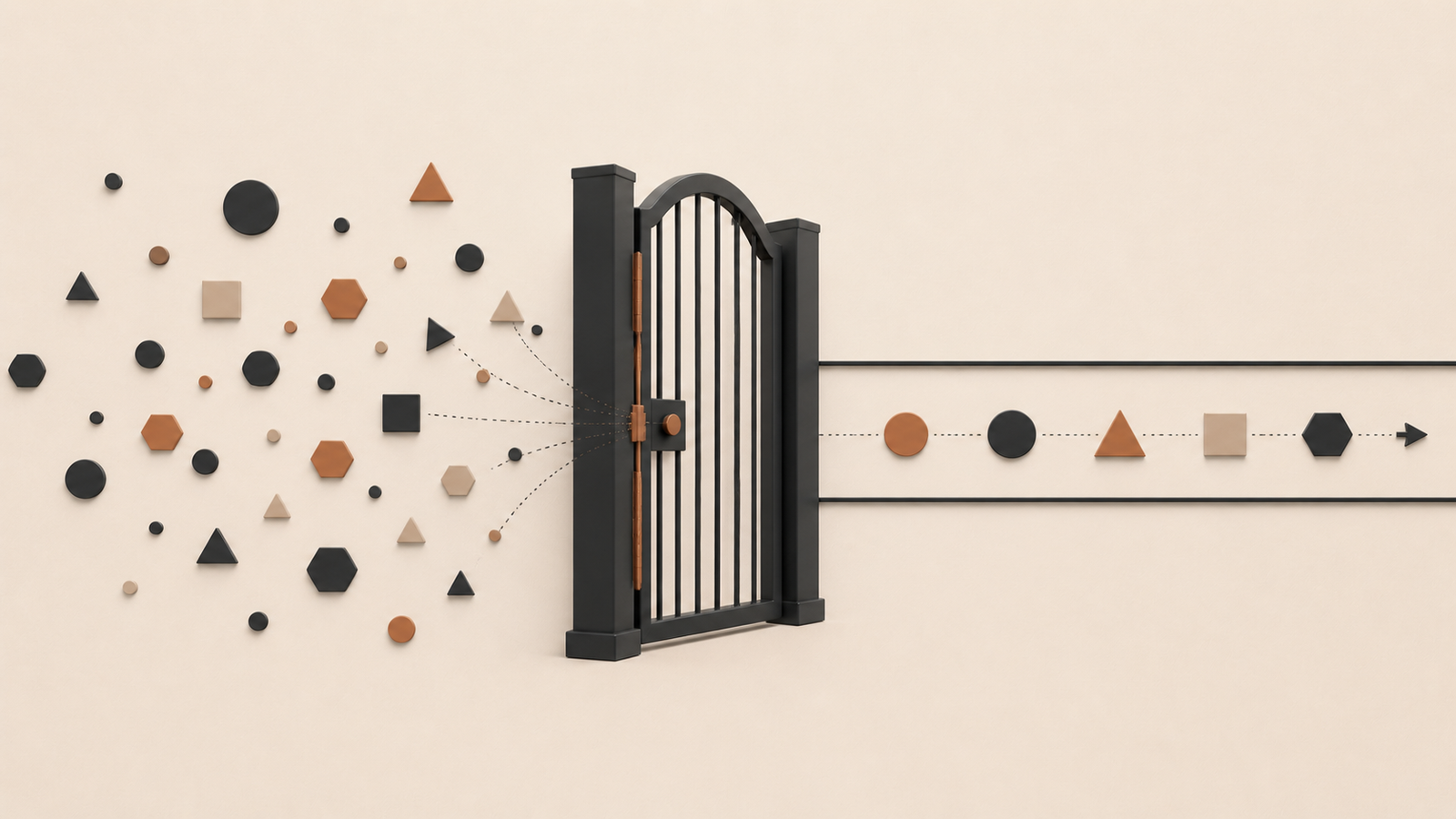
An attention control system begins with one decision: attention is a gate, not a stream. That distinction matters because most people treat attention like something that simply flows wherever life pulls it. That is weak strategy. Attention does not need to be followed. It needs to be governed.
If everything gets access to your mind, nothing is being managed. Notifications, arguments, headlines, memories, anxiety, unfinished tasks, and other people’s urgency all compete for entry. Without a gate, attention becomes public property.
This is where an attention control system begins. Before discipline can hold, behavior can stabilize, or clarity can form, attention has to be controlled.
What an Attention Control System Actually Does
An attention control system decides what gets processed. It determines what receives energy, what becomes important, and what begins shaping behavior.
Most people assume attention is passive. Something happens, and they notice it. However, that is incomplete. Attention works as a selection system. It chooses what enters the operating space of the mind.
Once something enters, it begins influencing emotion, thought, and decision-making. For that reason, attention must be treated as a gate, not an open channel.
What enters attention shapes thought.
Thought shapes response.
Response becomes behavior.
Where the Attention Control System Breaks
An attention control system fails when access goes unmanaged. At that point, the mind starts responding to whatever is loudest, newest, or most emotionally charged.
Although the person may still feel busy or engaged, that activity does not equal control. A distracted system can produce motion without progress.
Typically, the breakdown appears in three forms:
- Reactive focus: attention follows interruption instead of intention.
- Emotional capture: attention locks onto whatever produces the strongest feeling.
- Decision fatigue: attention fragments across too many open loops.
As a result, clarity collapses. The issue is not intelligence. The issue is access control.
The Gatekeeping Failure
If attention is a gate, then control must be defined. However, for most people, external forces manage that gate.
Phones, notifications, anxiety, unfinished conversations, and algorithmic feeds compete for entry. Each one pushes itself forward without asking permission.
This is not attention. It is exposure disguised as awareness.
A functional attention control system rejects that model. It enforces selective access. Not everything deserves entry, processing, or response.
Why Open Access Overloads the Mind
Open access creates overload because the mind cannot process every signal with equal seriousness. When everything feels urgent, the system loses hierarchy.
That is where distraction becomes dangerous. It does not always look chaotic. Sometimes it looks productive. A person can answer messages, read headlines, monitor conflict, and manage small tasks all day while avoiding the one decision that actually matters.
Over time, this produces a false sense of responsibility. The person feels active, but the attention system keeps draining itself on low-value inputs. Eventually, the mind gets tired before the meaningful work begins.
Attention control has to happen before the day fills itself. Otherwise, the system spends the rest of the day reacting.
How Attention Control Connects to Internal Systems
The Internal Systems layer governs thought, emotion, and behavior. Attention is the entry point into that system.
When attention remains unguarded, emotional regulation becomes unstable. Thought loops intensify. Discipline weakens. Behavior becomes reactive.
At the same time, Behavior Systems reinforce this pattern. Repeated attention creates repeated behavior. Over time, repeated behavior becomes identity.
Therefore, attention is not a small variable. It is the front-end control mechanism of the entire system.
Control Mechanism: Build the Attention Control System
The solution is not to “pay more attention.” That advice lacks structure.
Instead, the work is to build a functional attention control system. A system introduces rules, constraints, and decision points.
1. Define Access Points
First, identify what consistently captures your attention. This includes devices, people, unresolved tasks, and emotional triggers. Without identified access points, control remains impossible.
2. Introduce Delays
Next, create time between stimulus and response. Delay prevents automatic entry. It forces selection instead of reaction.
3. Establish Priority
Finally, assign hierarchy. Not all inputs carry equal weight. Priority determines what gets processed first and what gets ignored entirely.
What Strong Attention Control Looks Like
A strong attention control system does not eliminate input. Instead, it filters input.
It does not isolate the individual from the world. It protects the order in which the world gets processed.
When attention is controlled, decisions become cleaner. Emotional spikes lose intensity. Work becomes easier to enter. Discipline becomes more consistent.
Importantly, this is not about perfection. It is about reducing unauthorized access.
An attention control system does not increase openness. It strengthens boundaries.
The Daily Practice of Attention Control
Attention control becomes stronger when it becomes ordinary. It cannot only appear during crisis. It has to become part of the daily operating system.
Start by deciding what gets first access. Before the phone, before the inbox, before the feed, choose the first input deliberately. That first input sets the tone for the system.
Then create protected blocks of focus. These blocks do not have to be long. However, they must be defended. A short protected block is stronger than a long distracted one.
Finally, close open loops when possible. Unfinished tasks keep requesting attention. Some can be completed. Others can be scheduled. A few need to be abandoned. Either way, the gate needs fewer unresolved signals pressing against it.
The Compounding Effect of Attention Control
Over time, attention control compounds. As fewer distractions enter the system, clarity improves. Stronger clarity supports stronger decisions. Better decisions stabilize behavior.
Eventually, the system becomes predictable. Not because life becomes simple, but because internal control becomes consistent.
This is where attention stops being reactive and starts becoming strategic.
The Groundwork
Attention is not a stream to drift through. It is a gate to manage deliberately.
If the gate remains open, the system overloads. When the gate is controlled, the mind operates with clarity and direction.
This is the beginning of internal control. Not more thinking. Not more input. Just better selection.