
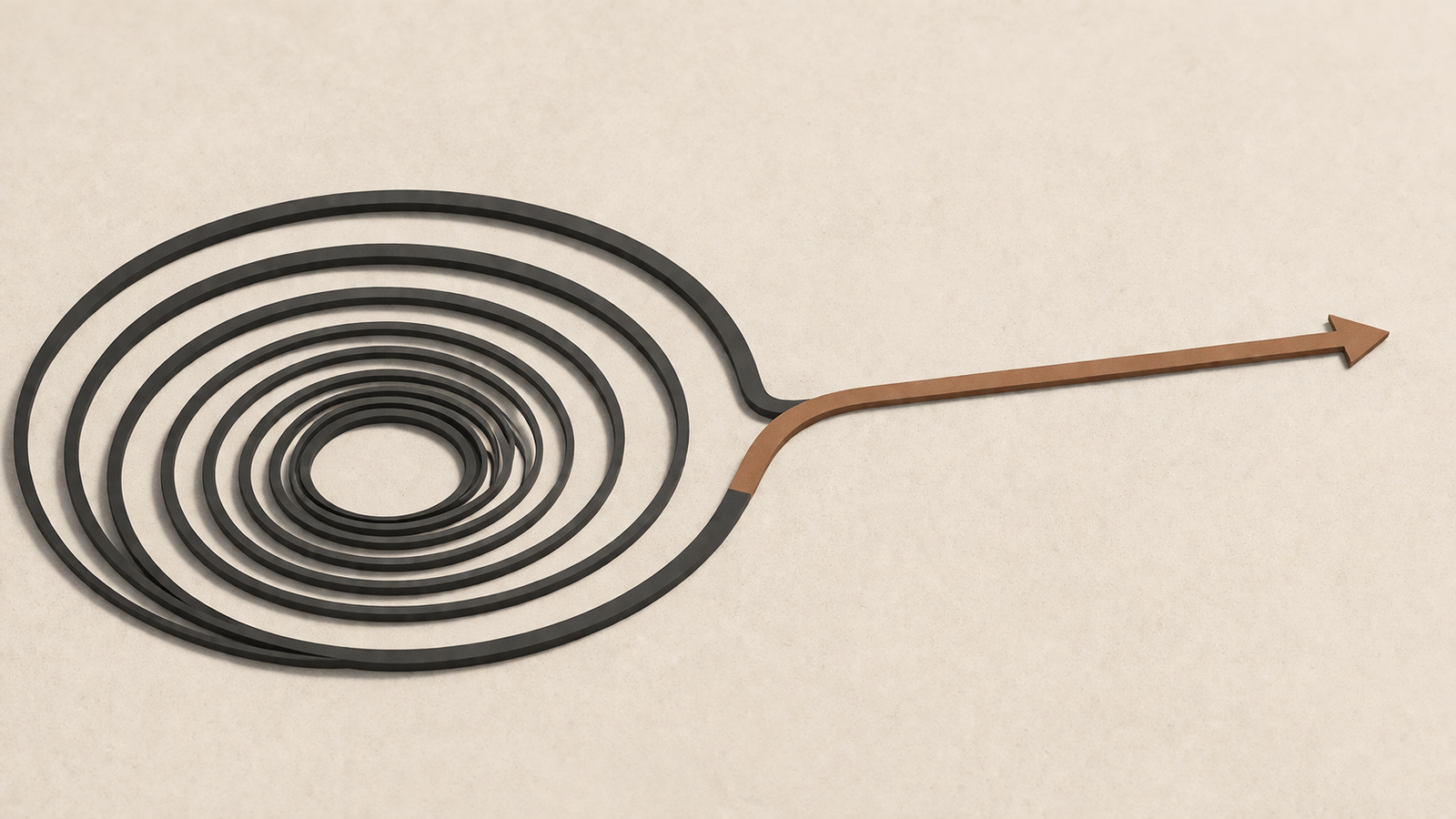
Thought loops false urgency begins when repetition starts pretending to be importance. The same idea circles long enough to feel immediate, necessary, and impossible to ignore. However, repetition is not importance. It is just repetition.
Most people trust what feels urgent. That trust becomes dangerous when urgency is manufactured internally instead of triggered by real conditions.
This is where control breaks. Not because the outside world changed, but because the internal system mistook repetition for priority.
What Thought Loops Actually Are
Thought loops are repeated internal narratives that cycle without resolution. The same concern, idea, imagined outcome, or replayed conversation runs again and again, often without new information.
At first, the loop feels like thinking. Over time, though, it becomes pressure. The mind confuses mental activity with progress.
The more the loop repeats, the more real it feels. Eventually, the system treats the loop as something that must be acted on immediately.
Repetition creates familiarity.
Familiarity feels important.
Importance creates urgency.
That urgency is false. Nothing external has changed. The loop has simply intensified.
Where Thought Loops False Urgency Comes From
Thought loops false urgency comes from unstructured thinking. When thoughts are not directed, they repeat. As they repeat, they gain emotional weight.
The internal system does not always distinguish between new information and repeated information. It only recognizes activity. As a result, repeated thoughts begin to feel like escalating problems.
This creates a distorted signal. The system pushes for action, even when action is unnecessary, premature, or misaligned.
At that point, the individual is no longer responding to reality. They are responding to the loop.
Why Thought Loops Feel Convincing
Thought loops feel convincing because they create internal pressure. The longer the loop runs, the harder it becomes to ignore.
Eventually, the system seeks relief. Action becomes the easiest way to release pressure, even when that action creates more problems.
This is why people overreact, overcorrect, send messages too soon, revisit decisions too quickly, or act from anxiety instead of clarity.
In this way, the loop does not only influence thinking. It starts driving behavior.
How This Connects to Internal Systems
Internal Systems govern how thought, attention, and emotion interact. Thought loops sit at the center of that interaction.
If attention allows the same input to repeat, the loop strengthens. If emotional reactivity is high, the loop gains intensity. If discipline is weak, the loop converts into action too quickly.
This connects directly to Attention Is a Gate, Not a Stream and Emotional Reactivity Is a Timing Failure.
Attention determines what enters. Timing determines when response happens. Thought loops distort what feels urgent.
Together, they shape behavior.
How Thought Loops Show Up in Real Time
Thought loops rarely appear as obvious repetition. Instead, they show up as shifting versions of the same concern.
You replay a conversation. Then you imagine a different version. After that, you anticipate a future response. Each version feels new, but the structure is the same.
The loop continues, building pressure with each pass.
At some point, action feels required. You send the message. You make the decision. You respond to something that never actually changed.
This is false urgency in action.
It also appears in work. A task feels unresolved, so the mind keeps circling it. Instead of making a plan, the system keeps rehearsing the pressure. That rehearsal creates urgency without producing direction.
The same pattern appears in relationships. One phrase, tone, or delay becomes the center of repeated interpretation. The mind keeps returning to it until the interpretation feels like fact.
That is the trap. The loop turns possibility into certainty.
Internal Signals of a Thought Loop
The system produces signals before the loop turns into behavior. These signals are not random. They are pattern markers.
- Repetition: the same idea returns without resolution.
- Escalation: the thought becomes more intense with each pass.
- Compression: everything starts to feel immediate.
- Narrowing: one interpretation begins crowding out other possibilities.
These signals do not require action. They require recognition.
Once recognized, the loop can be interrupted. Without recognition, the system continues to treat repetition as evidence.
Control Mechanism: Break the Loop
The solution is not to think more. More thinking often feeds the same cycle. The real solution is to structure thinking.
1. Label the loop
Identify that the thought is repeating. Naming the loop creates distance from it. Distance weakens the pressure to act immediately.
2. Interrupt the cycle
Shift attention to something concrete. Movement, writing, breathing, or structured work can break repetition long enough for the system to reset.
3. Delay action
Do not act while the loop is active. Wait until the system stabilizes and the urgency fades.
4. Check the evidence
Ask what has actually changed. If nothing external has changed, the urgency may be coming from repetition rather than reality.
Why More Thinking Makes It Worse
Many people respond to thought loops by thinking harder. That approach fails because it gives the loop more material.
More thinking creates more repetition. More repetition increases urgency. Eventually, the system becomes trapped inside its own process.
Clarity does not come from volume. It comes from structure.
That is the hard truth: not every thought deserves more time. Some thoughts need boundaries.
What Changes When Thought Loops Are Controlled
When loops are interrupted, urgency resets. The system returns to a baseline where decisions can be evaluated clearly.
Not every thought requires action. Not every concern requires resolution. Some inputs need to be filtered out entirely.
As control improves, decisions become more deliberate. Fewer actions are driven by pressure. More actions are driven by intention.
Over time, this changes the internal system. The mind learns that repetition does not automatically deserve authority.
Urgency should come from reality, not repetition.
The Groundwork
Thought loops false urgency does not create clarity. It creates pressure.
When repetition replaces structure, urgency becomes distorted. Once urgency becomes distorted, behavior follows the wrong signal.
Control begins by breaking the loop, not feeding it.
Not every thought deserves to be followed. Some need to be stopped.