The Uno rule lawyer shows up in every group eventually. Not because the game needs saving, but because somebody believes the official rules matter more than the way the table has already agreed to play.
Every group has one.
No exceptions.
The moment somebody drops a Draw 2 and stacks it, here they come:
“Actually… that’s not how the official rules work.”
Not “hold on.” Not “wait.”
“Actually.”
With complete confidence.
Like the integrity of the entire evening depends on restoring order to a card game happening next to somebody’s half-finished plate of food.
The energy shifts immediately.
Not because people are confused.
Because everybody at the table suddenly realizes the same thing:
Y’all are not playing by the same rules.
Then somebody usually leans back, shrugs, and says:
“That’s not how we play here.”
And just like that, the conversation changes.
That is the harder truth: being correct does not mean you are aligned. It only means you brought evidence into a room that may not care about evidence.
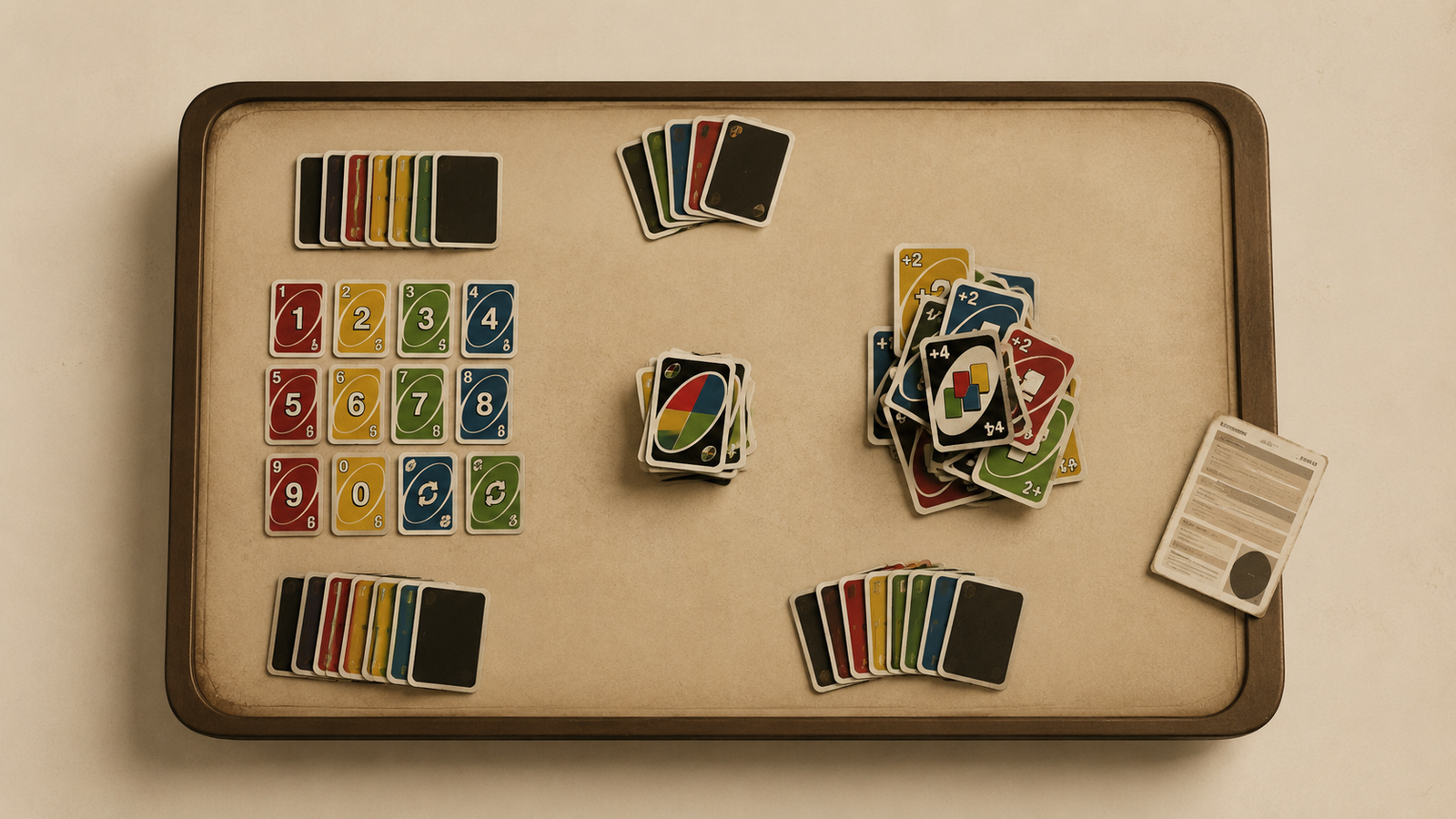
The Uno Rule Lawyer Problem
The Uno rule lawyer is not always wrong.
That is what makes the moment interesting.
Sometimes the person quoting the rulebook is technically correct. The issue is not accuracy. The issue is alignment.
If everyone else at the table has been playing with house rules, then the official rule is not the rule controlling the room. The enforced rule is.
That distinction matters beyond the game. Relationships work the same way. People can be technically right and still completely misread the emotional system they are inside.
And if that keeps happening, the problem is no longer misunderstanding. The problem is refusing to study the room while demanding the room respect your rulebook.
The Energy Shift
The interesting part is not who was technically right.
Technically, the rule lawyer may have been correct the entire time.
However, socially, that stopped mattering the moment the table decided otherwise.
People rarely operate according to official rules alone. Instead, they operate according to shared understanding, group rhythm, emotional context, and whatever version of the rules the environment has silently agreed to enforce.
The table decides what becomes real.
This is where people get offended, because it sounds unfair.
It is unfair.
That does not make it less true.
Rules vs. The Room
This is where things become uncomfortable.
Some people spend their whole lives believing correctness automatically creates alignment.
It does not.
You can be technically right and still completely disconnected from the room.
You can understand the official rules and still misunderstand the environment you are standing in.
That is why “You brought rules to a vibe fight” feels funny at first and painfully accurate a few seconds later.
The room was never only responding to logic. It was also responding to rhythm, familiarity, trust, timing, power, history, and group understanding.
That is the part people miss. They think the rule should settle the conflict. But in most relationships, the rule is only one piece of the conflict. The rest is about who feels heard, who feels controlled, who feels respected, and who feels like the other person keeps moving the target.
For broader context on how social norms shape behavior, see the Britannica overview of social norms.
Same Game, Different Reality
At some point, it hits you:
“Oh… we are not actually playing the same game.”
Same cards. Different expectations.
Same words. Different meanings.
Same relationship. Different assumptions about how things are supposed to work.
Suddenly, a lot of confusion starts making sense.
Many conflicts are not really disagreements about effort or intention. They are disagreements about the rules people thought everybody already understood.
One person thinks loyalty means staying through discomfort. Another thinks loyalty means telling the truth before resentment hardens. One person thinks privacy means protection. Another thinks privacy means distance. One person thinks consistency means routine. Another thinks consistency means emotional availability.
Both people can be sincere.
Both people can still be wrong for each other’s system.
The Logic of Relationships
This is not just about Uno.
It shows up in relationships constantly.
One person thinks honesty means direct communication. Another thinks honesty should be softened to protect feelings.
One person thinks consistency means daily effort. Another thinks consistency means showing up when it matters most.
Both people may believe they are being fair.
But fairness inside one system can feel completely wrong inside another.
You came with rules. They came with reality shaped by different experiences.
Unless those differences become visible, people keep hurting each other while believing they are playing correctly.
That is how relationships get stuck. Not because nobody cares. Because each person keeps trying to enforce a private rule as if it was a shared agreement.
Adjustment Changes Everything
Most people react to this realization in one of two ways.
Some keep arguing.
Others start observing.
They watch the rhythm. They study the environment. They stop assuming the official explanation tells the whole story.
Eventually, they adjust.
Not by abandoning themselves.
By understanding the table clearly enough to move intentionally inside it.
Adjustment does not mean surrender. That is the immature reading.
Adjustment means clarity.
It means knowing whether the table is worth learning, whether the rules can be named, whether the mismatch can be repaired, or whether continuing to play is just self-betrayal with better language.
The Harder Truths
Here is the part people do not like.
Some relationships do not fail because love disappeared.
They fail because the operating rules were never compatible.
Some friendships do not fade because people became fake.
They fade because one person changed the rhythm and the other person wanted the old version back.
Some families do not stay tense because nobody cares.
They stay tense because the house rules reward silence, guilt, avoidance, or control.
That is not a communication issue.
That is an enforcement issue.
If the room punishes honesty, then honesty is not really one of the rules.
If the relationship rewards inconsistency, then inconsistency is part of the structure.
If accountability only appears when someone is angry, then accountability is not a standard. It is a reaction.
Hard truth: people do not always follow the values they claim. They follow the values the environment rewards.
The Quiet Truth
Eventually, you stop arguing about whether the rules are fair.
You start paying attention to how the table actually works.
Once you see that clearly, you move differently.
Not because you became manipulative.
Because you finally realized relationships are not built only on rules.
They are built on shared understanding.
And when the understanding is different, the outcome usually is too.
The Uno rule lawyer teaches the quiet lesson. Being right is not the same as being aligned.
And sometimes the most mature move is not to keep proving your rulebook is correct.
Sometimes it is to admit the table was never playing your game.