
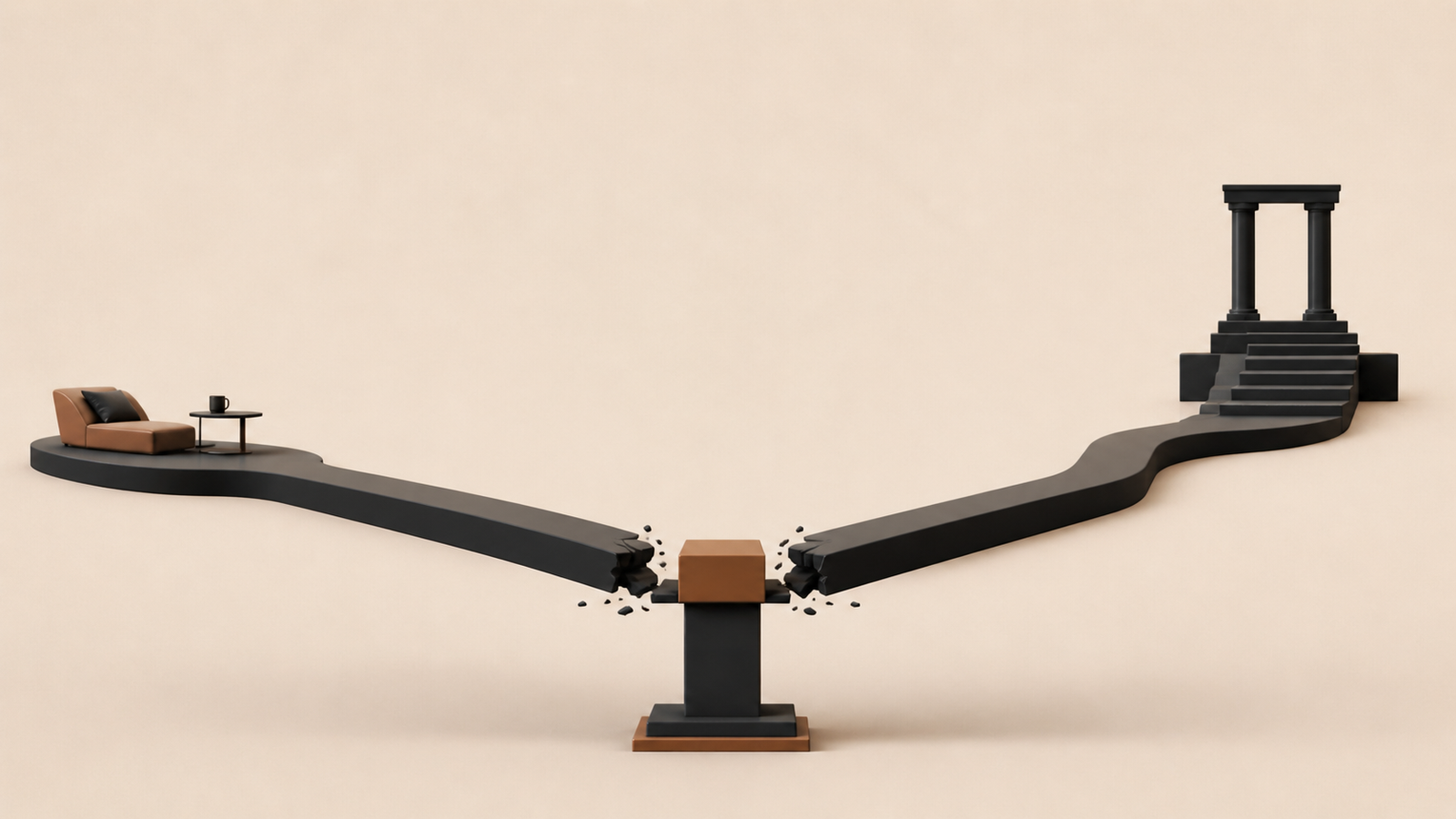
Internal conflict is a structural misalignment. It is not always confusion. It is not always weakness. Often, it is the result of competing internal systems trying to move in different directions at the same time.
One part of the system wants comfort. Another part wants progress. One part wants immediate relief. Another part wants long-term structure. The friction between those competing aims creates the feeling of being stuck.
That is why internal conflict feels exhausting. The person is not only making a decision. They are absorbing the cost of an unaligned system.
What Internal Conflict Really Is
Internal conflict happens when a person’s desires, standards, habits, emotions, and identity are not operating from the same structure.
The conflict is not always visible from the outside. A person may appear calm, capable, and functional while internally negotiating against themselves all day.
That negotiation is costly.
It drains attention. It weakens consistency. It creates delay. Over time, it can make simple decisions feel heavier than they should.
This is why Internal Systems matters. Behavior does not begin at the moment of action. It begins inside the structure that produces the action.
Why Misalignment Creates Friction
Friction appears when two internal systems are optimizing for different outcomes.
For example, the emotional system may want relief. The identity system may want discipline. The habit system may want what is familiar. The future-focused system may want change.
None of those systems are automatically wrong.
The problem is that they are not coordinated.
When coordination is missing, the person starts using willpower to hold together what structure should already be aligning.
Internal conflict is often the sound of competing systems without a governing standard.
The Competing Systems Model
Internal conflict usually forms across four systems.
1. The Comfort System
This system wants relief, ease, familiarity, and lower pressure. It is not evil. It is protective. However, when it governs too much behavior, growth slows down.
2. The Identity System
This system carries the standard. It asks what kind of person the behavior supports. When identity is weak, discipline becomes unstable. That is why Discipline Fails Where Identity Is Weak.
3. The Habit System
This system repeats what has been reinforced. It does not care whether the pattern is useful. It cares whether the pattern is familiar.
4. The Future System
This system points toward long-term outcomes. It understands consequences, but it often lacks urgency in the present moment.
Internal conflict appears when these systems are not ranked. If comfort, identity, habit, and future all carry equal authority, every decision becomes a negotiation.
Real-World Examples
Example 1: Wanting change but repeating the old pattern
A person says they want better health, but each stressful day ends with the same behavior they said they wanted to stop.
The stated goal is health. The active system is relief.
That is not a character flaw. It is a structural mismatch. The person has a future goal, but no control point between stress and response.
Example 2: Wanting discipline but depending on mood
A person wants consistency, but only follows through when they feel ready.
The identity says, “This matters.” The motivation system says, “Only when it feels good.”
That creates instability. The correction is not more hype. The correction is structure. Self-Control Is a System, Not a Trait explains why control improves when the system reduces friction before pressure arrives.
Example 3: Wanting peace but feeding the argument
A person wants calm, but keeps returning to the same conversation, comment section, or conflict loop.
The stated value is peace. The active system is emotional stimulation.
Until that contradiction is named, the pattern continues.
Example 4: Wanting clarity while living from an unstable baseline
A person wants better decisions, but makes most decisions while tired, overstimulated, reactive, or rushed.
The issue is not intelligence. The issue is baseline state. Your Default State Determines Your Decisions because decisions inherit the condition of the system producing them.
How to Correct the Misalignment
Alignment does not happen by wishing harder. It happens by reorganizing authority inside the system.
1. Name the competing systems
Do not stop at “I feel conflicted.” Identify what is competing. Is comfort fighting identity? Is habit fighting future? Is emotion fighting structure?
2. Choose the governing standard
Every system needs authority. Without a governing standard, the loudest impulse wins.
3. Reduce friction around the aligned behavior
Make the desired action easier to repeat. If the aligned behavior is too difficult to start, the comfort system will keep winning.
4. Add a delay before the old pattern
Delay creates space. Space allows evaluation. Evaluation gives the governing standard time to speak.
5. Build recovery into the system
Misalignment will not disappear overnight. Recovery protects continuity when the old pattern reappears.
The goal is not to eliminate every internal pull. The goal is to stop letting every internal pull govern behavior.
What Alignment Actually Looks Like
Alignment does not mean every part of you feels excited about the same decision.
That is fantasy.
Alignment means the system knows which standard has authority.
You may still feel resistance. You may still feel discomfort. You may still want the easier option. However, those signals no longer control the final decision.
That is the difference between internal conflict and internal governance.
Alignment is not the absence of resistance. It is the presence of order.
FAQ
What causes internal conflict?
Internal conflict is often caused by competing systems inside the person. Desire, habit, identity, emotion, and long-term goals may be pushing in different directions.
Is internal conflict emotional?
It can feel emotional, but the deeper issue is often structural. Emotion reveals the friction, but misalignment produces it.
How do you resolve internal conflict?
Name the competing systems, choose the governing standard, reduce friction, introduce delay, and build a recovery plan.
Why do I keep doing things I do not want to do?
Because the active system may not match the stated goal. Your identity may want one outcome while your habits, emotions, or comfort patterns pull toward another.
The Groundwork
Internal conflict is a structural misalignment.
When competing systems pull in different directions, behavior becomes inconsistent and decision-making becomes expensive.
The solution is not shame. It is alignment.
Name the competing systems. Choose the governing standard. Build the structure that supports the behavior you claim to value.
That is how internal conflict becomes internal order.