
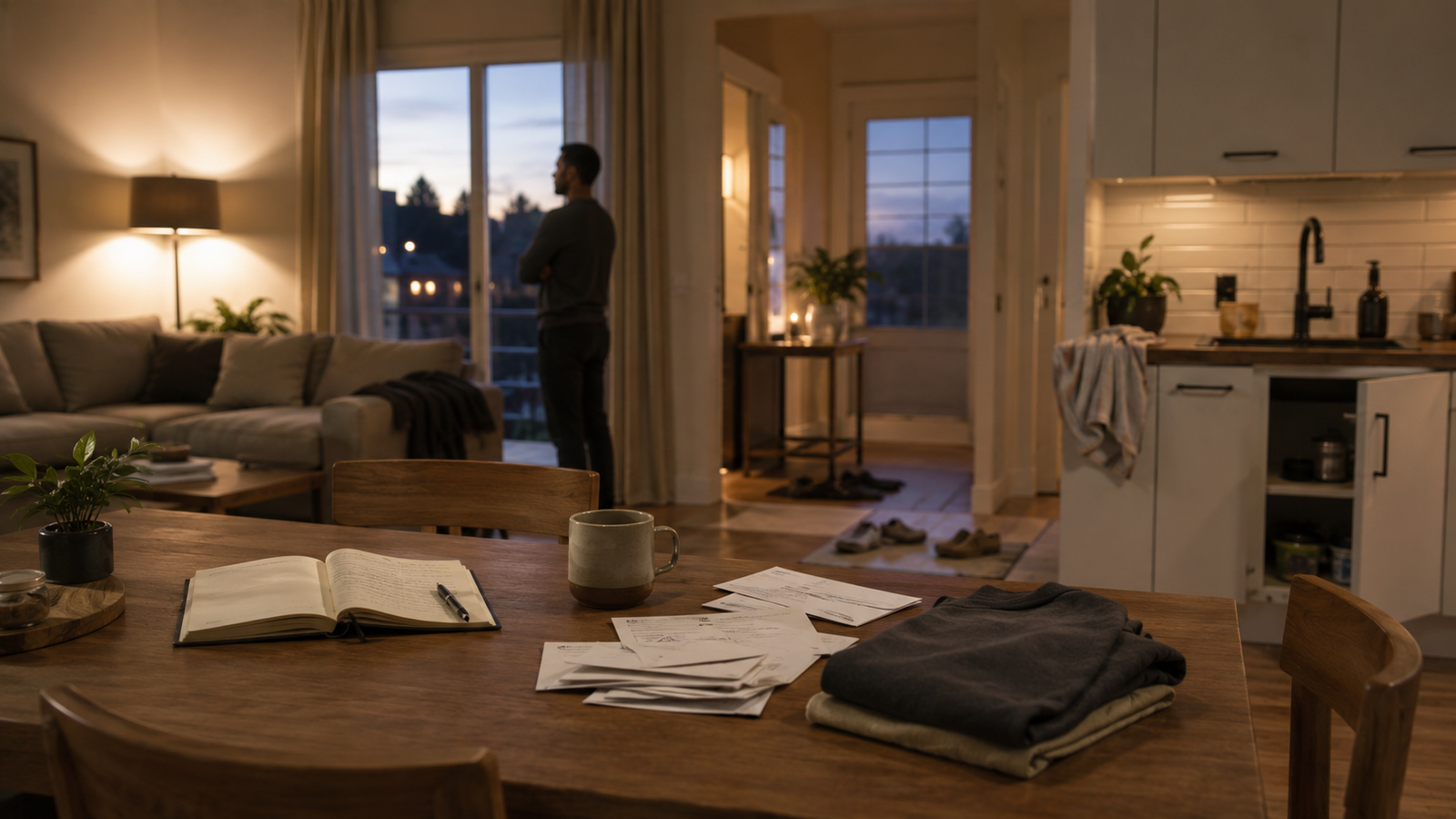
The cost of living without ritual is rarely visible at first. It usually arrives as drift. A dish waits in the sink. A bag stays near the door. Bedtime slides by twenty minutes, then an hour. A bill gets opened but not handled. By morning, the day begins with searching instead of starting.
The Cost of Living Without Ritual Starts Quietly
None of these moments look serious by themselves. That is why they survive. They seem too small to name, too ordinary to interrupt, and too familiar to challenge. Still, the home keeps absorbing them.
Over time, the absence of ritual becomes a hidden tax on the household. It taxes attention. It taxes patience. It taxes memory. It also taxes relationships.
Simple actions become repeated decisions. Those decisions become fatigue. Eventually, the home may still function, but it no longer restores.
That is the quiet cost. Life without ritual may look normal from the outside. It may look busy. It may even look successful. However, inside the rhythm of the home, something is leaking.
There is movement without cadence. Activity continues, yet closure never arrives. Effort keeps showing up, but containment does not.
House Rhythm Begins With Chosen Repetition
House Rhythm does not begin with decoration. It does not begin with productivity theater. It begins with the recognition that a home is a system.
Every system needs rhythm. Without rhythm, the system still repeats something. The only question is whether that repetition was chosen.
If nothing is chosen, something still repeats.
That is the part most people miss. A household without intentional ritual does not become free. Instead, it becomes governed by whatever is loudest, easiest, most urgent, or most neglected.
The phone becomes a ritual. The mess becomes a ritual. Avoidance becomes a ritual. Tension becomes a ritual. Last-minute recovery becomes a ritual.
The cost of living without ritual is not only disorder. More precisely, it is the slow transfer of authority from intention to accident.
Ritual Is Not What Most People Think
When people hear the word ritual, they often imagine religion, ceremony, candles, inherited tradition, or something formal enough to require explanation. That definition is too narrow.
At home, ritual is repeated action with meaning attached to it. Sometimes the meaning is spoken. More often, it is simply understood.
Keys go in the same place because the morning should not begin with panic. Shoes come off at the door because the outside world should not be dragged through the whole house.
Dinner happens at a certain time because bodies and relationships need a reliable place to land. A Sunday reset happens because Monday should not inherit every loose end from the week before.
These are not aesthetic choices. They are structural choices.
A ritual tells the household what matters enough to repeat. It removes argument from actions that should not require debate. It gives the day a shape before emotion gets involved.
Ritual Prepares Before Pressure Arrives
Emotion is a poor architect. It responds to pressure. Ritual prepares for pressure before it arrives.
A home with ritual has fewer moments where everything must be decided from scratch. The same small actions happen in the same reliable sequence.
For example, the coffee area is ready. The entryway is reset. Laundry has a day. Mail has a place. Evening has an ending. Morning has a beginning.
None of this needs to be dramatic. In fact, the strongest rituals often become almost invisible. Their power comes from repetition, not spectacle.
That is why ritual is easy to underestimate. People notice big effort. They notice deep cleaning, new planners, new bins, new rules, and new schedules.
However, they do not always notice the quiet force of something that simply happens every day.
The home notices.
Your body notices.
Even the nervous system notices.
Ritual Is Operational Memory
A repeated rhythm lowers the number of decisions a person must make while already tired. It reduces the friction hiding inside ordinary transitions.
In addition, it gives people fewer chances to abandon what matters because the system has already prepared the next step.
This is why ritual is not nostalgia. It is operational memory.
It says: this is how the home begins. This is how the home closes. This is where things return. This is what gets protected. This is what happens again.
The cost of living without ritual grows when the home loses that memory. People must then carry every transition manually.
Every task must be rediscovered. Every loose end waits for someone tired enough to resent it.
Houses Remember What People Forget
A home has a memory. Not in the sentimental sense. In the practical sense.
It remembers what was not put away. It remembers which drawer became a graveyard for loose items. It remembers the pile of mail that no one wanted to face.
It also remembers the chair that stopped being a chair and became a storage system.
Later is where many homes go to lose their rhythm.
The unfinished task does not disappear because attention moved away from it. It waits. Then it becomes background pressure.
After enough time, it becomes part of the environment. People may stop seeing it clearly, but they still feel it.
That feeling matters. A cluttered or unresolved home often creates a low-grade demand on attention. A person walks through the room and receives silent instructions from every unfinished thing.
Handle me. Move me. Decide me. Wash me. Open me. Fold me. Pay me. Answer me.
Visual Noise Becomes Mental Load
No single instruction is overwhelming. Together, they create noise.
This is why a house can look merely lived-in and still feel mentally expensive. The issue is not whether the home could appear in a magazine. That is the wrong standard.
The better question is whether the environment supports recovery or keeps calling the body back into unfinished labor.
Without ritual, the home starts storing decisions instead of resolving them.
Every object without a place becomes a future decision. Every task without a time becomes a future negotiation. Every repeated friction point without a ritual becomes a small daily argument between intention and reality.
A household ritual solves this by giving recurring actions a place in the rhythm of life. The mail does not have to become a pile if it has a processing point.
Likewise, the kitchen does not have to reset itself through resentment if the evening has a closing sequence.
That is what ritual does. It converts recurring problems into recurring actions.
A Home Needs Shock Absorption
Ritual is not about becoming rigid. Rigidity tries to control life so completely that nothing unexpected can enter.
Ritual does something better. It builds enough stability that unexpected life can be absorbed without taking down the whole system.
A home without ritual has very little shock absorption. One late night can throw off the next morning. One rushed morning can leave the house scattered.
Then one scattered house can make the evening heavier. One heavy evening can turn into avoidance.
After that, the cycle repeats.
By the time people name the problem, they often call it stress. Sometimes it is. However, sometimes what they are feeling is the cost of living without ritual inside a home that has lost cadence.
The Cost of Living Without Ritual Is Rhythm Failure
There is a weak version of this argument that should be rejected immediately. Not all burnout is caused by household disorganization. That would be lazy and unfair.
Some burnout comes from exploitation, grief, caregiving pressure, financial strain, health issues, unsafe workplaces, and systems that ask too much from people with too little support.
House Rhythm should never pretend that better routines can solve structural pressure by themselves. That is self-help theater, and it does not hold up under real life.
Still, another truth deserves to be said plainly. When life is already demanding, the absence of ritual makes everything more expensive.
Hard weeks become harder when there is no reset. Stressful jobs become more consuming when the home has no reliable transition out of work mode.
Caregiving becomes heavier when every basic item must be found under pressure. Financial strain becomes more chaotic when bills, receipts, and decisions live in scattered places.
Emotional fatigue deepens when there is no closing ritual that tells the body the day is done.
Ritual Protects What Pressure Tries to Take
The workload may be real. The pressure may be real. Yet the lack of rhythm can remove the buffers that help a person survive that pressure with less damage.
This is why ritual is not soft. It is protective.
A consistent bedtime ritual protects sleep. A consistent morning ritual protects attention. A consistent meal rhythm protects the body from being run entirely by urgency.
A weekly reset also protects the next seven days from beginning with inherited mess.
When those structures are missing, everything bleeds into everything else. Work bleeds into rest. Screens bleed into sleep. Errands bleed into meals.
Meanwhile, cleaning bleeds into resentment. Decisions bleed into exhaustion. The day never lands. It just keeps spreading.
That spread is costly.
Ritual Creates Edges
People often imagine burnout as collapse. Sometimes it is. More often, burnout begins as the loss of distinction.
No clean start. No clean stop. No true transition. No reliable return to baseline.
Without ritual, the home loses its punctuation. There is no comma. No period. No paragraph break. Just one long sentence of unfinished life.
This is why small rituals matter. They create edges.
The morning ritual says: begin here.
The meal ritual says: gather here.
The reset ritual says: return this to order.
The evening ritual says: close this day.
Those edges do not remove pressure. They contain it.
Daily Negotiation Is the Hidden Cost
The most overlooked cost of living without ritual is negotiation.
When there is no ritual, the same questions return again and again. What happens now? Who handles this? Where does this go? When will this get done?
Is this urgent? Can it wait? Did anyone remember? Why is this still here?
At first, these questions seem ordinary. They are part of life. Yet when they repeat without structure, they become a drain.
A home should not have to renegotiate its basics every day.
The more basic the action, the more it needs rhythm. Dishes. Laundry. Food. Sleep. Entryways. Mail. Trash. Cleaning. Calendars. School materials. Work bags. Medication. Charging cords. Keys.
These are not glamorous topics. Good. Glamour is not the point. Stability is built from unglamorous things that either repeat cleanly or create friction every day.
The Cost Is Relational Too
A household that constantly decides what to do with the basics has less energy left for anything deeper.
There is less energy for conversation. There is less patience for children. There is less capacity for planning. There is less emotional space for repair.
That is the part people miss when they dismiss ritual as small.
Small is where the system lives.
A missing ritual around dinner can slowly become a missing ritual around connection. A missing ritual around bedtime can slowly become a missing ritual around rest.
Similarly, a missing ritual around money can slowly become a pattern of avoidance.
A missing ritual around cleaning can slowly become a home where everyone feels accused by the environment.
When the home has no rhythm, people begin assigning blame for what the system has failed to hold.
Someone becomes the messy one. Someone becomes the nag. Someone becomes the irresponsible one. Someone becomes the person who always has to remind everyone.
Sometimes those patterns are about behavior. Often, they are also about missing design.
A better system does not remove responsibility. It clarifies it. Ritual makes responsibility visible before resentment has to do the work.
Ritual Creates Freedom Because It Reduces Friction
People who resist ritual often think they are protecting spontaneity. That assumption is understandable, but incomplete.
Spontaneity without structure becomes unstable. It depends too much on mood, memory, energy, and chance.
It feels open at first. Then it quietly becomes chaotic because nothing is holding the basics in place.
The stronger argument is this: ritual creates enough stability for spontaneity to survive.
When the kitchen is reset, cooking becomes easier. When the entryway is organized, leaving becomes easier. When sleep has rhythm, mornings become less punishing.
When the week is reviewed, surprises become fewer.
That is freedom.
Not the freedom of having no structure, but the freedom of not being trapped by preventable disorder.
Good Rituals Are Rails, Not Cages
A good ritual should not feel like a cage. It should feel like a rail. Something that helps the day move without requiring constant force.
This is why the best household rituals are modest. They do not try to manage every breath. They do not turn the home into a workplace.
They also do not punish people for being human.
Instead, they protect the recurring points where life tends to leak.
Start of day. End of day. Meals. Money. Cleaning. Rest. Return.
These are the places where rhythm matters most.
Ritual also reduces decision fatigue by making certain choices unnecessary. A person does not have to decide where the keys go if the keys always go in the same place.
A household does not have to decide when the reset happens if the reset has a protected window.
This is not about eliminating thought. It is about saving thought for what deserves it.
Ritual Helps People Return to Themselves
A home should not consume its best attention on preventable friction.
That is the operational case for ritual. It preserves energy. It protects attention. It reduces recurring stress.
It also allows people to move through ordinary life with less unnecessary drag.
There is a deeper case as well.
Ritual gives people a way to return to themselves.
A person who begins every morning in reaction can start believing reaction is their nature. A person who ends every night in drift can start believing exhaustion is their identity.
But calm often begins as repetition. Not instant peace. Not a perfect home. Not a flawless schedule.
Just one repeated action can say: this part of life will no longer be left to chance.
Accidental Rituals Are Still Rituals
A hard truth: every home already has rituals.
The question is whether they were chosen.
If everyone enters the house and drops belongings wherever they land, that is a ritual. If everyone eats separately in front of separate screens, that is a ritual.
If bills are avoided until anxiety forces action, that is a ritual.
If bedtime always happens after scrolling, that is a ritual. If Sunday night always becomes panic, that is a ritual.
Repetition creates culture whether anyone names it or not.
This is why the absence of intentional ritual does not create neutrality. It creates accidental governance.
The home starts being governed by impulse, fatigue, avoidance, convenience, and whatever habit formed first.
Once a pattern repeats long enough, it begins to feel natural. That does not mean it is healthy. It only means it is familiar.
The House Is Always Teaching
Familiarity is not evidence.
Some households normalize rushing. Others normalize silence. Some normalize clutter. Others normalize everyone disappearing into their own device.
Some normalize starting the week unprepared. Others normalize ending the day without closure.
These patterns may not look dramatic, but they shape the emotional weather of the home.
A house can teach urgency. It can teach avoidance. It can teach care. It can teach return.
The difference is not always income, square footage, or taste. Sometimes the difference is what repeats.
That is why ritual deserves more respect. It is one of the quiet ways a household teaches people how life works.
Children learn what matters by what repeats. Adults relearn what matters the same way.
A couple learns the condition of the relationship through recurring patterns of attention, repair, meal, rest, silence, and responsibility.
The house is always teaching. If the lesson is accidental, the cost will eventually show.
Build One Ritual Before Building Ten Goals
The mistake most people make is trying to fix everything at once. That impulse is understandable. Once the drift becomes visible, the temptation is to overhaul the whole home.
New schedule. New bins. New planner. New rules. New morning routine. New cleaning day. New budget system. New meal plan.
That is usually too much.
A system that is already tired rarely needs more ambition first. It needs one reliable rhythm.
One ritual, repeated long enough to become trusted, can begin changing the atmosphere of the home. It creates proof.
Proof matters because people do not trust systems that only exist in imagination. They trust what they have seen survive a normal week.
Start smaller than pride wants to start.
Do not begin with a total life redesign. Begin with one recurring friction point.
Find Where the Home Keeps Leaking
Where does the home leak most often?
Is it the morning? Is it the kitchen? Is it laundry? Is it bedtime? Is it the entryway? Is it money? Is it Sunday night?
Choose one.
Then build the ritual with five moves: observe, name, reduce, repeat, protect.
Observe.
Look at the pattern without drama. What keeps happening? When does it happen? Who is affected? What small friction point keeps returning? Do not moralize it yet. Study it.
Name.
Give the pattern a clear name. The morning search. The Sunday pile. The late-night drift. The mail delay. The kitchen debt. Naming makes the invisible system easier to address.
Reduce.
Make the ritual smaller than your ideal version. If the kitchen is the issue, do not start with a full nightly cleaning routine. Start with counters cleared and sink empty.
Repeat.
The ritual only becomes real through repetition. Not intensity. Not enthusiasm. Repetition. Let it become boring. Boring is where stability starts working.
Protect.
Decide what will threaten the ritual and guard against it. Screens may threaten bedtime. Late errands may threaten reset. Exhaustion may threaten the kitchen. Protection keeps the ritual from being swallowed by the same forces that created drift.
Where the First Ritual Should Usually Begin
If the home has many broken rhythms, begin where the return will be felt quickly.
For many households, that means the evening.
An evening ritual protects the next day before it begins. It does not have to be elaborate. Ten minutes can change the morning if those ten minutes are used well.
Clear the kitchen surface. Set the essentials for tomorrow. Put the bag where it belongs. Return shoes to one place. Close the laptop. Lower the lights.
Give the home a signal that the day is ending.
This kind of ritual matters because sleep and morning clarity are not isolated events. They are shaped by what the evening leaves behind.
The second place to begin is the entryway.
The entryway is a small space with large consequences. It controls departure and return. When it is unstable, the day begins with searching and ends with dumping.
A simple entry ritual can recover more time than people expect. One tray. One hook. One shoe zone. One mail rule. One return sequence.
The third place is the weekly reset.
A week without review becomes a week run by surprises. A weekly ritual does not need to predict everything. It simply gives the household a chance to see what is coming before pressure arrives.
The House Rhythm Loop
House Rhythm has already built the daily loop: morning activation, midday correction, evening reset, and weekly reset.
This long-form essay sits above those pieces. It explains why the loop matters.
The operational posts teach the moves.
This essay names the cost of not having them.
Daily Routines for Stability at Home
Morning Activation Protocol: Start the Day Without Friction
Midday Correction System: Reset Without Losing the Day
Why Evening Reset Routines Protect the Next Day
Weekly Reset Protocol: Rebuild the System Before It Breaks
The Quiet Return
The goal is not to make the home impressive. That is a shallow target.
The goal is to make the home returnable.
A returnable home gives people a place to come back to themselves. It does not demand performance at every hour. It does not pretend life is clean.
It also does not require every surface to be empty or every person to be calm.
However, it has enough rhythm that disorder does not become the default authority.
A home can be lived-in and still have rhythm. A home can contain children, work, noise, laundry, meals, visitors, stress, and imperfection and still have a center.
The center comes from what repeats with care.
When ritual disappears, the center weakens. People can still live there. They can still love there. They can still survive there.
Yet the house begins requiring more effort to do what it should have helped to do all along.
That is the cost of living without ritual.
Let the Ritual Hold
Ritual is how the home starts carrying its share again.
Not through magic. Through repetition. Through chosen return. Through small actions that happen often enough to become part of the architecture of the day.
A stable life is rarely built from major decisions alone. More often, it is built from small things repeated long enough to become invisible.
Where the keys go.
How the night closes.
When the week is reviewed.
What happens before sleep.
How people return to the table.
How the house is allowed to begin again.
Ritual does not make life perfect. It makes life less expensive to carry.
That is enough reason to build one.
Not ten. One.
Choose the place where the home keeps leaking. Build a small rhythm there. Repeat it until the house learns it. Protect it until the people trust it.
Then let the ritual do what good structure always does.
Let it hold.
CDC – About Sleep
Mayo Clinic – Sleep Tips: 6 Steps to Better Sleep
NIH News in Health – Good Sleep for Good Health
