
Police stop rights begin before the first question is asked. Every police stop operates inside a constitutional framework where authority, procedure, consent, silence, recording, and documentation all matter.
Most people think about police stops emotionally. That is understandable. A flashing light, a question, a command, or a request to search can create pressure before a person has time to think clearly. But the law does not only operate through emotion. It operates through authority, limits, procedure, documentation, and constitutional structure.
That is why understanding police stop rights is part of Building Institutional Literacy. The goal is not to argue on the roadside. The goal is to understand what kind of encounter is happening, what authority is being used, and what protections may apply.
This article is educational. It is not legal advice. Laws and procedures vary by state, and serious situations require qualified legal counsel. Still, the basic framework is worth knowing before pressure arrives.
Core idea: Police stop rights are strongest when people understand the difference between required compliance, voluntary conversation, consent, detention, recording, passenger rights, and arrest.
What Police Stop Rights Mean
Police stop rights are the constitutional and legal protections that shape how law enforcement may stop, question, detain, search, record, or arrest a person.
These rights do not mean a person can ignore lawful commands. They do not mean every uncomfortable question is illegal. They do not mean a police stop will always feel fair, calm, or clear.
They mean government authority has boundaries.
That distinction matters. A person may need to provide a driver’s license during a traffic stop. A person may need to step out of a vehicle if ordered. A person may need to comply with basic safety commands. But compliance with lawful instructions is different from volunteering information, consenting to a search, or explaining personal activity.
Weak thinking says, “Just know your rights.” That is not enough. Rights are not slogans. Rights work through timing, language, setting, and procedure.
A better question is:
What kind of police encounter is this?
There are several possibilities:
- A voluntary conversation
- A traffic stop
- A Terry stop
- A search request
- A recorded encounter
- A passenger detention
- An arrest
- A custodial interrogation
Each one carries different rules. Institutional literacy begins when a person learns to separate those categories.
The Fourth Amendment Framework
The Fourth Amendment protects people against unreasonable searches and seizures. A traffic stop is a seizure, even when brief. A street detention can also be a seizure when a reasonable person would not feel free to leave.
Under Terry v. Ohio, police may briefly stop a person when they have reasonable suspicion supported by specific facts that the person is involved in criminal activity. A frisk requires an additional concern that the person may be armed and presently dangerous. That is not the same thing as a full search. It is supposed to be limited.
Traffic stops also have constitutional limits. In Rodriguez v. United States, the Supreme Court held that police may not extend a traffic stop beyond the time reasonably needed to handle the mission of the stop unless there is independent reasonable suspicion.
That rule matters because many police stops begin with one reason and then drift into another purpose. A stop for speeding can become a series of unrelated questions. A stop for a broken light can become a request to search. A short detention can become longer than necessary.
The Fourth Amendment does not eliminate police authority. It structures it.
A police stop is not just a moment of contact. It is a test of whether public authority stays within its assigned lane.
What Officers May Ask
During a police stop, officers may ask questions. That does not mean every question must be answered.
This is where many people lose control of the encounter. They confuse a question with a legal obligation.
An officer may ask:
- Where are you coming from?
- Where are you going?
- Do you know why I stopped you?
- Have you been drinking?
- Is there anything illegal in the car?
- Do you mind if I take a look?
Some questions may relate to the purpose of the stop. Others may be exploratory. A person should not lie. Lying can create new legal problems. But declining to answer voluntary questions is different from lying.
A calm response can be simple:
- “I prefer not to answer questions.”
- “I choose to remain silent.”
- “Am I free to leave?”
The point is not to sound clever. Clever is overrated during a police encounter. Clear is better.
Police stop rights work best when language is short, respectful, and repeatable. Long explanations create openings. Arguments raise temperature. Sarcasm weakens judgment. The goal is to reduce risk, preserve rights, and keep the record clean.
Required Documents vs. Voluntary Answers
One practical mistake is treating every part of a police stop the same.
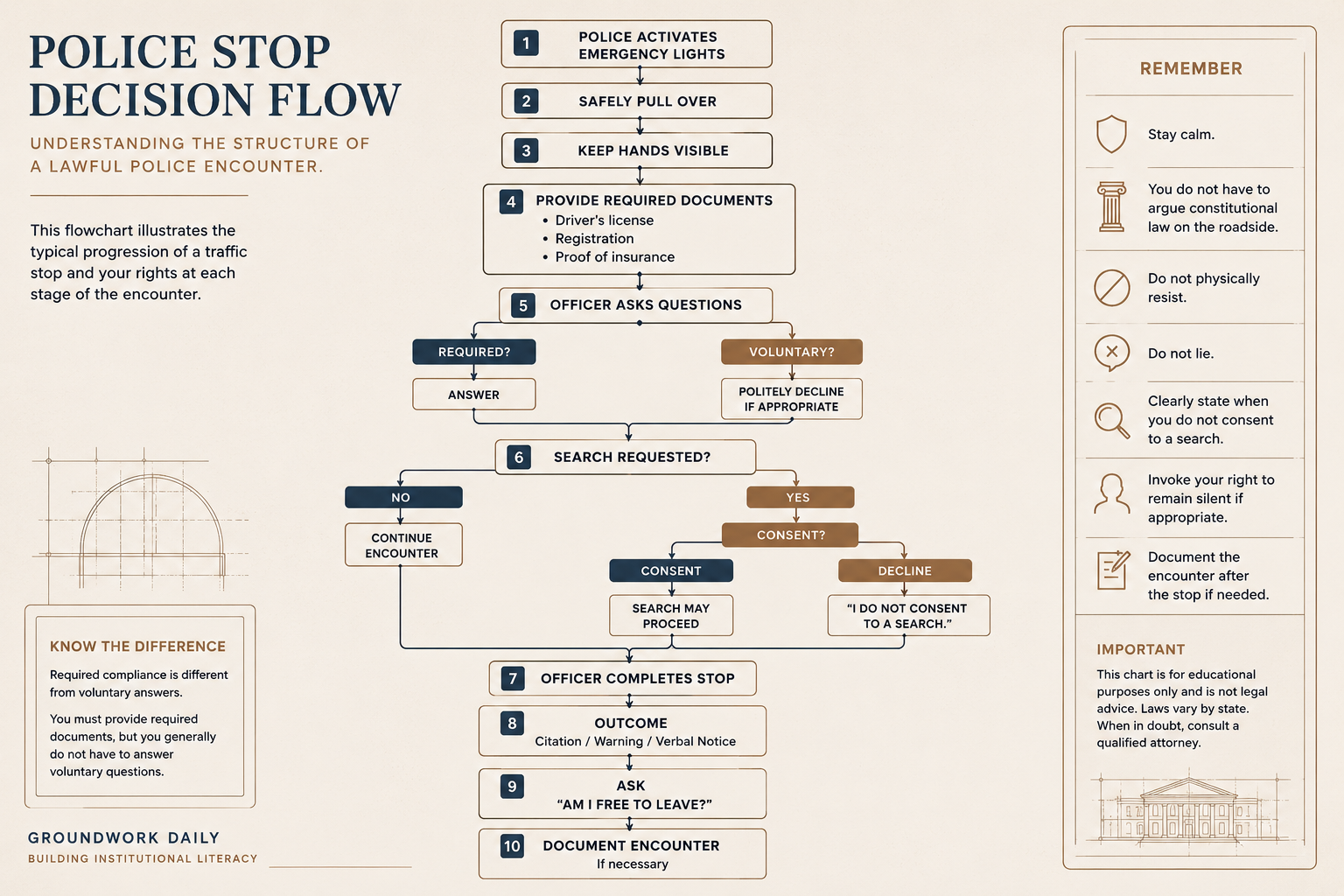
During a traffic stop, a driver usually must provide legally required documents. That commonly includes a driver’s license, vehicle registration, and proof of insurance. State law may control the exact requirements.
That is required compliance.
But required documents are not the same as voluntary answers. A person generally does not have to explain where they have been, where they are going, who they were with, or what they were doing.
This distinction is basic, but it is powerful.
A legally stronger approach is:
- Provide required documents.
- Keep hands visible.
- Comply with lawful safety instructions.
- Do not volunteer unrelated information.
- Do not consent to searches casually.
- Ask calmly whether the stop is over.
The weak move is trying to talk your way out of pressure. Sometimes talking helps. Often it expands the encounter.
Institutional literacy teaches a colder truth: the more serious the setting, the less useful improvisation becomes.
Searches and Consent
Searches are one of the most important parts of police stop rights.
Police may search in some situations without consent. For example, a lawful arrest may create search authority. Probable cause may justify certain vehicle searches. Safety concerns may justify limited protective action. A warrant may authorize a search in other contexts.
But in many encounters, police ask for consent because they do not yet have another legal basis.
The question may sound casual:
- “Mind if I look around?”
- “Can I check the car?”
- “You do not have anything to hide, right?”
This is where the language matters.
A person who does not want to consent should say:
“I do not consent to a search.”
That statement should be calm. It should not be paired with insults, lectures, or threats. It should be repeated if necessary.
Refusing consent does not guarantee that police will not search. But it can preserve an important legal issue for later review. If a search happens anyway, the legality of that search may depend on what authority police had besides consent.
Consent is not a small thing. Consent can turn a questionable search into an allowed search. That is why police stop rights require more than awareness. They require discipline under pressure.
Consent is one of the places where rights are often surrendered without anyone using the word surrender.
Recording a Police Stop
Recording a police stop can protect the record, but it must be handled carefully.
In general, people have a First Amendment right to record police officers performing official duties in public, as long as the recording does not physically interfere with police activity. That right has been recognized by several courts and is widely treated as part of public accountability. Still, state recording laws, wiretapping laws, and the facts of the encounter can matter.
That means the practical rule is simple: record openly, safely, and without interfering.
Asking, “Am I being recorded?” is reasonable. It may create a clearer record. But do not assume the answer will be complete. Some officers have body cameras. Some vehicles have dash cameras. Some systems activate automatically. Others do not. Policies vary by department.
A stronger question is:
“Officer, is your body camera on?”
Another practical statement is:
“I am recording this encounter for my safety and yours.”
That statement should be calm. Do not wave the phone around. Do not reach suddenly. Do not put the phone in an officer’s face. Do not step out of the car unless ordered. Do not unlock your phone and hand it over unless legally required or advised by counsel.
If you are going to record, start before the conversation escalates if you can do so safely. Keep the phone still. Place it where it does not look like a weapon or sudden movement. If asked to stop recording, you can calmly say:
“I am not interfering. I am recording from where I am.”
If an officer orders you to move or gives a safety command, do not turn the recording issue into a physical confrontation. Preserve the issue later. A phone can document the encounter, but it should not become the reason the encounter escalates.
Recording preserves memory. It does not replace judgment.
Passenger Rights During a Police Stop
Passengers have rights during a police stop. They are not invisible just because they are not driving.
When police stop a vehicle, passengers are generally considered seized under the Fourth Amendment. That means a passenger may be able to challenge the legality of the stop. The Supreme Court recognized this in Brendlin v. California.
At the same time, passengers may be ordered out of the vehicle during a lawful traffic stop for officer safety. The Supreme Court has allowed officers to order both drivers and passengers out of a lawfully stopped vehicle. That does not mean police can automatically search a passenger.
A passenger may usually ask:
- “Am I free to leave?”
- “Am I being detained?”
- “Do I have to answer questions?”
If the officer says the passenger is free to leave, the passenger should leave calmly and safely. If the officer says the passenger is detained, the passenger should not walk away.
Passengers also have the right to remain silent. They should not lie, argue, or volunteer unnecessary information. If a passenger owns a bag, phone, or other property, they can say:
“I do not consent to a search of my property.”
If the passenger is recording, the same practical rules apply. Record openly, do not interfere, keep movements calm, and follow lawful safety commands.
The driver should not speak for the passenger. The passenger should not speak for the driver. Each person has separate rights, separate risks, and separate legal exposure.
The Fifth Amendment and Silence
The Fifth Amendment protects against compelled self-incrimination. In ordinary language, it protects a person from being forced to provide testimonial evidence against themselves.
That does not mean silence always works automatically. It is usually better to clearly invoke the right to remain silent.
A useful phrase is:
“I am invoking my right to remain silent.”
If the person wants legal counsel, another useful phrase is:
“I want to speak with a lawyer.”
Miranda rights are often misunderstood. Police do not have to read Miranda warnings just because they stop someone or ask basic roadside questions. Miranda is tied to custodial interrogation. The Supreme Court’s Miranda rule concerns questioning after a person is in custody, where statements may be used in a criminal case unless warnings and waiver requirements are satisfied.
This means two things can be true at once:
- A person may have the right to remain silent before Miranda warnings are read.
- Police may not be required to read Miranda warnings during every ordinary traffic stop.
That is the kind of distinction people miss when they rely on television law.
The practical lesson is simple. Do not wait for a dramatic warning to decide whether you should talk. If the situation has legal risk, keep answers limited and invoke rights clearly.
Practical Police Stop Rights
Police stop rights are most useful when they become practical habits.
The first habit is calm compliance with lawful safety instructions. Keep hands visible. Avoid sudden movements. Do not physically resist, even if the stop seems wrong. A roadside encounter is rarely the place to litigate the Constitution.
The second habit is controlled speech. Provide required identification or documents. Do not lie. Do not guess. Do not explain more than necessary. If a question feels unrelated, use a short rights-preserving response.
The third habit is preserving consent. If you do not consent to a search, say so clearly. Do not physically interfere. Let the legal record matter later.
The fourth habit is using clear recording language if you choose to record:
- “Officer, is your body camera on?”
- “I am recording this encounter.”
- “I am not interfering.”
The fifth habit is asking status questions:
- “Am I being detained?”
- “Am I free to leave?”
- “What is the reason for the stop?”
These questions help identify whether the encounter is voluntary or a detention.
The sixth habit is documentation after the encounter. Write down the time, location, officer names or badge numbers if available, patrol car numbers, witness names, what was said, what was searched, whether consent was requested or refused, and whether any recording exists.
If there is a citation, court date, search, arrest, injury, seized property, or threat of charges, get legal help quickly. Deadlines matter. Records matter. Delay can weaken options.
What Happens After the Stop
The stop does not always end when the officer leaves. Sometimes the most important work begins after the encounter is over.
If nothing serious happened, there may be nothing more to do. But if there was a search, citation, arrest, threat, damaged property, seized property, injury, or possible misconduct, documentation becomes critical.
Do not rely on memory alone. Memory gets emotional. Records stay colder.
After a serious stop, consider these steps:
- Save any video immediately.
- Do not edit the recording.
- Back up the file in more than one place.
- Write down the time, date, and location.
- Record officer names, badge numbers, or vehicle numbers if known.
- Save citations, receipts, notices, or paperwork.
- Photograph damage or visible injuries.
- Write down witness names and contact information.
- Preserve text messages or calls related to the stop.
- Speak with qualified counsel if there is legal exposure.
This is not paranoia. It is procedure. The legal system runs on records. If a person wants a complaint, claim, motion, hearing, or defense to be taken seriously, the facts need to be preserved early.
That is why Building Institutional Literacy is practical. It turns abstract rights into habits that survive pressure.
What Not to Do During a Police Stop
Bad advice travels fast. Some of it sounds empowering. Some of it is just reckless.
Do not argue constitutional law on the roadside. Do not reach suddenly for a phone or documents without explaining what you are doing. Do not physically resist. Do not lie. Do not insult officers. Do not consent casually because you feel pressured. Do not assume the encounter is being recorded from every useful angle. Do not rely on memory alone afterward.
The strongest posture is not loud. It is structured.
That is the larger lesson of police stop rights. Rights need behavior that can carry them. A person can know the Fourth Amendment and still create risk through panic, anger, performance, or over-explaining.
Structure protects judgment.
Why Police Stop Rights Are Civic Systems Knowledge
Police stop rights are not only about individual encounters. They are about how public authority is designed to operate.
Law enforcement has real authority. That authority exists inside constitutional limits. Those limits exist because public power must be accountable. When people understand the structure, they are better prepared to navigate the moment.
That does not make every encounter safe. It does not make every officer fair. It does not remove discretion, stress, bias, or error. But it gives people a map.
A map is not the territory. Still, walking without one is worse.
Building Institutional Literacy means understanding that civic systems do not only appear in courtrooms, agencies, and legislatures. They also appear on the roadside, in a question, in a request for consent, in a passenger’s silence, and in the moment when someone decides whether to record.
The work is not glamorous. It is necessary.
Further Groundwork
Continue the Civic Systems framework:
Receipts
This article is an educational overview, not legal advice. Laws vary by jurisdiction, and individual situations require qualified legal counsel.
- Terry v. Ohio, 392 U.S. 1 (1968)
- Rodriguez v. United States, 575 U.S. 348 (2015)
- Miranda v. Arizona, 384 U.S. 436 (1966)
- U.S. Courts: Brendlin v. California Case Summary
- Arizona v. Johnson, 555 U.S. 323 (2009)
- ACLU: Recording and Documenting Police and Federal Agents
- Glik v. Cunniffe, 655 F.3d 78 (1st Cir. 2011)
FAQ
What are police stop rights?
Police stop rights are the constitutional and legal protections that govern how officers may stop, question, detain, search, record, or arrest a person.
Should I ask if I am being recorded?
Yes, you can calmly ask, “Officer, is your body camera on?” This may help clarify the record, but policies vary and you should not assume every part of the encounter is being captured.
Can I record a police stop on my phone?
Generally, people have a First Amendment right to record police performing official duties in public, as long as they do not interfere. State laws and facts can matter, so record safely and openly.
Can police ask me to unlock my phone?
Police may ask, but whether they can require it depends on the circumstances, applicable law, and whether they have lawful authority such as a warrant. Phone searches involve serious constitutional issues, so seek legal counsel if your device is seized or searched.
Do I have to answer where I am coming from?
In many situations, you generally do not have to answer exploratory questions about where you are coming from or where you are going. You should not lie, but you may calmly state that you prefer not to answer questions.
Do passengers have rights during a traffic stop?
Yes. Passengers are generally seized during a traffic stop under the Fourth Amendment. They may ask if they are free to leave, may invoke the right to remain silent, and may refuse consent to searches of their own property.
Can police order passengers out of the car?
Yes. During a lawful traffic stop, police may order passengers out of the vehicle for officer safety. That does not automatically give police authority to search the passenger.
Do police have to read Miranda rights during every stop?
No. Miranda warnings generally apply to custodial interrogation. Police do not have to read Miranda warnings during every ordinary traffic stop.