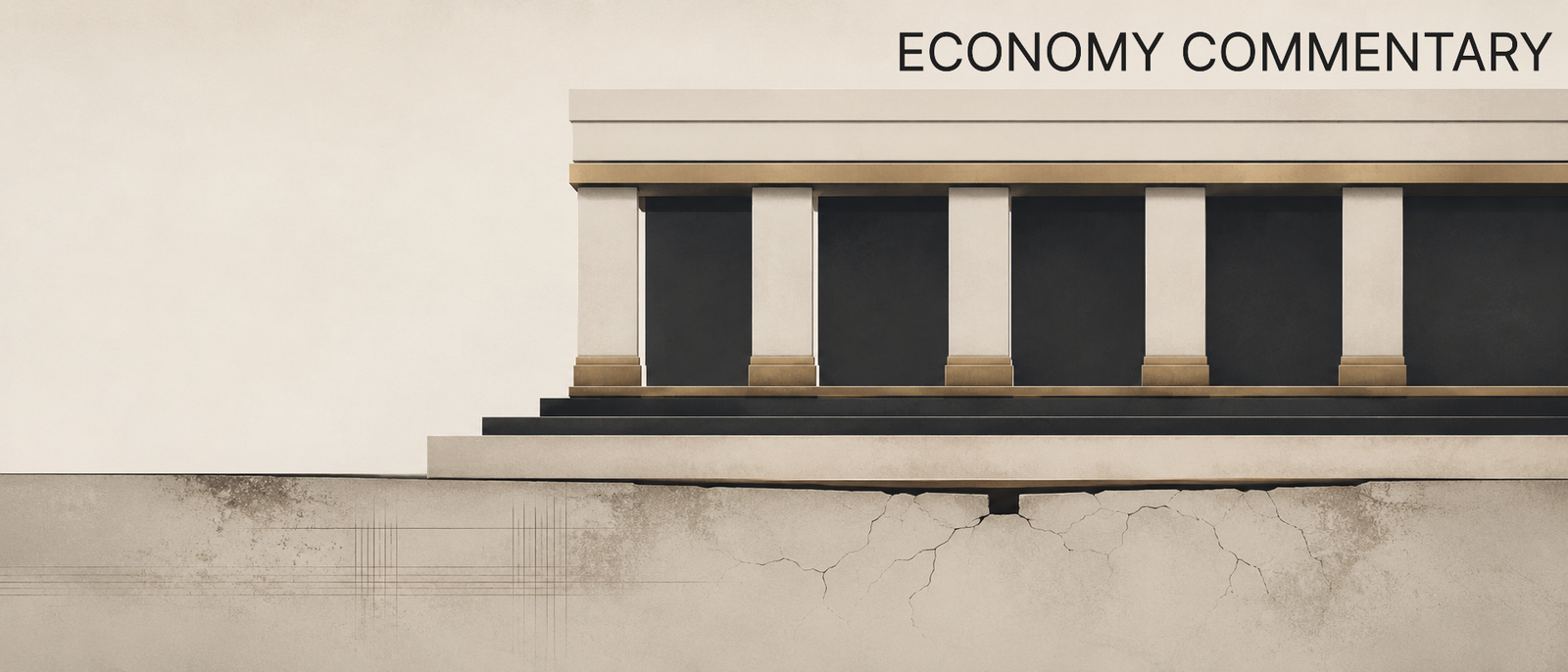
The economy can expand while people feel poorer.
A business can grow while customer traffic weakens. At the same time, wages can rise while purchasing power stays compressed. Inflation can fall even though prices remain painfully high, and asset values can climb while households struggle to build margin.
Those outcomes are not necessarily contradictions. Instead, they are often different parts of the same economic system.
Economy Commentary examines the structure underneath those differences. Written by Trent “Numbers” Lawson, the series translates economic signals into structural meaning. From there, it follows the incentives, ownership, leverage, and pressure that determine who benefits and who absorbs the cost.
The headline is the entry point. The structure underneath it is the story.
Economic Commentary That Looks Beneath the Headline
Economic reporting often begins with a number. GDP grew. Inflation slowed. Employment increased. Consumer spending remained resilient. Markets rose. A company beat expectations.
Those numbers matter. However, none of them, by themselves, explains how the benefit was distributed, where pressure moved, whether the improvement is durable, or what conditions made the result possible.
That is where Economy Commentary begins.
Rather than rejecting aggregate economic data because lived experience feels different, the series asks what the data measures, what it does not measure, and what becomes visible when the same economy is viewed from another level.
For example, averages can improve while distribution remains uneven. Revenue can rise while visit frequency declines. Employment can remain high while hiring becomes harder. Likewise, inflation can slow while the price level stays elevated.
The number can be true, and so can the pressure underneath it.
The Aggregate Economy and the Lived Economy
Markets measure economic activity at altitude. Households, workers, businesses, and neighborhoods experience it at ground level. Because those perspectives capture different conditions, the difference in altitude matters.
A stock index can rise while rent consumes more income. Similarly, wage growth can look healthy while insurance, food, transportation, and housing absorb the increase.
Consumer spending can also remain strong for very different reasons. Households may be financially comfortable. Higher prices may require more spending for the same goods. In other cases, people may be leaning harder on credit.
Those explanations are not interchangeable. Therefore, good economic analysis has to distinguish between them.
Economy Commentary examines the gap between economic performance and economic position. Performance asks what moved. Position asks who gained room, who lost it, and what changed underneath the headline.
Who Benefits, Who Absorbs Pressure, and Where the Gap Is Hidden
Every Economy Commentary article begins with a structural question:
Who benefits first, who absorbs the pressure, and where does that gap usually get hidden?
That question can lead into inflation, wages, labor markets, restaurant pricing, housing, consumer spending, intellectual property, corporate strategy, market concentration, asset ownership, capital allocation, or the economics of everyday habits.
The subject may change, but the analytical discipline does not.
If prices rise, the series asks where the cost originated and where it moved. When a company grows, the analysis asks whether the growth came from stronger demand, higher prices, acquisitions, new locations, financial engineering, or some combination of those forces.
Similarly, if workers create value, the question becomes who owns the asset capable of capturing that value over time. If customers begin disappearing, the focus shifts toward what weakened before the decline became obvious.
The goal is not merely to describe an outcome. It is to make the mechanism legible.
Pressure Moves Through Economic Systems
Costs rarely disappear. More often, they move.
A business facing higher labor, insurance, rent, financing, or material costs has several choices. It can accept lower margins, raise prices, reduce service, redesign the product, negotiate harder with suppliers, automate part of the operation, or slow hiring.
Each choice transfers pressure somewhere else.
Households make similar adjustments. When housing, groceries, transportation, childcare, healthcare, debt service, or insurance consume more income, people usually respond by changing something elsewhere.
As a result, purchases are delayed, frequency declines, brands are substituted, vacations get shorter, repairs wait, and savings contributions shrink. Even convenience becomes something that must justify its price.
Importantly, these adjustments often occur long before an economic system looks weak from the outside. That is why quiet deterioration matters.
A system can preserve its visible shape while the behavior supporting it changes underneath.
Pricing Power Is Not the Same as Raising Prices
Economy Commentary pays close attention to pricing because price reveals the relationship between business power and customer tolerance.
Any company can increase a price. That action alone, however, does not mean the company possesses pricing power.
Real pricing power exists when customers continue accepting the exchange because the value remains clear enough to preserve demand.
By contrast, if higher prices cause traffic to fall, purchase frequency to weaken, customers to substitute alternatives, or promotions to become necessary to restore demand, the business may be discovering the limits of its leverage.
This distinction reaches far beyond restaurants or retail. In practice, it applies wherever a company mistakes repeated customer behavior for permanent willingness to pay.
Ownership Changes Who Keeps the Value
Income explains part of economic life. Ownership often explains what happens next.
The person producing value and the person owning the asset capable of capturing that value are not always the same person.
Land, equity, intellectual property, trademarks, platforms, distribution channels, financial assets, and other forms of durable ownership can continue producing economic benefit after the original labor is complete.
For that reason, questions about wages, technology, housing, culture, business growth, or entrepreneurship frequently become ownership questions when the analysis goes deep enough.
Economy Commentary follows that movement because ownership often determines who receives temporary income and who accumulates durable leverage.
Business Strength Can Hide Business Pressure
Companies create their own version of the aggregate-versus-lived divide.
Total revenue can increase while established locations weaken. Meanwhile, average customer spending can rise while transaction volume falls. Margins can improve because operations became more productive, or because costs were transferred somewhere else.
Those distinctions matter because the headline measure does not always reveal the operating mechanism underneath it.
Revenue, for example, is not the same thing as traffic. Growth is not always an expansion in demand, and a higher price is not automatically evidence of pricing power.
A strong aggregate measure is useful. Even so, its meaning becomes clearer only after understanding what produced it.
Economic Incentives Shape Behavior
Economic outcomes do not emerge from numbers alone. They also emerge from incentives.
Companies respond to margins, competition, regulation, labor availability, investor expectations, customer behavior, and access to capital. Households, meanwhile, respond to income, prices, debt, risk, time, security, and available alternatives.
Policy can change incentives. Ownership can change incentives. Market concentration can alter them as well. Tax treatment affects behavior, while technology can change the cost of certain choices and make entirely different options possible.
For that reason, Economy Commentary does not stop at whether a decision was good or bad. The deeper question is what the system rewarded.
Once the incentive becomes visible, behavior that initially looked irrational often becomes easier to understand.
What Economy Commentary Covers
The series focuses on structural economic interpretation across recurring areas, including:
- Economic pressure: where rising costs land and how businesses or households respond.
- Pricing power: when higher prices reflect genuine leverage and when they begin weakening demand.
- Labor markets: the difference between employment, hiring, wages, bargaining power, and worker position.
- Consumer behavior: what spending, substitution, frequency, and pullback reveal beneath headline demand.
- Ownership: who controls the assets, platforms, property, intellectual property, and systems that capture durable value.
- Business models: how revenue, margins, customers, costs, and incentives interact beneath company performance.
- Capital allocation: where money moves, what receives investment, and what those choices reveal about economic priorities.
- Market structure: how competition, concentration, distribution, and access shape economic outcomes.
- Quiet decline: what begins weakening before visible failure arrives.
What Economy Commentary Is Not
Economy Commentary is not a trading newsletter, investment advice, a corporate earnings recap service, or a partisan economics column. Nor is it a place for dramatic predictions based on one chart or one data release.
Current events can provide an entry point when they reveal a durable economic mechanism. However, they are not the destination.
Instead, the standard is whether the analysis remains useful after the immediate headline cools. If an article only explains what happened this morning, it probably does not belong here.
Evidence Before Certainty
Economy Commentary is built to be inspectable.
Material economic claims are checked against credible evidence, with primary sources used whenever practical. Depending on the subject, that can include the Bureau of Labor Statistics, Bureau of Economic Analysis, Federal Reserve and FRED, Census Bureau, Congressional Budget Office, Securities and Exchange Commission, Treasury, Federal Deposit Insurance Corporation, company filings, academic research, and other authoritative datasets.
The purpose is not to decorate an argument with citations. Instead, the purpose is to know whether the argument survives contact with the evidence.
That requires distinguishing inflation from the price level, nominal growth from real growth, averages from distributions, correlation from causation, and company claims from independently established facts when those differences materially change the interpretation.
If the evidence complicates the expected story, the story changes. The argument does not get protected from the numbers.
Meet Trent “Numbers” Lawson
Trent “Numbers” Lawson writes Economy Commentary for Groundwork Daily, where he tracks the gap between what the economy is doing and what it feels like to live inside it.
He got the nickname in his first finance job for annotating his own grocery receipts. He never really stopped.
Trent approaches economic analysis with skepticism toward hype in either direction. A strong number does not automatically mean everything is fine. Likewise, a painful household experience does not automatically invalidate a strong aggregate measure.
Both deserve to be examined on their own terms.
In practice, the method is straightforward: check the number, identify the mechanism, follow the pressure, and distinguish what the evidence establishes from what the evidence merely suggests.
Continue Building
Economy Commentary sits inside a larger Groundwork Daily system for understanding money, ownership, and economic structure. Continue with Discipline Before Dollars, Structure Builds Freedom, and The Ownership Equation.
Why Economy Commentary Exists
Economic information is everywhere. Economic interpretation is harder.
A headline can tell readers that inflation slowed, jobs were added, consumer spending increased, markets rallied, or a company produced record revenue. Yet those statements can all be accurate while leaving the most important structural questions unanswered.
Who gained leverage? Who absorbed the additional cost? Was the improvement broadly distributed or concentrated? And did the system become stronger, or did it simply become better at moving pressure somewhere less visible?
Economy Commentary exists to ask those questions without manufacturing crisis when the evidence does not support one.
Sometimes the good number is simply good news. In other cases, the weak number is less alarming than the headline suggests. And sometimes a healthy aggregate is sitting directly above a structural problem that deserves closer inspection.
The job is not to decide the answer in advance. Instead, the job is to make the structure visible.
The Groundwork Principle
The headline provides the entry point, while the number provides evidence. From there, the incentive helps explain the mechanism.
Ownership shows who is positioned to keep the value. Pressure, meanwhile, helps reveal who ultimately pays for it.
Economy Commentary connects those pieces so the economy becomes easier to read from both altitude and ground level.