

Black Prom Culture · Recognition · Social Performance
Black prom culture is often reduced to spectacle, spending, dresses, cars, and dramatic entrances. That reading is too shallow. The celebration is also a rite of passage, a family gathering, a creative economy, a public declaration of pride, and a system of recognition.
Black prom culture can announce itself before anybody gives you the date. The driveway becomes a runway, somebody has rented a car that looks like it needs its own security detail, and the dress has been under construction long enough to qualify as a municipal project.
Meanwhile, cousins are outside, aunties have opinions, phones are up, and somebody is directing traffic like the governor is expected. For a few minutes, one teenager is not simply going to a school dance.
They are being presented.
That distinction matters. The spectacle is real, but so are the pride, creativity, preparation, family labor, anticipation, and sense of arrival underneath it.
If we are going to analyze the culture, then we need to analyze the whole thing: not just the bill, the dress, or whatever video made somebody mad on Facebook that morning.
The Send-Off Is Its Own Kind of Homecoming
For many families, the send-off becomes part family reunion, part fashion presentation, part coming-of-age ritual, and part public affirmation. People travel to see the teenager leave. Grandparents watch, cousins gather, food appears, music follows, and somebody who swore they were staying fifteen minutes is still there two hours later.
That ceremony carries meaning. Real Talk Blueprint is interested in what happens once that meaning starts attracting visibility, investment, comparison, and social reward.
If education matters, stability matters, ownership matters, career matters, parenthood matters, discipline matters, and adulthood matters, then it is fair to ask which of those milestones receives anything close to the same public energy.
Prom is not the villain here. Joy does not need an apology, and Black families are allowed to celebrate their children beautifully.
The sharper question, instead, is why this particular milestone has become such a powerful container for recognition, aspiration, style, family pride, identity, visibility, and social reward.
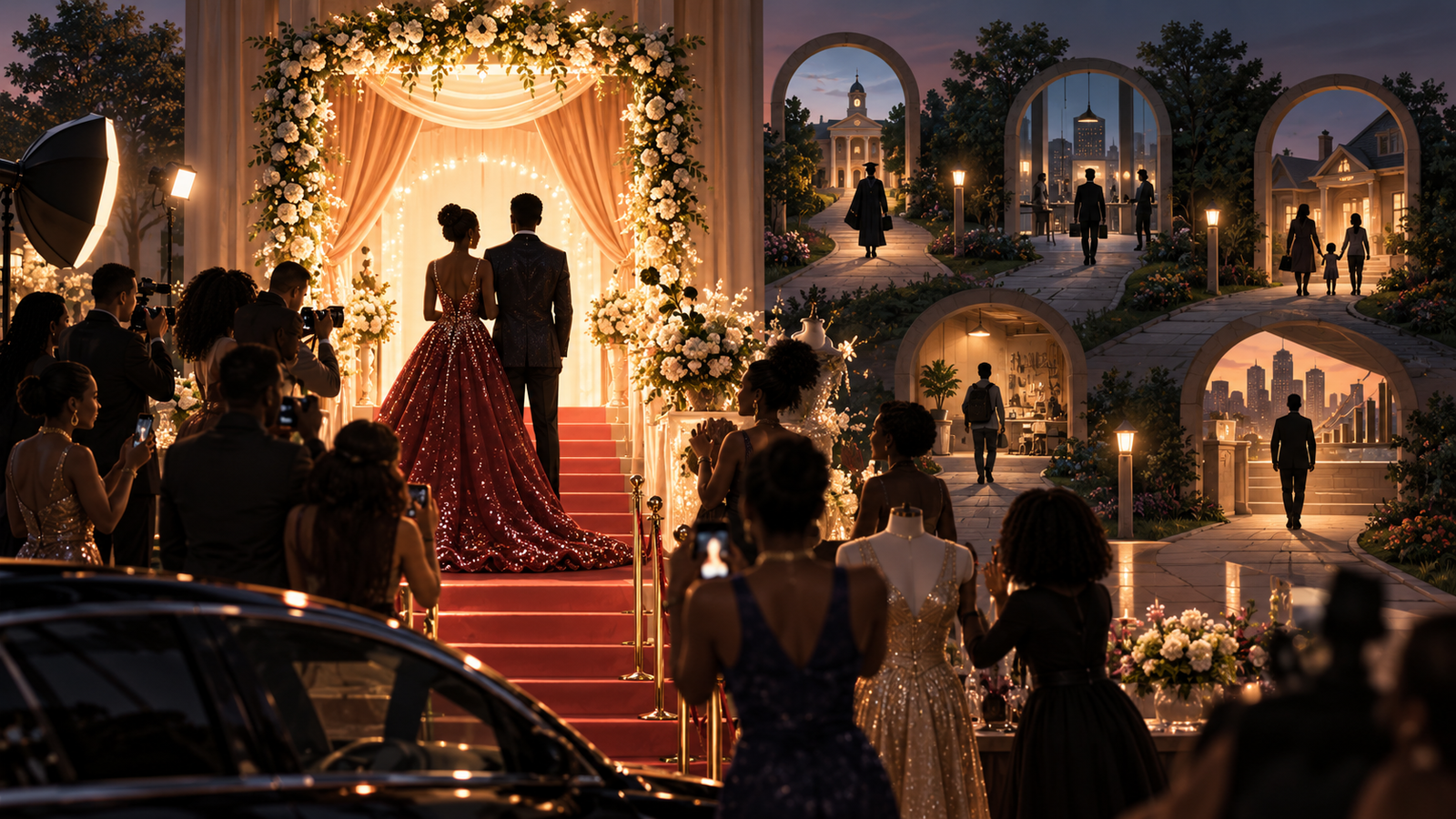
Start With the Whole Picture
What Black Prom Culture Actually Includes
Prom itself is an American high school tradition, but Black prom culture has developed its own visual language, rituals, expectations, and community practices.
History is part of that picture. Black students were not always welcomed equally into school social life, and segregated proms continued in parts of the United States long after formal school integration. Wilcox County, Georgia, held separate “Black prom” and “white prom” events into 2013, nearly four decades after its schools legally integrated.
Black communities therefore developed celebration traditions inside a larger history of exclusion, self-definition, and community-made ceremony.
So when somebody asks why a prom send-off can look like a wedding reception, family reunion, runway show, and block gathering at the same time, part of the answer is simple: Black communities have a long habit of building ceremony for themselves.
The send-off is often its own event
The public ritual often begins before the teenager reaches the official school event. Family and community can participate fully there. The teenager gets dressed, steps outside, poses, gets loved on, hears everybody’s commentary, takes a small nation’s worth of photographs, and eventually leaves.
Depending on the family and city, the send-off can be intimate or elaborate. Some happen in front yards; others use event spaces, custom backdrops, coordinated decorations, catering, professional video, DJs, or multiple vehicles.
Either way, the public presentation matters because it creates a moment the entire circle can witness.
There Is No Single Black Prom Culture Template
This distinction matters because internet culture has a bad habit of turning whatever goes viral into “what Black people do.”
No. Philadelphia has its traditions. Chicago has its own visual language. Detroit, Baltimore, Atlanta, Indianapolis, Houston, New York, Rochester, and smaller communities can develop different norms.
Families also vary by income, religion, personality, regional culture, school environment, and what they personally consider enough. Some teenagers want couture; others want clean and simple. Some households build a whole event, while others take pictures in the yard and get everybody into the car before somebody starts another speech.
Serious analysis has to leave room for that variation. The point is not to declare one universal behavior. Instead, it is to identify recurring patterns inside a recognizable cultural phenomenon without pretending every Black family performs them the same way.
Name the Pattern
Black Prom Culture Gets Bigger When Recognition Gets Concentrated
A milestone is supposed to sit inside a larger ladder. Graduation, first jobs, certifications, college acceptance, military service, apprenticeships, business launches, stable housing, marriage, parenting, homeownership, and career advancement can all mark forward movement.
Different lives will use different ladders. Still, the principle remains the same: one moment should not have to carry the emotional weight of every future moment.
The Recognition Loop
Here’s the mechanism underneath everything in this article. A milestone happens. If it also comes with built-in visibility, such as a date, an outfit, and a driveway full of people, it collects public recognition.
Recognition creates an incentive to do it again, bigger, next year. That incentive attracts investment: money, time, coordination. The investment produces a performance worth photographing, and the performance gets rewarded with more attention, which reinforces the whole loop for the next family.
Prom completes every stage of that loop almost automatically. A scholarship notification, a completed apprenticeship, or a young mother’s first stable month with childcare in place hits the same milestone stage, but usually stalls out at visibility.
There is no date on the calendar, no outfit, no driveway. Without visibility, the loop never reaches recognition, so it never earns the incentive to repeat, and it never gets reinforced the way prom does.
Black prom culture becomes structurally interesting, in other words, when prom starts carrying more than prom.
It becomes the night to be seen, the night to be beautiful, the night the family gathers, the night everybody takes pictures, and the night the community publicly says, “Look at our child.”
That is not meaningless vanity. Recognition is a real human reward.
Families want their children to feel visible. Communities enjoy ceremony. Young people want moments that announce transition. For teenagers who may spend much of ordinary life being evaluated, corrected, stereotyped, underestimated, or simply overlooked, being presented with intention can carry its own emotional weight.
Meaning does not make Black prom culture untouchable
This is where the conversation usually gets stuck. One group sees extravagance and decides the whole thing is irresponsible. Another sees cultural pride and decides any criticism must be disrespectful.
Both positions are too easy.
Meaning does not place a ritual beyond examination. Instead, meaning is exactly why we should examine it more carefully.
We can honor what the event gives people while still asking what it teaches, where the money goes, which behaviors receive applause, what skills are being demonstrated, and whether the same communal energy follows the young person after the cameras come down.
Explanation vs. Behavior
Visibility Changed the Scale of Black Prom Culture
Listen to families describe prom and you will hear reasonable explanations. This is a once-in-a-lifetime memory. The child worked hard. Everybody deserves one beautiful night. The family wants to celebrate.
Fair enough. Yet the behavior adds another layer.
The reveal matters, as does the entrance. Coordinated looks matter, professional photographs matter, and the gathered audience matters too.
Therefore, the event is not functioning only as a private memory. It is also functioning as public recognition.
Social media enlarged the room
Social media did not create Black prom culture. It did, however, make the audience much larger.
A send-off that once belonged primarily to family, friends, neighbors, and whoever happened to be standing outside can now travel through Instagram, TikTok, Facebook, repost accounts, fashion pages, reaction clips, and group chats.
In other words, local witness can become scalable witness.
Visibility also increases comparison
Once the audience grows, comparison becomes easier. Yesterday’s beautiful dress can become today’s baseline, the car joins the presentation, and photography becomes cinematic.
Then the entrance needs a concept, and the concept needs a reveal.
Nobody has to issue a memo saying, “Spend more.” The incentive can teach that lesson by itself. It is the Incentive → Investment leg of the loop running on autopilot.
Visibility creates comparison, while comparison creates pressure to distinguish. Distinction can then increase demand for customization, production, novelty, and polish.
Of course, that does not mean every family is competing or every prom celebration is financially irresponsible. Rather, the ritual now exists inside an attention environment that rewards visual escalation.
Look at the Work
The Creative Economy Inside Black Prom Culture
This is another place where shallow criticism misses the landscape. Look closely at an elaborate prom season and you are looking at work.
Designers sketch, seamstresses sew, and tailors fit. Hairstylists build looks, barbers cut, and makeup artists book appointments. Florists arrange, bakers produce, and decorators install. Photographers shoot, videographers edit, drivers coordinate, and event planners manage timing.
Meanwhile, families often organize the entire operation.
A Real Number Behind the Craft
Indianapolis designer Mondriana Brown, profiled in Mirror Indy, is a 24-year-old self-taught fashion designer who has become one of the season’s most sought-after names for exactly this reason. A single custom prom dress from her home-based business, Monies Closet, can take 20 to 30 hours of work. In one season alone, she produced five dresses and four suits.
That is not a hobby. That is a small business running on a compressed, high-demand calendar, the kind of thing that is easy to miss if the only thing you’re counting is what the family spent.
A custom garment can take many hours of skilled labor before anybody sees the finished look. The teenager stepping onto the carpet may be the focal point, but an entire local production network can be standing just outside the frame.
Prom spending can circulate through local businesses
That reality changes the economic analysis. Money spent on prom does not simply evaporate into “materialism.”
Some of it pays local creators, independent service providers, small businesses, and people turning craft into income. Therefore, treating every dollar spent as proof of waste ignores where at least part of that money is going.
That deserves recognition.
The stronger question is whether the capability compounds
Once we acknowledge the economic activity, another question appears. Does the designer leave with strong portfolio material? Does the photographer get credited? Does the young stylist helping her cousin recognize a marketable skill?
Likewise, does the event organizer understand that she just coordinated vendors, deadlines, client expectations, aesthetics, and logistics?
Those are not imaginary capabilities. The opportunity is to convert seasonal demand into longer-term infrastructure.
A prom dress can become a design portfolio. A send-off can become an event-production case study. A photographer can turn one family’s photographs into referrals. Meanwhile, a talented teenager can see a career pathway inside something the community already values.
If one evening produces that much visible creative capability, the smart move is not to dismiss the evening. It is to make sure more of the capability survives it.
When Life Stages Overlap
When Parenthood Appears Inside Black Prom Culture
Another image periodically enters online conversations about Black prom culture: a teenage or young mother appearing in prom photographs or a send-off with her infant.
Predictably, commentary arrives fast.
Some observers treat one image like evidence for every opinion they already had about Black families, teenage pregnancy, morality, parenting, or culture.
That is weak analysis because one photograph cannot carry that much evidence.
However, the image can still tell us something useful: it shows two life stages occupying the same frame.
The school calendar still says adolescence, while parenthood says adulthood has already introduced itself.
The ceremony stays while responsibility changes
The dress, photographs, friends, music, and send-off still belong to a teenage milestone. At the same time, the young woman may already be carrying responsibilities that do not care how old the yearbook says she is.
That tension is worth examining without turning the young mother into a prop for somebody else’s argument.
Instead of asking what is wrong with her, ask what happens when the visible ceremony available to someone belongs to one stage of life while her actual responsibilities have already moved into another.
Prom is still scheduled, friends are still going, and the family may still want her celebrated. She may still want one piece of an adolescence that changed faster than expected.
There is humanity in that, but there is also a structural question hiding inside it.
Black prom culture cannot be the only visible stage
Where are the equally visible rituals for returning to school after childbirth, establishing reliable childcare, completing a certification while raising a baby, maintaining stable housing, or creating a working parenting routine?
Those milestones may matter far more to the future. Yet they simply do not photograph like prom, which means they often never clear the visibility stage long enough to earn recognition at all.
That does not mean they deserve less recognition. Instead, communities may have to become more intentional about making quieter progress publicly legible.
Trace the Incentive
Why Black Prom Culture Keeps Producing Bigger Celebrations
The pattern survives because several incentives reinforce one another. None of them requires families to be irrational.
Visible success is easier to celebrate
A finished look can be photographed immediately, but a scholarship search cannot. Likewise, a dramatic entrance gives everybody something to react to, while six months of disciplined saving rarely attracts a crowd.
Quiet systems are often terrible at announcing themselves. That matters because cultures do not teach only through speeches. They also teach through attention.
Prom offers certainty
Prom has a date. Families know when it is coming, what the ritual looks like, and when the celebration will end.
Many adult milestones are less cooperative. Career progress can take years, marriage may or may not happen, and homeownership depends on income, credit, location, housing costs, and timing.
A business may require years of ugly, unphotogenic work before anybody calls it successful. As a result, certainty can attract investment because certainty is emotionally easier to plan around.
Presentation is prestige families can control
A family cannot control the labor market, guarantee a scholarship, secure a future promotion, or promise a mortgage approval. It can, however, control one presentation.
Clothing, transportation, styling, photography, decorations, food, music, and the story surrounding the moment can all be shaped directly. That control has emotional value, particularly when other forms of recognition feel less predictable.
Black prom culture gives the community a role
There is another reason the ritual has power: people can participate.
You do not need to understand a financial aid package to clap when the teenager comes outside, nor do you need expertise in apprenticeships to tell somebody they look beautiful.
The ceremony gives relatives, neighbors, elders, friends, and younger children an obvious role. Public rituals are sticky partly because everybody knows what to do.
Price the Pattern
The Cost of Black Prom Culture Is Bigger Than the Prom Budget
The obvious cost can be financial. Prom clothing, tailoring, hair, makeup, transportation, photography, food, decorations, and other extras can add up quickly.
Still, cost alone cannot tell us whether a particular celebration is irresponsible, since families have different resources and make different trade-offs.
The better question is whether the spending fits the household.
A beautiful event paid for comfortably is not the same decision as a beautiful event that raids rent money, emergency savings, tuition money, or high-interest credit.
Price without context is gossip. Allocation is the real issue.
There is also a cultural cost
Another cost appears when peak effort repeatedly attaches itself to the most visible moment instead of the most durable outcome.
Young people notice where adults become animated. They notice what relatives travel for, what gets photographed, what gets funded quickly, and what becomes a family production.
That does not mean a teenager consciously concludes that prom matters more than the future. Culture is rarely that literal.
Instead, the lesson can be quieter: this is what celebration looks like.
Groundwork Daily’s How Status Marketing Converts Black Aspiration Into Profit covers the adult version of this same pattern: the gap between a recognition premium spent to be seen and the equity that quietly builds a household’s actual position. Prom is often the first place a young person learns that gap exists, years before anyone hands them a receipt to compare it against.
The deeper risk is concentrated recognition
This is where the argument becomes bigger than Black prom culture itself. Any culture can overconcentrate attention on milestones that are easy to see.
Weddings can do it. Graduations can do it. Birthday culture can do it. Professional titles can do it. Social media can make almost any visible marker feel more consequential than the slower systems supporting it.
Prom simply gives us a vivid case study. When one ceremonial moment receives enormous emotional, financial, creative, and social energy while other forms of progress remain mostly private, the reward system becomes uneven.
Pressure-Test the Argument
No, Black Prom Culture Does Not Make Every Send-Off a Financial Crisis
There is a lazy version of this critique too. It looks at Black people dressed beautifully and starts auditing everybody’s bank account from a photograph.
We are not doing that.
Nobody looking at one photograph knows whether the family saved for a year, whether an aunt made the dress, whether the vehicle belongs to a relative, whether services were traded, or whether the household can comfortably afford every dollar spent.
Looking expensive is not proof of financial irresponsibility. Likewise, Black celebration does not become suspicious merely because it is visible.
What a Sociologist Studying This Actually Found
Sadiyah Malcolm-Wallace, a sociologist who earned her Ph.D. at the University of Michigan and is now an assistant professor at UMass Amherst, has spent years studying Philadelphia prom send-offs specifically. Her research asks a pointed question: how do Black Philadelphians use the send-off to push back against being told, implicitly, that they do not deserve to celebrate the way they do?
She has pushed back directly on the argument that the money would be “better spent” elsewhere, not because cost does not matter, but because assuming a different purchase would fix generational poverty is its own kind of wrong assumption, and because it is not anyone else’s place to decide how a family should spend its own money.
Her broader point is useful here: structural inequality and genuine cultural creativity can exist side by side in the same celebration. Neither cancels the other out.
Elaborate celebration does not prove shallow values
A family can invest heavily in prom and education. It can celebrate beauty and discipline. It can fund a send-off and still maintain savings.
Human beings are capable of having more than one priority.
Therefore, the argument is bigger than somebody’s receipt. It is about alignment.
Do stated values, public rewards, financial decisions, ceremonial energy, and long-term goals point in roughly the same direction?
When they do, celebrate. When they do not, the answer is not humiliation. It is correction.
Redistribute the Prestige
Black Prom Culture Shows Why More Milestones Need a Stage
Here is where the critique becomes a build.
If prom carries too much symbolic weight, making prom smaller is not the strongest answer. The better move is to make the ladder bigger and give more milestones the same visibility that lets them clear the loop.
Scholarship wins
A student who secures scholarship money has reduced the cost of the next stage of life. That deserves more than a quiet administrative announcement.
Trade and certification milestones
Apprenticeships, licenses, union entry, technical credentials, and professional certifications can create direct bridges into income and capability. Those achievements are ceremony-worthy too.
First business milestones
The first paying client, first profitable month, first employee, first storefront, and first year surviving without chaos each mark progress on an ownership ladder.
Stable housing
The first apartment somebody can actually afford and maintain is more than a set of keys. It reflects planning, independence, and operating capacity.
Return-to-school milestones
Going back after interruption takes a different kind of discipline than moving straight through. Finishing under pressure deserves recognition.
Young-parent stability milestones
A young parent who completes school, maintains childcare, builds a stable routine, secures work, and keeps a household functioning is doing more than surviving.
That is building.
Financial progress
An emergency fund established, debt paid down, a semester completed without new debt, or a first year of steady saving may be less cinematic.
Fine. Give it a camera anyway.
Build It Better
Keep Black Prom Culture. Change What the Celebration Connects To.
The correction does not require stripping the joy out of prom. Instead, it requires connecting the joy to a wider system.
Connect the send-off to the next destination
If the young person is headed to college, trade school, military service, work, entrepreneurship, or another path, name that future during the celebration.
Let the public story include where the young person is going, not only what they are wearing.
Make the production economically legible
Credit the dressmaker. Tag the photographer. Name the barber, stylist, decorator, baker, videographer, and organizer.
In other words, let one night become portfolio capital for the people whose skill created it.
Put a budget around the beauty
This is where discernment matters. A family can decide what it wants to spend without pretending every desire deserves equal priority.
The strongest flex is not spending until everybody notices. It is knowing exactly what the household can carry and refusing to let one visible night destabilize the invisible months afterward.
Create other ceremonies on purpose
Families create traditions all the time, and communities can do the same.
Build scholarship dinners. Hold certification send-offs. Celebrate first apartments with practical support. Make business launches visible. Recognize educational return, responsible young parenthood, and financial progress.
Give disciplined adulthood some theater.
Tell young people what Black prom culture already demonstrates
Prom required planning, deadlines, coordination, decision-making, presentation, budgeting, creativity, and execution.
Those are transferable skills. Consequently, the lesson should not end at “You looked good.”
The stronger lesson is: look at what it took to build that.
The Real Talk
Black Prom Culture May Be Carrying More Meaning Than One Night Should Hold
Black prom culture is not one thing. It is fashion, family, identity, craft, local business, adolescence, recognition, history, joy, competition, memory, performance, and sometimes financial pressure sharing the same driveway.
That complexity is exactly why cheap judgment does not work. The useful question is not whether everybody should spend less or celebrate differently.
Instead, ask whether the culture has enough visible milestones for all the things it says matter after prom night.
If scholarship, certification, stable housing, business ownership, disciplined parenting, financial progress, educational return, and long-term stability matter, they need witnesses too.
Keep the prom. Build more stages.

Continue Building
Follow the Structure Beneath the Celebration
This article is about recognition, incentives, and whether visible rewards align with the future people say they want.
→ Core Principle:
Structure Builds Freedom
Build enough structure around a meaningful moment that the future does not have to absorb preventable disorder.
→ Resource Discipline:
Discipline Before Dollars
Examine what happens when resources arrive without an operating structure strong enough to direct them.
→ The Adult Version of This Pattern:
How Status Marketing Converts Black Aspiration Into Profit
See how the same recognition-versus-equity gap plays out in adult spending, and how to measure it in your own household.
→ Series:
Explore Real Talk Blueprint
Read more cultural and behavioral analysis about the gap between what people say they value and what their behavior reinforces.
Real Talk Blueprint
See the pattern before it becomes the habit.
Groundwork Daily examines relationships, culture, accountability, communication, and the behavior underneath the performance.
Groundwork Architecture
The Principle and Condition Beneath This Work
This article examines what happens when public recognition, cultural incentives, resources, and long-term priorities do not receive the same weight.
Primary Core Principle
Structure Builds Freedom
Celebration becomes easier to sustain when it sits inside a larger structure that protects future priorities instead of competing with them.
Primary Condition · Coordinates
Alignment
Alignment coordinates purpose, priorities, incentives, resources, and action. Here, it asks whether what receives the most public energy matches what the culture says matters over the long term.
Explore the Groundwork Daily Core Principles and The Conditions .

About the Builder
Rochelle “Ro” Hayes
Rochelle “Ro” Hayes is the Groundwork Daily builder behind Real Talk Blueprint, a series focused on culture, relationships, accountability, communication, and the behavior people often explain away before they examine it.
Ro works primarily inside Culture, Media & Leadership, with strong overlap into relationship systems, public behavior, gender expectations, attention incentives, and modern social performance.
Real talk creates structure where avoidance creates confusion.
Ro builds frameworks that make ordinary behavior harder to ignore. The work is direct, observational, and culturally grounded. Rather than performing outrage, it names the pattern, identifies the incentive, and asks what people are really protecting.
Real Talk Blueprint examines the gap between what people say they value and what their behavior actually reinforces.
Meet Rochelle “Ro” Hayes · Explore Real Talk Blueprint · Explore Culture, Media & Leadership
Receipts
These sources support the historical and cultural context around Black prom traditions, send-offs, social-media visibility, community ritual, and creative production. The interpretive framework and structural conclusions remain Groundwork Daily analysis.
→ 3Arts | Prom Send Offs: The Rites of Passage for African American Girls
→ The Philadelphia Inquirer | Inside Philadelphia’s Elaborate Prom Send-Off Culture
→ Mirror Indy | Why Prom Is So Important in the Black Community
→ PBS | Prom: Fashion Statement, Cultural Ritual, and Social Phenomenon
Evidence Note
Black prom culture is not uniform across Black families, cities, regions, income levels, or schools. These examples document recurring cultural practices and interpretations, not a single universal Black experience. Likewise, individual images of young mothers attending prom with infants are treated here as cultural examples, not demographic evidence of prevalence.