
Community banking is not about putting a bank on every corner. Instead, it is about whether communities have financial institutions capable of turning deposits, trust, business activity, and local knowledge into credit, ownership, and durable economic capacity.
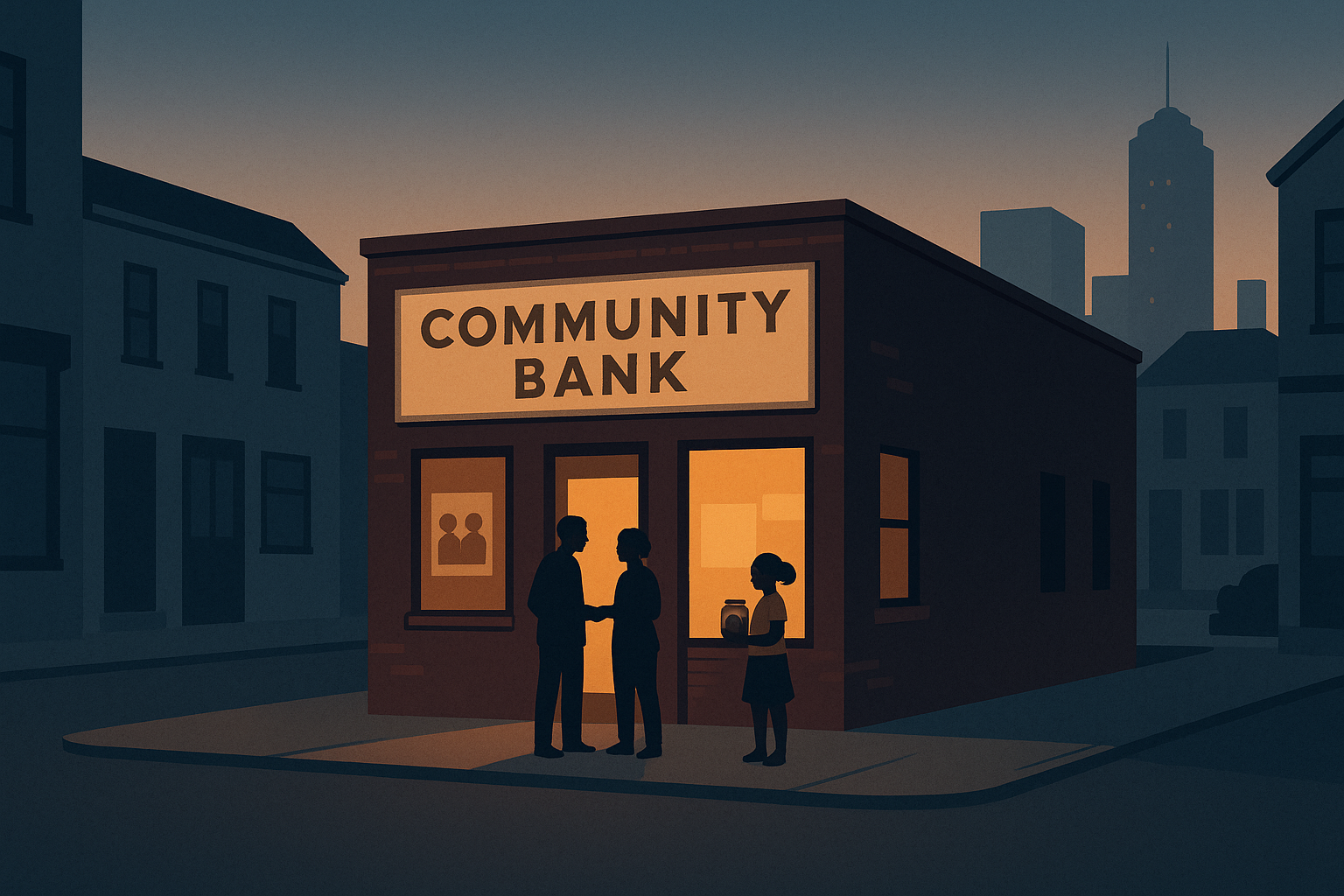
The phrase community bank can trigger an easy picture: a modest branch, familiar employees, local business owners walking through the door, and decisions being made close to the people affected by them.
There is something valuable in that picture. However, there is also something incomplete about it.
Buildings alone do not create financial power.
Likewise, a bank charter does not guarantee community investment. Local ownership cannot excuse weak underwriting, poor governance, inadequate capitalization, bad technology, or ineffective risk management.
Therefore, asking whether every neighborhood should have its own bank starts in the wrong place.
A stronger question is this:
Does every community have access to financial infrastructure capable of turning the economic activity already happening there into greater local capacity?
On that question, the answer should be yes.
The Capital Mechanism
Local Deposits → Trusted Intermediation → Local Credit → Productive Investment → Asset Formation → Community Capacity
In practice, money becomes economically meaningful when institutions can move it from storage into productive uses without abandoning sound underwriting, risk management, or accountability.
Community Banking
Proximity Still Has Economic Value
Large banks can operate at enormous scale. Meanwhile, digital financial companies can remove friction from transactions, and automated systems can process information faster than a neighborhood loan officer ever could.
Still, none of that makes local knowledge worthless.
Credit decisions depend on information. For example, income, payment history, debt, collateral, cash flow, and account activity can travel easily through a database.
Other forms of information are harder to flatten.
A lender rooted in a market may understand the commercial corridor, local housing stock, seasonal business patterns, neighborhood institutions, or the operating history of a borrower in ways that a distant institution does not.
That does not mean local lenders should ignore risk. Instead, proximity can improve the quality of information used to understand risk.
Consequently, local knowledge has value when it sharpens judgment rather than replacing financial discipline.
Access Is Not the Same as Financial Capacity
The United States has made meaningful progress in basic banking access. According to the FDIC’s 2023 household survey, 4.2 percent of U.S. households were unbanked in 2023, the lowest level recorded since the survey began in 2009.
In addition, the Black household unbanked rate fell substantially, from 21.4 percent in 2009 to 10.6 percent in 2023.
That progress matters. However, an account is an entry point, not the finish line.
A checking account can help someone participate in the financial system. It does not automatically provide affordable business credit, mortgage access, patient capital, asset ownership, or the financing required to expand an enterprise.
Therefore, financial inclusion becomes more consequential when participation can develop into financial capacity.
The Real Function
Banking Shapes What Money Is Allowed to Become
People often think of banking as storage.
Money enters an account, bills leave the account, and a card provides access. As a result, everyday banking can look like little more than movement and recordkeeping.
In reality, banking performs a much larger economic function.
Financial institutions help determine which households can finance homes, which businesses can acquire equipment, which entrepreneurs can survive uneven cash flow, which properties can be developed, and which borrowers receive enough time and capital to expand.
Therefore, finance does not merely record economic activity.
Finance helps decide which economic activity receives the resources to continue.
That is why community banking matters.
The strategic question is not simply whether residents can deposit money locally. Rather, it is whether institutions serving a community can responsibly transform financial resources into productive credit.
The Groundwork
A community bank is not powerful because it is small. It becomes useful when it can convert financial resources into productive local capacity while protecting the institution well enough to keep doing the work.
Capital Is a Form of Permission
A business may have customers and still lack the financing to expand.
Similarly, a household may have stable income and still struggle to cross the threshold into ownership.
Contractors can face the same constraint. Work may be available while the capital needed to hire, purchase equipment, or carry receivables remains out of reach.
In addition, an organization may have committed revenue but still face a timing gap between expenses and reimbursement.
In each case, economic potential exists before financing arrives.
Credit determines whether some of that potential can move. Consequently, the allocation of capital becomes one of the quietest forms of power in an economy.
Institutional Memory
Black Banking Was Built Because Access Was Never Neutral
Black-owned and Black-led financial institutions did not emerge merely because communities wanted culturally familiar places to keep money.
Instead, they developed within a much harder history of exclusion from mainstream financial systems, restricted access to credit, discriminatory housing and lending practices, and the practical need to build institutions capable of serving markets that other institutions neglected or exploited.
That history matters because it changes the meaning of community banking.
Institutions such as Carver Federal Savings Bank in New York and Liberty Bank and Trust grew from a tradition in which financial institutions were expected to do more than process transactions. Their institutional purpose included serving communities whose economic needs were frequently underserved elsewhere.
Scale Does Not Automatically Destroy Mission
Liberty Bank and Trust was founded in New Orleans in 1972 and has since grown far beyond the footprint of a single neighborhood.
That growth exposes an important flaw in the romantic version of community banking.
A community-rooted institution does not have to remain geographically small to remain institutionally useful.
In other words, scale and mission are not automatically enemies.
The harder governance problem is preserving purpose as scale increases.
The Modern Model
The Future Is Not a Bank on Every Corner
Nostalgia is not an operating model.
Opening a regulated financial institution requires capital, governance, compliance, technology, cybersecurity, risk management, skilled personnel, and the ability to survive losses without destroying depositor confidence.
Those requirements are not bureaucratic decoration. Instead, they are part of what makes a financial institution capable of holding other people’s money safely.
Therefore, “every neighborhood should start a bank” is the wrong prescription.
A weak bank does not create community power. It creates community exposure.
Build an Ecosystem, Not a Symbol
The stronger strategy is to build and strengthen an ecosystem of institutions capable of serving the same structural purpose through different forms.
Community Banks
Relationship-Based Intermediation
Locally or regionally rooted banks can combine regulated deposit-taking and lending with deeper knowledge of the markets they serve.
Credit Unions
Member-Owned Financial Infrastructure
Credit unions offer a cooperative model in which members collectively own the financial institution serving them.
CDFIs
Mission-Driven Capital
Community Development Financial Institutions are designed to expand financial opportunity in communities and markets that conventional finance may not serve adequately.
Minority Depository Institutions
Institutional Representation and Access
Minority depository institutions remain an important part of the financial ecosystem serving minority communities and borrowers.
Technology Should Extend the Institution
Digital infrastructure can strengthen all of these models.
For example, a community-rooted financial institution no longer needs to depend entirely on a branch-heavy footprint to maintain relationships. Mobile banking, digital applications, electronic payments, remote servicing, and better financial technology can expand reach while lowering some operating friction.
However, technology should extend the institution rather than erase the institution’s reason for existing.
Operating Standard
Community Finance Has to Hold Three Things at Once
A durable community banking model has to solve three problems simultaneously.
1. Local Trust
People need to understand who the institution serves, how decisions are made, and whether leadership remains accountable to the stated mission.
However, trust cannot mean approving every request. Instead, it means the institution is legible enough that people understand the rules and credible enough that those rules are applied consistently.
2. Modern Infrastructure
Mission cannot compensate for weak operations.
Customers expect secure accounts, reliable digital access, competent servicing, fraud protection, efficient payments, and financial products capable of competing in the modern economy.
Consequently, a community institution that cannot deliver basic operational reliability eventually turns loyalty into a burden.
3. Capital Discipline
Community lending still has to be lending.
Loans have to be underwritten, risk has to be priced, capital has to be protected, and losses have to remain survivable.
At the same time, borrowers need products that create opportunity without quietly creating a future crisis.
Good intentions without financial discipline can destroy the institution people were trying to build.
Therefore, the central tension is clear:
The institution must expand opportunity without becoming structurally reckless.
Accountability
Community Ownership Does Not Remove the Need for Standards
There is a temptation in conversations about community finance to divide responsibility too neatly.
On one side, banks get blamed for everything. On the other, every unequal outcome gets reduced to a lecture about individual financial behavior.
Neither approach is serious enough.
Institutions Carry Obligations
Financial institutions have responsibilities. Fair access matters. Transparent underwriting matters. Product design matters. Responsible servicing matters.
In addition, reinvestment matters. Discriminatory practices and structural barriers matter as well.
Community-rooted institutions should not ask for trust while refusing scrutiny.
Borrowers and Communities Carry Obligations Too
Borrowers and institutions operating within the community also have responsibilities.
Accurate books matter. Repayment matters. Cash-flow management matters. Documentation matters.
Likewise, business planning, financial literacy, estate planning, and preparing the next generation to manage assets all matter.
These are not competing truths. Rather, they are different parts of the same financial system.
Ultimately, accountability becomes unserious when it only travels in one direction.
Pressure Test
How Do You Know Whether Community Banking Is Actually Working?
The easiest mistake is measuring the institution by its symbolism.
A community-oriented name is not enough. Likewise, a local branch is not enough.
Minority ownership by itself also does not tell us whether capital is reaching productive uses.
Therefore, the stronger test is functional.
| Question | What It Reveals |
|---|---|
| Are deposits being converted into productive credit? | Whether financial resources are creating additional economic capacity. |
| Can viable local businesses access capital? | Whether entrepreneurship can move beyond self-financing and survival. |
| Can households move toward durable ownership? | Whether financial participation can become asset formation. |
| Is the institution financially sound? | Whether the model can survive long enough to remain useful. |
| Does mission survive growth? | Whether scale increases capacity or quietly replaces institutional purpose. |
That is a much harder standard than asking whether a neighborhood has a bank.
More importantly, it is a much more useful one.
The Answer
So, Should Every Neighborhood Have Its Own Bank?
Not necessarily.
If “its own bank” means creating thousands of small institutions simply for the symbolism of local ownership, the strategy is weak.
Financial institutions are too consequential to build as gestures.
However, every community should have meaningful access to financial institutions capable of understanding its markets, serving viable borrowers, financing productive activity, and creating pathways from participation to ownership.
The Form Can Change
In some places, the right institution will be a community bank.
Elsewhere, a credit union may be more effective.
In other cases, the work may be carried by a CDFI, minority depository institution, community loan fund, or another responsible financing structure.
The form can evolve. However, the economic function cannot disappear.
The Groundwork
The Real Question Is Who Controls the Flow of Capital
Money can enter a neighborhood every day without building much there.
Paychecks arrive, consumers spend, businesses generate revenue, deposits accumulate, and property changes hands.
Yet economic activity alone does not guarantee economic position.
Activity Has to Become Capacity
What matters is whether some portion of those resources can be organized into institutions capable of financing the next layer of capacity.
For example, can businesses acquire productive assets?
Can families move from renting to ownership when ownership is financially sound?
Can entrepreneurs finance expansion without surrendering the enterprise before it has a chance to mature?
Finally, can capital remain connected to a community long enough to compound?
Those questions move the conversation beyond representation. Instead, they move it toward infrastructure.
A community does not become financially powerful because money passes through it. Power grows when institutions can turn resources into assets, assets into capacity, and capacity into something that can hold.
Continue Building
Community banking is one part of a larger ownership system. Continue through the structures that determine whether income and access become durable economic position.
→ Framework: Discipline Before Dollars
→ Mechanism: The Financial Discipline Framework
→ Mechanism: Explore Economy & Ownership
Receipts
→ FDIC: 2023 National Survey of Unbanked and Underbanked Households
→ FDIC: Minority Depository Institutions Program
→ U.S. Treasury Community Development Financial Institutions Fund

Build Better. Every Day.
Ownership starts with understanding the system beneath the money.
Groundwork Daily examines the structures beneath money, ownership, work, institutions, discipline, and everyday decisions. Continue building beyond the transaction.
Groundwork Architecture
Primary Core Principle: Structure Builds Freedom
Primary Condition: Capacity
Meet the Builder
Marcus Vaughn
Economy, Ownership & Generational Structure
Marcus Vaughn writes about ownership, financial discipline, family structure, and generational continuity through Money Monday and Legacy In Motion.