
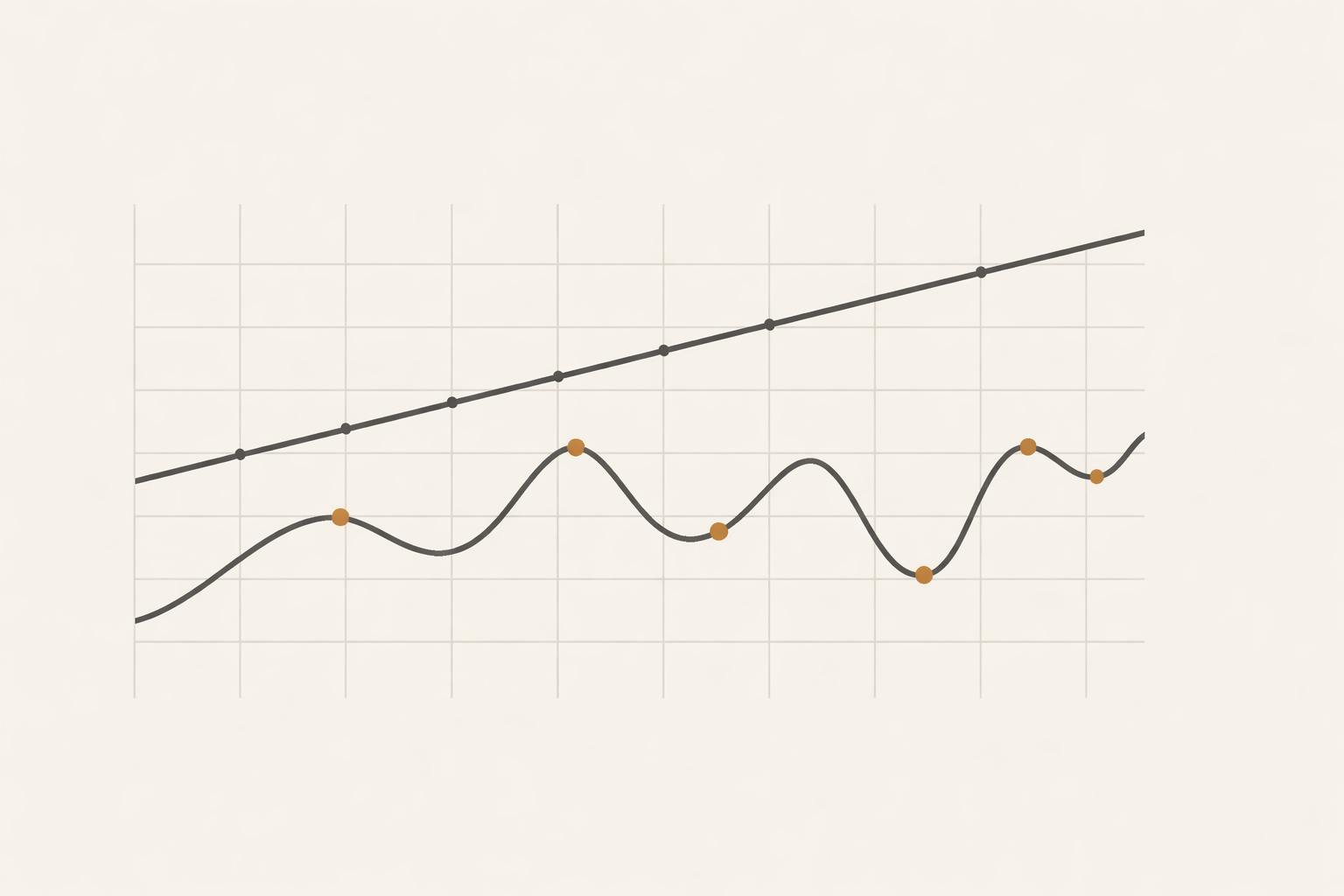
Comparison without strategy is not insight. Instead, it is exposure without control.
When comparison is unmanaged, it shifts from measurement to judgment. In that state, reference replaces reasoning, and observation becomes destabilizing.
Importantly, comparison itself is neutral. The damage appears only when it is used as a verdict on identity rather than a tool for calibration.
The failure of comparison without strategy
The failure is not looking sideways. Rather, the failure is allowing someone else’s position to define your internal scorecard.
At that point, assessment collapses into identity outsourcing. Judgment weakens. Agency erodes.
Two types of comparison
Calibration comparison clarifies standards. It identifies gaps. It informs next actions.
Status comparison, by contrast, evaluates meaning. It asks what another person’s progress implies about your worth.
As a result, calibration produces strategy. Status produces noise.
Why comparison without strategy fails
Without strategy, comparison creates constant re-referencing. Attention moves outward. Decisions slow. Momentum fragments.
Over time, the individual audits position instead of executing plans. Progress stalls, not from lack of effort, but from unstable reference points.
Strategy resolves this failure by fixing the standard internally. Once the reference is chosen, comparison becomes informational rather than corrosive.
For this reason, discipline before dollars remains the governing order.
The principle
Do not ban comparison. Instead, ban comparison without agency.
Joy does not require blindness. It requires a stable internal framework.
Accordingly, behavioral research shows that external reference points degrade satisfaction when they are not paired with agency (American Psychological Association).
Comparison without strategy breeds misery. Comparison with intent builds leverage.
