
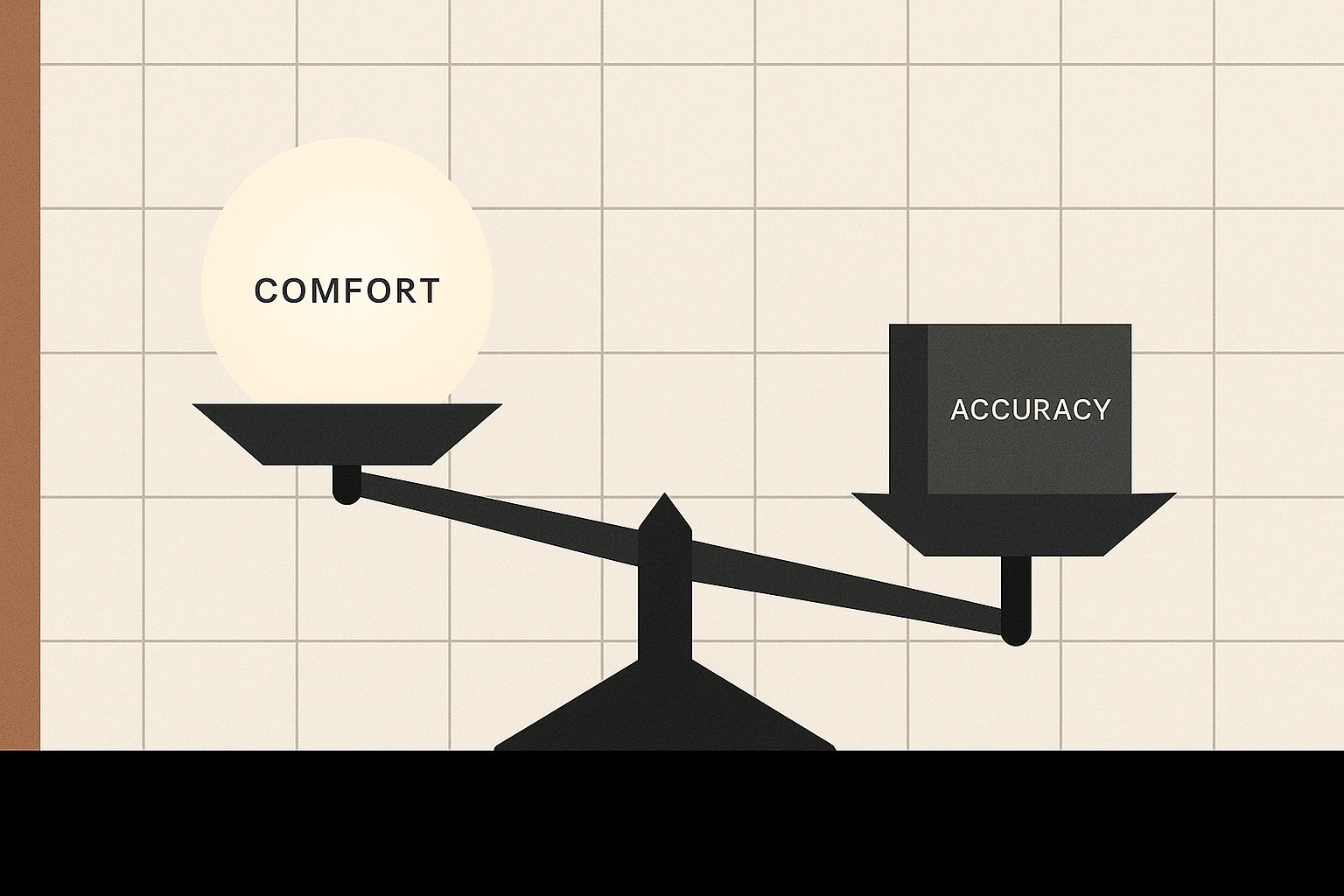
The cost of comfort systems shows up slowly. Some failures arrive quietly. Others arrive disguised as ease. We rarely notice the moment accuracy slips, because comfort makes the drift feel reasonable.
This is how systems erode: not with a dramatic collapse, but through accommodation. When people inside a system choose ease over clarity, the structure bends. Once it bends enough times, the cost of correction becomes higher than the discipline that was avoided.
You can see it everywhere: agencies that choose what is politically safe instead of what is operationally sound, workplaces that reward likability instead of competence, families that postpone difficult truths until resentment performs the audit. Drift rarely begins with malice. It begins with comfort disguised as efficiency.
This is the clearest way to see the cost of comfort systems. Structures shaped by preference instead of principle lose their accuracy long before anyone notices, and by the time people start asking questions the drift is already built into the daily routine.
Understanding the Cost of Comfort Systems
Every institution faces the temptation to choose the step that creates the least friction right now. It feels strategic. It feels humane. But accuracy is not a luxury. Accuracy is the load bearing beam that everything else relies on.
The hidden cost of comfort is the slow build up of mismatched expectations, normalized incompetence, declining trust, and systems that only seem to work if no one looks closely. What looks like kindness in the moment often becomes confusion later.
How Comfort Driven Systems Create Long Term Debt
When a team, agency, or community abandons its standards for convenience, it sets a new precedent: the system will adjust to our avoidance. Once that message spreads, discipline becomes optional and accountability becomes personal instead of structural.
By the time the consequences appear, such as budget failures, broken workflows, and inaccurate reporting, the institution has already accepted comfort as policy. The cost of comfort systems is paid in wasted effort, lost trust, and decisions that no longer match reality on the ground.
The Discipline We Avoid Becomes the Crisis We Inherit
Every system has a point where consequences return with interest. Comfort feels like relief until the bill arrives. Accuracy feels like friction, but it creates stability that can be trusted, repeated, and scaled.
When you study the cost of comfort systems across institutions, the pattern is consistent. Drift begins with convenience and ends with consequences. The choice is never between comfort and pain. The real choice is between short term relief and long term stability.
The Groundwork
Choose one place in your world where comfort has become the default. Name the standard that was softened. Write it back into the process, share it with the people who touch that system, and review it on a schedule. Structures respond to what is written, reviewed, and reinforced, not to what is silently hoped for.
