
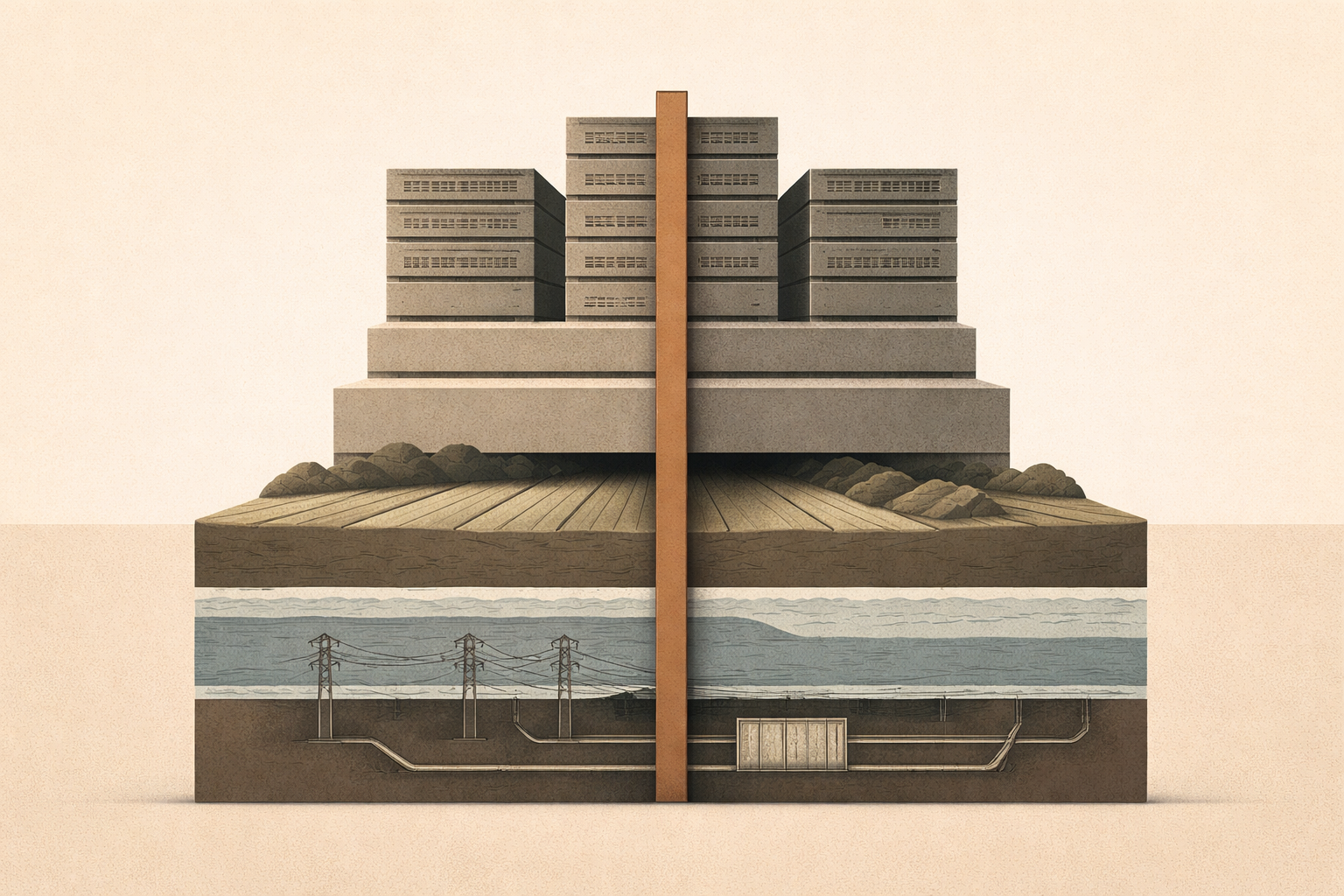
The physical cost of digital ambition is easy to overlook because digital products feel weightless. Data moves invisibly. Platforms scale instantly. However, every layer of the digital economy rests on land, water, energy, and local infrastructure.
Tech ambition scales globally. Infrastructure does not. As a result, the benefits of digital growth concentrate upward while physical burdens settle into specific communities.
The physical infrastructure of the digital economy
Cloud computing, artificial intelligence, and streaming platforms depend on data centers and server facilities that consume enormous amounts of electricity and water. Consequently, these facilities strain power grids, reshape zoning decisions, and alter municipal budgets.
For communities hosting this infrastructure, the digital economy is not abstract. Instead, it shows up as utility rate increases, land-use changes, and long-term environmental pressure. This pattern mirrors dynamics explored in Tech Wealth Concentration Is Accelerating.
Why the physical cost of digital ambition keeps rising
Scale arrives faster than digital infrastructure governance
Digital demand accelerates faster than regulatory oversight. Therefore, infrastructure projects often move forward before communities fully understand their long-term obligations. As a result, negotiations favor speed over durability.
Energy and water use in digital infrastructure remains local
Data centers consume power and water at the scale of small cities. While services distribute globally, the energy use of digital infrastructure concentrates locally. Consequently, communities absorb grid stress while platforms extract global value.
Tax incentives shift physical infrastructure risk downward
Municipalities frequently offer abatements to attract digital infrastructure. Meanwhile, maintenance costs, environmental exposure, and system upgrades remain local long after incentives expire. This reflects the ownership imbalance examined in Equity vs Diversity in Tech.
Communities as collateral infrastructure in the digital economy
This pattern reveals a deeper truth. Communities are not simply hosts for digital infrastructure. Instead, they become collateral infrastructure — pledged quietly as risk buffers for digital growth.
The upside floats upward through platforms and markets. Meanwhile, the downside anchors itself in land, water systems, and power grids. In this way, externalities become normalized.
We have been here before
| Era | System Built | Who Benefited | Who Carried the Cost |
|---|---|---|---|
| Industrial Age | Railroads and factories | Industrial owners and financiers | Factory towns, laborers, surrounding land |
| Mid-20th Century | Highways and urban renewal | Suburban commuters and developers | Urban neighborhoods, often Black communities |
| Late 20th Century | Globalized manufacturing | Multinational firms and consumers | Deindustrialized cities and offshore labor zones |
| Digital Era | Cloud infrastructure and data centers | Platform owners and global markets | Local communities supplying land, water, and power |
Across eras, the pattern remains consistent. When decision-makers are disconnected from the communities absorbing impact, efficiency rises while responsibility diffuses.
Who pays for digital infrastructure today
The environmental cost of cloud computing is not paid evenly. Instead, infrastructure gravitates toward areas with cheaper land, weaker resistance, and fewer political safeguards. Historically, this means working-class and Black communities carry a disproportionate share of the physical burden.
Therefore, without structural reform, digital growth will continue to externalize cost while centralizing reward.
The Bottom Line
The physical cost of digital ambition exposes a recurring truth. Digital systems are only as fair as the structures beneath them. Ultimately, innovation cannot float above geography forever. Someone always carries the load.
