
Evidence review: August 2026 · Public data and policy sources are listed in Receipts.
The physical cost of digital ambition is easy to miss because digital life feels almost weightless. A search arrives in a moment. A video starts on demand. Artificial intelligence can answer a question without showing any of the machinery that made the answer possible.
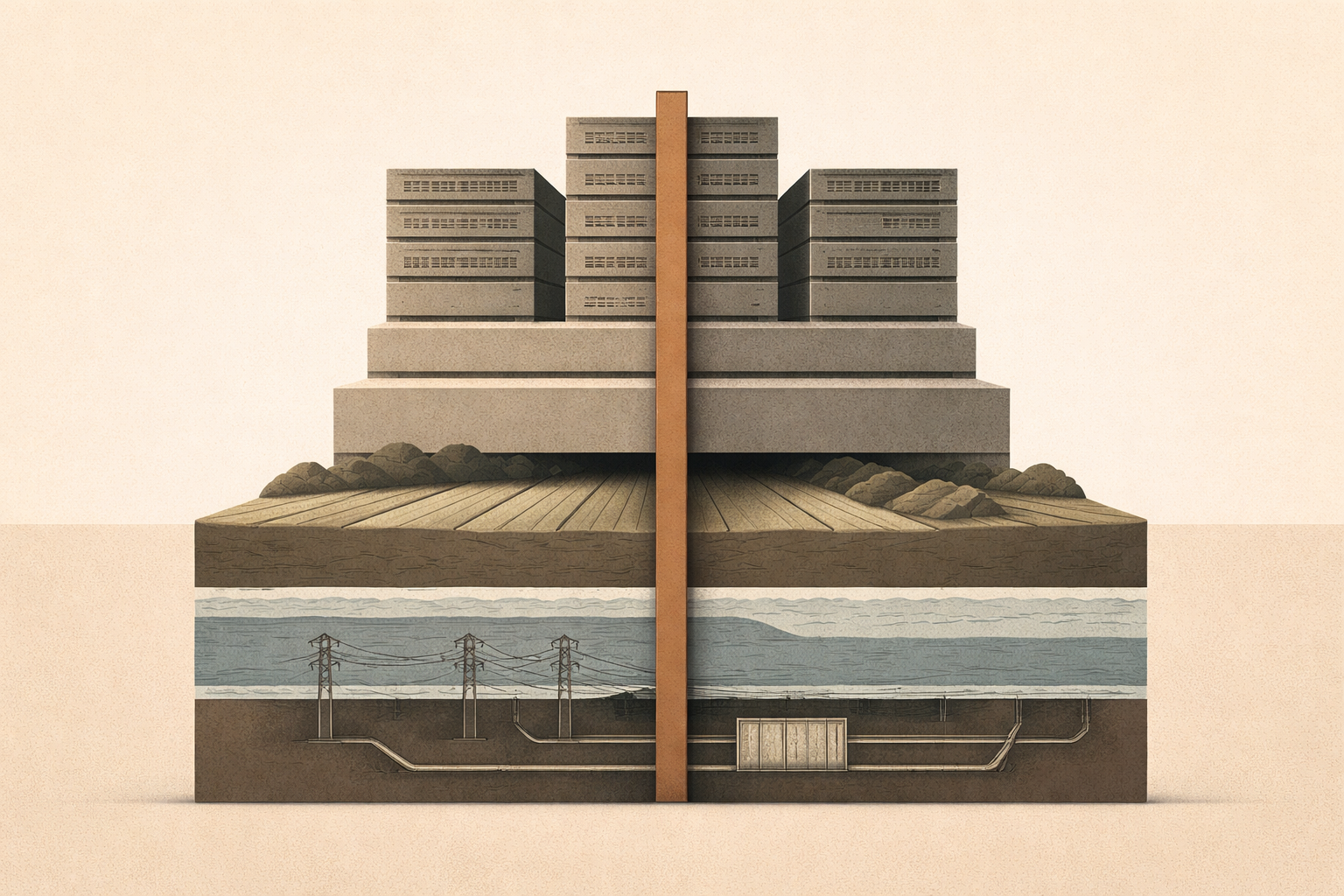
Behind that experience is a very physical system. Servers sit inside buildings. Those buildings need land, electricity, network connections, cooling equipment, backup systems, roads, and utility infrastructure. Depending on the cooling design, water may also become part of the operating equation.
That changes the policy question. Digital growth can create enormous economic value, but the infrastructure carrying that growth still has to fit inside real communities with finite grids, finite land, public budgets, and existing demand.
Digital ambition can scale around the world. Its physical load still has to land somewhere.
The Short Answer
What Is the Physical Cost of Digital Ambition?
The physical cost of digital ambition is the demand that digital services place on electricity, land, cooling systems, water resources, transmission infrastructure, roads, public planning, and local government capacity. The central governance question is not whether data centers should exist. It is whether the systems carrying them are being strengthened at the same pace as the demand.
Ground
Why the Physical Cost of Digital Ambition Is Local
The cloud is a useful metaphor, but it can hide more than it explains. Cloud computing happens in facilities built on actual ground. Artificial intelligence requires processors housed in data centers. Streaming depends on networks, storage systems, fiber, power, and cooling.
In other words, digital infrastructure is still infrastructure.
Groundwork examines that physical chain more closely in Digital Infrastructure Isn’t Virtual: How the Internet Physically Works . Once the underlying machinery becomes visible, the geography of digital growth becomes much harder to ignore.
A platform can serve people across the world. However, the facility supporting that platform still sits inside a particular utility territory, county, state, watershed, and electrical system.
As a result, the value can travel much farther than the physical burden.
Costs
Data Center Infrastructure Costs Start With Power and Capacity
Electricity is the clearest place to see the scale of the change.
Lawrence Berkeley National Laboratory’s June 2026 update estimates that data centers could account for about 11.8 percent of total U.S. electricity use by 2030. The report’s modeled scenarios range from 9.5 percent to 15.3 percent.
Central estimate for the share of total U.S. electricity use that data centers could represent by 2030.
Lawrence Berkeley National Laboratory, U.S. Data Center Energy Usage Report: 2025 Update, published June 2026.
That does not mean every community will experience the same pressure. Data center demand is geographically uneven, and local grid conditions matter. So do generation resources, transmission constraints, utility rules, facility design, and the timing of new projects.
Water use also requires more precision than the usual headlines allow. Some cooling systems rely on evaporation and can consume substantial water. By contrast, closed-loop and advanced cooling systems can reduce freshwater demand considerably. Climate, facility design, workloads, and reuse systems all change the result.
Therefore, data center infrastructure costs cannot be reduced to one national number. The meaningful question is what additional demand a particular project creates and what the surrounding system must build, upgrade, reserve, or maintain in response.
This is where capacity becomes practical. Capacity defines what a system can reliably carry without unacceptable degradation.
Communities
How Data Centers Affect Local Communities
The effect does not begin at the data center fence line. It moves through several systems before most residents ever notice it.
01 · Demand
Computing demand grows
AI, cloud storage, streaming, business software, and other digital services require more computing capacity.
02 · Infrastructure
Physical systems expand
New computing demand requires buildings, electrical connections, cooling systems, substations, fiber, land, and supporting infrastructure.
03 · Public Systems
Local capacity gets tested
Utilities, permitting agencies, roads, transmission systems, water networks, emergency services, and planning departments may all have to respond.
04 · Allocation
Someone carries the cost
Developers, utilities, ratepayers, taxpayers, governments, or some combination of them ultimately finance the infrastructure required to support growth.
That final step is the one that deserves the most scrutiny.
A project can be economically productive while still creating a poor public bargain. Conversely, a large infrastructure project can place substantial new demand on a system and still produce a strong public return if the costs, obligations, and benefits are structured well.
The outcome depends on the agreement.
The same logic applies to margin. A grid may have enough capacity for today’s demand and still lack enough reserve for another major project, a heat wave, equipment failure, future housing, or industrial expansion.
A system can look efficient while it is quietly spending its room to maneuver.
Who Pays
Who Pays for Data Center Infrastructure Upgrades?
There is no single national answer. The cost depends on state law, utility regulation, local agreements, infrastructure ownership, tax policy, and the specifics of the project.
Still, the policy activity tells us something important. This is no longer a niche land-use question.
In 2026, the National Conference of State Legislatures reported that 38 states offer preferential tax treatment for data centers. At the same time, lawmakers across the country are reconsidering how these projects interact with electricity, water, incentives, and local control.
2026 Policy Signal
States are actively rewriting the data center bargain
Those numbers do not prove that data centers are harmful. They show that governments are confronting a real allocation problem.
Who pays for added generation? Who pays for new transmission? Who finances a substation or other utility upgrades? How much tax revenue does the project produce after incentives? Does the agreement protect existing customers if projections change?
Those are questions of accountability, not ideology.
The Governing Question
If a project succeeds economically, does the structure also protect the systems and communities required to carry it?
Ownership
Digital Value Can Travel. Infrastructure Cannot.
Ownership makes the equation harder because digital value and physical exposure can move in different directions.
A platform can serve customers across continents. A cloud provider can sell computing capacity around the world. Investors can participate in the financial upside from almost anywhere.
The host community has a different relationship to the project. Its power grid, roads, utility systems, land, and public institutions stay where they are.
That difference connects to Tech Wealth Concentration Is Accelerating . Participation in a technology system and ownership of that system are not the same thing.
Groundwork also explores that distinction in Equity vs Diversity in Tech . Representation can change who participates in an industry. However, it does not automatically change who owns infrastructure, captures returns, negotiates public terms, or carries the downside when assumptions fail.
This is why the physical cost of digital ambition ultimately becomes a civic question. Ownership helps explain where value goes. Governance determines how obligations, risk, and capacity are distributed.
Governance
What Local Governments Should Ask Before Approving a Data Center
Communities do not need a reflexive yes or a reflexive no. They need a better operating picture.
Before approving a major project, local and state decision-makers should be able to answer questions like these:
- Power: How much reliable electrical capacity will the project require during normal and peak conditions?
- Grid: Which generation, transmission, distribution, or substation upgrades become necessary?
- Cost: Who pays for those upgrades, and can any portion of the cost shift to existing customers?
- Water: What cooling system will the facility use, and what are its expected freshwater and reuse requirements?
- Land: What other uses become less available once the site and supporting infrastructure are committed?
- Taxes: What revenue does the project generate after exemptions, abatements, or other incentives are included?
- Margin: How much usable system reserve remains after the project begins operating?
- Expansion: Does the original agreement govern future growth, or can substantially more demand arrive under the same terms?
- Review: What happens if electricity demand, water use, job creation, public revenue, or infrastructure costs differ from the original projections?
Those questions are not anti-growth. They are what responsible growth looks like.
They also create alignment between private investment, public infrastructure, utility planning, tax policy, community priorities, and long-term capacity.
Without that alignment, one part of the system can look successful because another part quietly absorbed the cost.
The Groundwork
Innovation Has to Carry Its Own Weight
The physical cost of digital ambition is not a case against technology. It is a case for seeing the full system underneath it.
Digital growth needs physical capacity. Physical capacity depends on electricity, land, cooling, infrastructure, maintenance, planning, public authority, and enough reserve to handle what comes next.
Good governance does not require communities to reject growth. Instead, it requires growth to arrive with a structure capable of carrying the pressure it creates.
That is where Structure Is Mercy becomes practical. Good structure absorbs preventable disorder before people and communities are forced to absorb it themselves.
The same test sits underneath Build What Holds . The question is not simply whether infrastructure can be built. The question is whether the wider system can carry it through growth, maintenance, disruption, and time.
The internet may feel weightless. The bargain underneath it is not.
Someone provides the land. Someone provides the power. Someone carries the infrastructure. Someone absorbs the risk.
Good policy makes that bargain visible before the bill arrives.
Further Groundwork
→ Digital Infrastructure Isn’t Virtual: How the Internet Physically Works
Receipts
This article synthesizes public energy and policy data. It does not estimate the cost or resource use of a specific facility. Local outcomes vary by project design, utility structure, cooling technology, climate, tax agreements, and existing infrastructure.
→ Lawrence Berkeley National Laboratory: U.S. Data Center Energy Usage Report, 2025 Update
→ National Conference of State Legislatures: Data Centers, Power, Water, Incentives, and Local Control
Groundwork Architecture
The Structure Beneath This Article
This article examines what happens when fast-growing digital demand meets finite public and physical systems. The governing Principle identifies what should remain true. The Conditions identify the jobs the system has to perform well.
Primary Core Principle
Structure Is Mercy
Good structure absorbs preventable disorder before people and communities are forced to absorb it.
Supporting Core Principle
Build What Holds
Durable systems must carry load, survive pressure, receive maintenance, and remain useful over time.
Primary Condition
Margin
Margin protects usable reserve between current load and reliable capacity.
Supporting Conditions
Capacity, Accountability, Alignment
Capacity determines what can be carried. Accountability assigns responsibility and corrects drift. Alignment coordinates authority, resources, incentives, priorities, and action.
Meet the Builder

Langston Reed
Builder, Civic Power & Policy
Langston Reed helps readers understand how institutions, governance, public policy, and civic systems shape everyday life. His work looks beneath visible outcomes to examine the structures that made them possible, the incentives moving through them, and the institutional patterns that remain after public attention shifts.
“Headlines describe movement. Systems explain movement.”
Reader Promise:
Move past the visible outcome and understand the system underneath it.